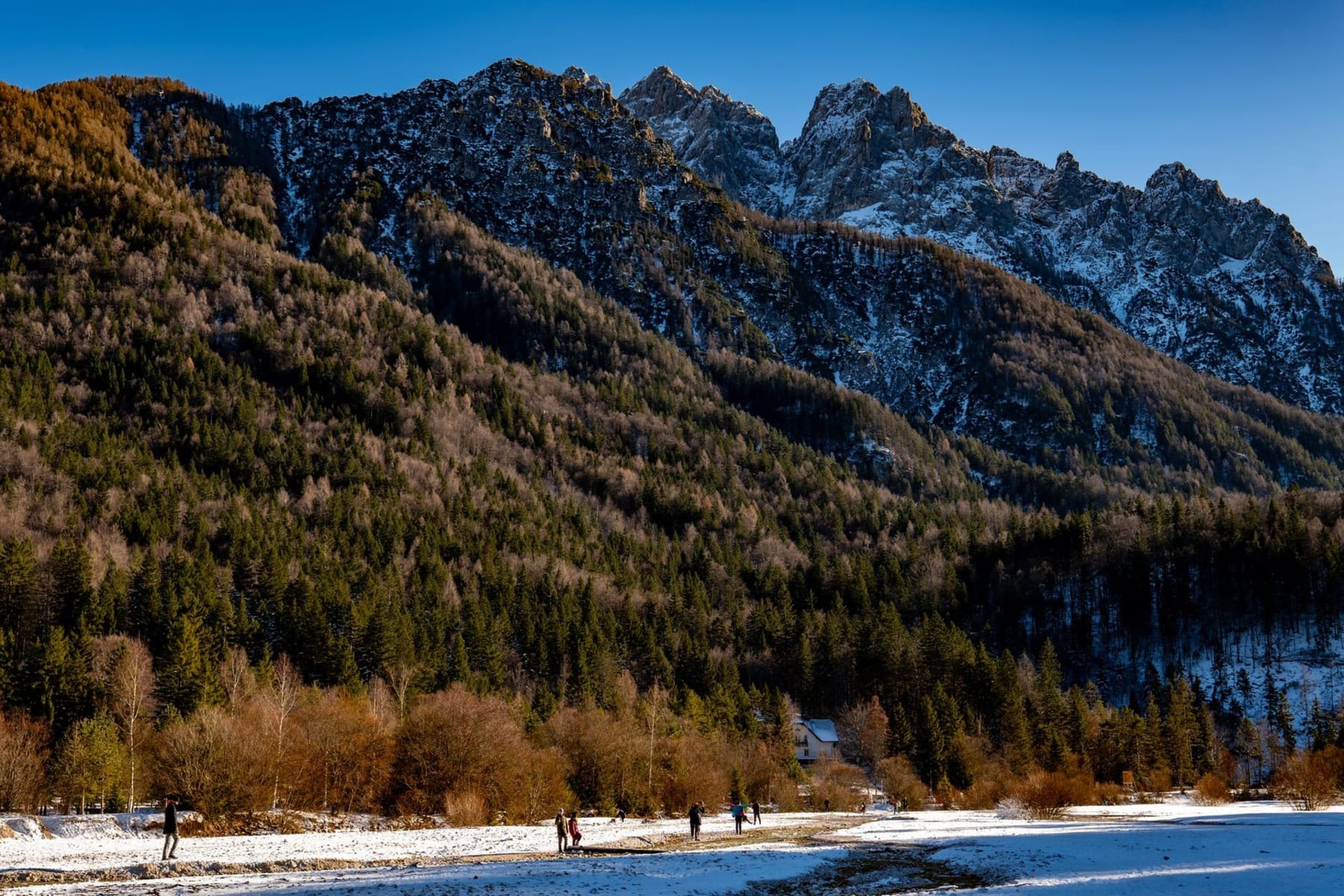
Triglav National Park
"Triglav teaches you that the Alps don't have to be crowded to be magnificent."
Slovenia's only national park wraps around its highest peak, hiding emerald rivers, limestone plateaus, and trails few foreigners ever find.
I had braced myself for something like Chamonix — gondolas, crowds, espresso machines humming in eight languages. What I found instead was a park that seemed genuinely indifferent to being discovered. The road into the Soča Valley narrows to a single lane just past Bovec, the limestone walls closing in on either side, and the river below shifting between colours I still cannot name precisely: not turquoise, not jade, something partway between the two that the light invents fresh each morning.
The Soča River and What It Does to You
The first time Lia and I waded into the Soča near the footbridge at Kluže, we both stopped speaking. The water is cold the way mountain water always is, but the colour is the stranger thing — a translucent, almost chemical green that comes from the fine calcium carbonate suspended in the glacial melt. You can see every smooth stone on the bottom from three metres up. We stayed for an hour and spoke very little. That is what the Soča does: it takes language away.
The valley trail along the Soča — marked on the park maps as the Soška Pot — winds through old-growth beech and spruce, occasionally dropping to the riverbank where the water pools wide and shallow. On a Tuesday morning in late September we shared the path with two Slovenian cyclists and a fox that watched us pass from a moss-covered boulder without moving.
Up Toward the Limestone Plateau
The real surprise came higher. I had expected the scenery above the tree line to be severe, all raw grey karst and thin air. Instead the plateau near Planina pri Jezeru opens into a broad alpine meadow dotted with wooden shepherd huts — the planšarije — some still in use. A woman was moving cattle between pastures on the far side of the meadow, a small dog threading between the animals’ legs. The bells carried across the plateau with extraordinary clarity. It was the kind of scene that feels staged but is simply Slovenian farming life, still intact at 1,500 metres.
I ate a bowl of ričet — a thick barley and bean stew — at the hut nearest the trail junction. It tasted of smoked ham and woodsmoke and exactly the altitude I was standing at.
Finding Your Own Corner of the Park
Triglav’s trails are well-marked but rarely crowded beyond the summit approaches in peak summer. The Trenta Valley, on the park’s western edge, stays quiet well into August. The village of Trenta itself is a handful of stone houses and a small museum about Julius Kugy, the alpinist who mapped much of this range on foot in the early 1900s. Standing in that museum, looking at his hand-drawn notes and worn leather boots, the mountains outside felt continuous with his — unchanged, unhurried.
When to go: Late June through September offers the best trail conditions, but late September brings extraordinary light, thinner crowds, and the first cold nights that keep the Soča’s colours at their most saturated. Avoid the summit route in early season without mountaineering experience — the upper slopes hold ice well into July.