Postojna Cave
"The temperature dropped to 10°C the moment we entered the mountain, and it didn't care what month it was outside."
There is a moment, about three minutes into the electric train ride into Postojna Cave, when the entrance tunnel narrows, the limestone closes overhead, and the temperature drops suddenly to 10°C regardless of what season is happening outside. I was there in July. I was wearing a t-shirt. Bring a layer — they sell fleece rentals at the entrance, which tells you everything you need to know about how often people arrive unprepared.
Underground at Scale
Postojna is not a charming little cave. It is one of the longest cave systems in Europe — 24 kilometers of passages, of which visitors traverse roughly five on foot and two by train. The scale takes time to register. The initial chambers are already large enough to recalibrate your sense of interior space. Then the train deposits you in the area of the Concert Hall — a cavern where actual concerts have been performed for thousands of people — and you recalibrate again, upward, and then give up trying to hold a coherent sense of the size of the place.
The formations are extraordinary in the way that geological patience produces: curtains of calcite thin enough to transmit light, columns formed over millions of years where a stalactite and stalagmite finally met and merged, and a formation called Brilliant that tour guides photograph from below with a torch to demonstrate its translucency. I’d expected this kind of thing to feel like a museum — roped off, narrated to death. It doesn’t. The scale and the darkness and the cold absorb the tour group noise and leave something else behind.
The Creature in the Tank
Near the end of the walking section there is a vivarium tank containing Proteus anguinus — the olm, the cave salamander, what Slovenians call the human fish. It is pale, almost translucent, eyeless in the adult form (the eyes develop then recede as the animal matures in permanent darkness), 20 to 30 centimeters long, and nearly motionless in cold water. It breathes through feathered external gills. It lives for over a hundred years. It has been adapting to these specific caves for millions of years. I stood in front of the tank longer than I stood in front of most of the stalactites, trying to work out what category of thing I was looking at.
Predjama Castle
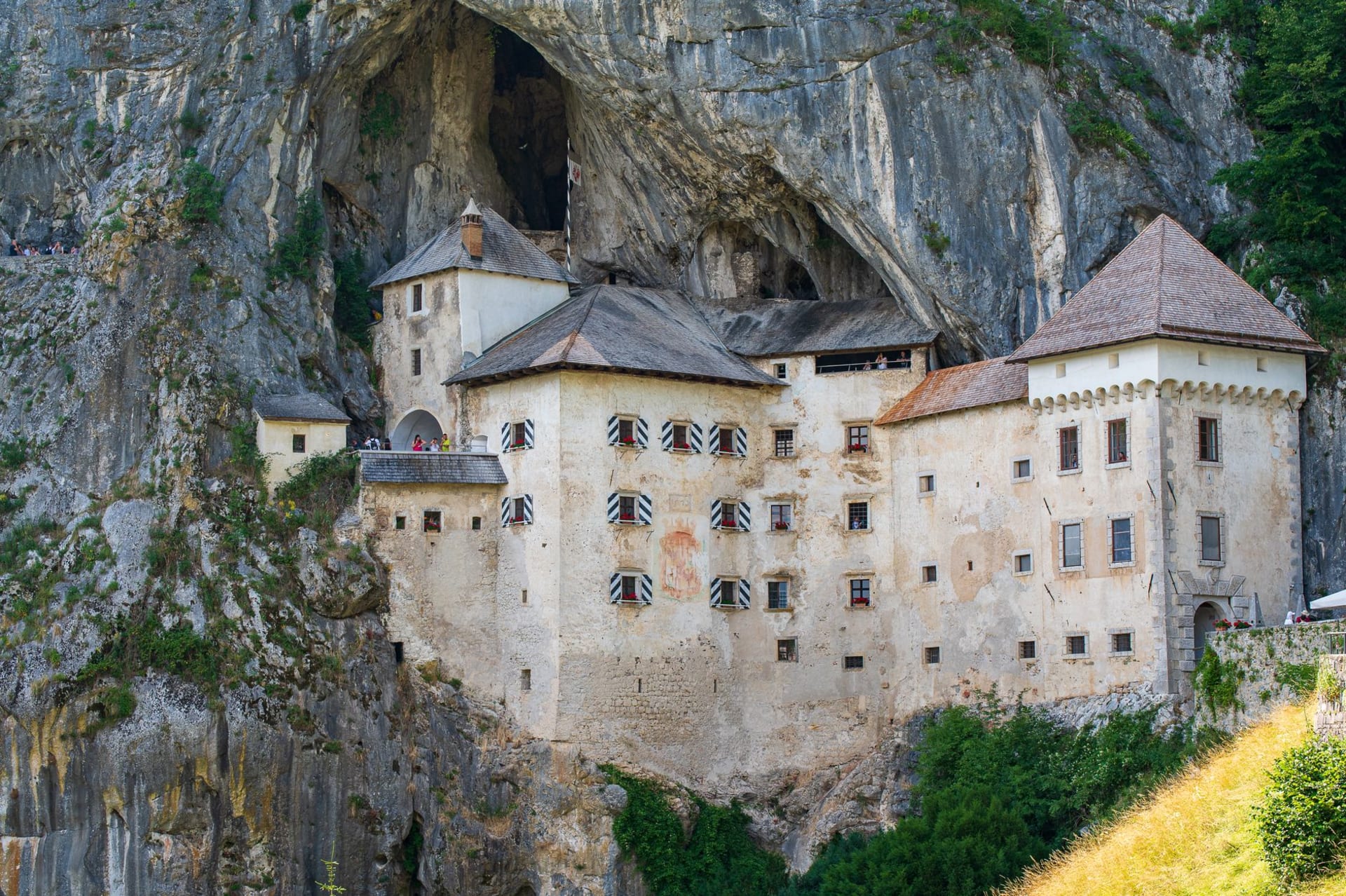
Ten minutes by car from Postojna, Predjama Castle is built into the mouth of a cave in a cliff face. Not near a cliff — into the cliff, occupying the cave entrance so completely that it’s impossible to determine where the medieval masonry ends and the natural rock begins. A 15th-century knight named Erasmus of Lueg held out here against a Habsburg siege for more than a year, resupplied through secret tunnels that run through the mountain behind the castle. The interior is smaller than the exterior suggests — the cliff face provides most of the drama — but the setting is genuinely implausible. I spent too long in the meadow below trying to photograph it knowing none of the shots would do it justice, and then took another dozen anyway.
The Karst Plateau
The landscape surrounding Postojna — the Karst region, which gave karst topography its name — is flat, pale, scrubby, pocked with sinkholes and limestone outcrops. It’s not conventionally scenic but it has a particular quality in late afternoon when the stone takes on warmth and the distances open up over the plateau. I drove through villages where the houses are built from the same pale stone as the ground beneath them and nearly invisible until you’re among them.
When to go: Postojna Cave is open year-round and maintains 10°C inside regardless of season — bring a layer even in August. Spring and autumn are best for avoiding the longest queues; July and August can mean waiting an hour or more. Book tickets online in advance for summer visits. The cave is worth it despite the crowds, but an early morning slot makes a significant difference.