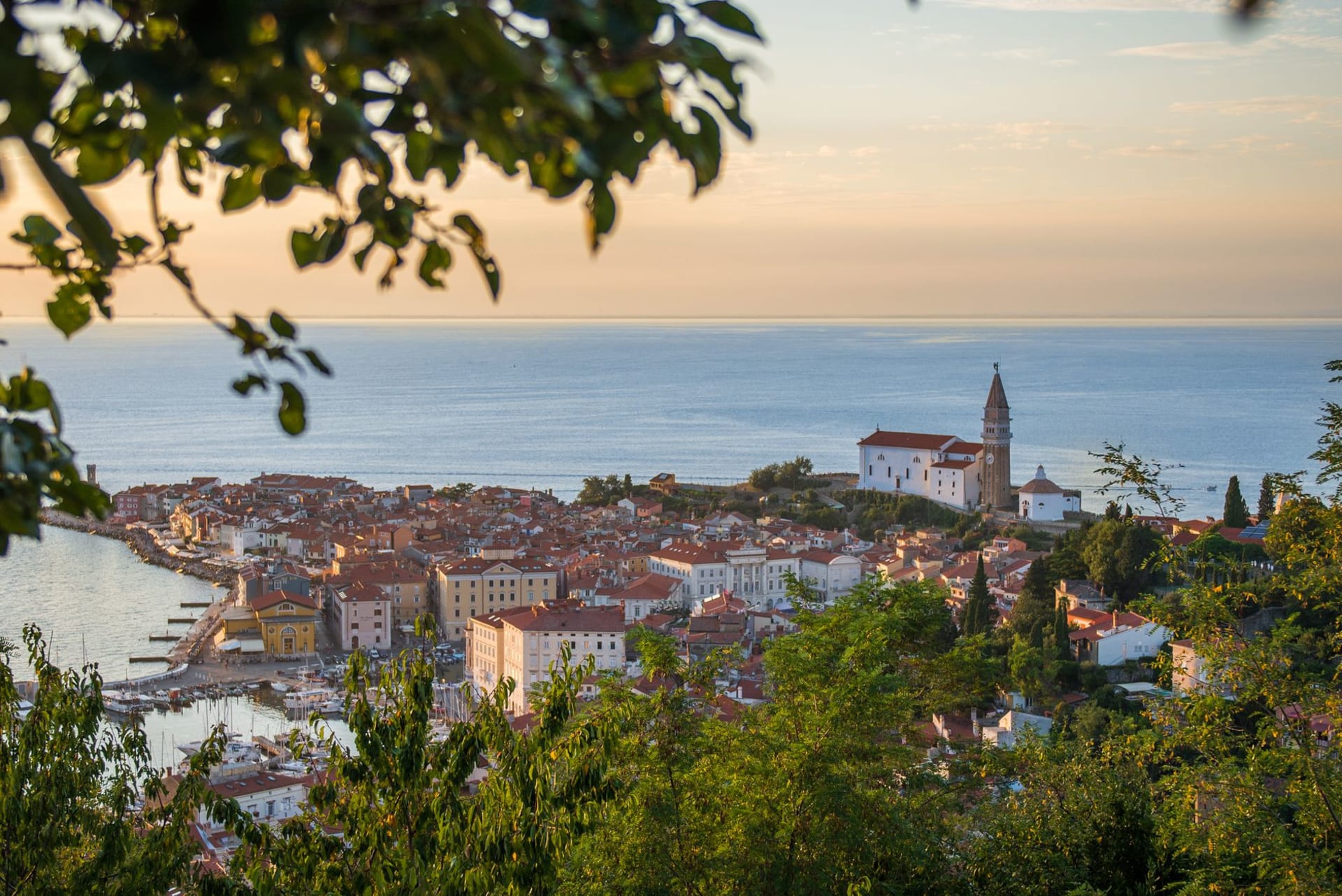
Piran
"Piran is what remains when Venice is distilled to its pure salt-and-stone essence."
A perfectly preserved Venetian sea town jutting into the Adriatic from Slovenia's tiny coastline — salty, golden, and achingly beautiful.
There is a particular quality to the light in Piran in September — low and amber, the kind that turns every stone facade into hammered gold. I noticed it the moment Lia and I climbed the city walls above Tartinijev trg and looked back at the old town pressing into the sea from three sides: a city that has no room left to grow, and seems proud of it.
The Weight of Stone and Salt
Piran belongs to no one country’s story cleanly. It was Venetian for centuries, then Austrian, then Yugoslav, now Slovenian — and it carries all of those lives in its bones. The campanile of the Cathedral of St. George is a near-perfect replica of the one in San Marco, except here it stands above a town of five thousand souls instead of five million tourists. Walking up Ulica IX. korpusa in the early morning, past shuttered wooden doors painted in faded ochre and rust, the only sounds are gulls and the clinking of someone’s coffee cup. No vaporetto engines. No selfie sticks. Just the smell of brine and old stone warming in the sun.
I ate the best grilled brancin of my life at a table practically in the harbor, at a place where the menu was handwritten on a chalkboard and the owner brought bread without being asked. The fish had been caught that morning — I believed it entirely, without needing to be told.
The Salt Pans of Sečovlje
What caught me completely off guard was the afternoon we rented bikes and rode south along the coast to the Sečovlje Salina Nature Park. I had expected a flat industrial detour, something to tick off before dinner. Instead we found a landscape of pale geometric pools stretching to the horizon, edged with samphire and visited by flamingos — actual flamingos, in Slovenia, in late September. Lia stopped her bike in the middle of the path and just laughed. Sometimes a place hands you something you had no right to expect.
The salt from these pans, harvested by hand using centuries-old methods, ends up in small linen bags sold throughout Piran’s old town. I brought three home. They sit on my kitchen shelf in Mexico like a small, portable piece of the Adriatic.
Before You Leave
Find time for the view from the Church of St. George just before sunset. The whole peninsula glows. Then walk back down through Ulica Bolniška toward the harbor and order a glass of Malvazija, the local Istrian white — dry, mineral, tasting faintly of the sea air that surrounds you.
When to go: Late May through June or September through early October — warm enough to swim, quiet enough to hear the town breathe. July and August bring Italian and Austrian tourists in real numbers; the town remains beautiful, but the stillness disappears.