Mangart Saddle
"The road runs out of mountain before it runs out of nerve, and somehow they match up exactly at the top."
Slovenia's highest mountain road, a narrow ribbon of switchbacks climbing to over 2,000 meters between Italy and the Julian Alps, ending at a saddle with nothing but sky on either side.
I’d driven the Vršič Pass the day before and felt reasonably confident I’d seen Slovenia’s most dramatic mountain road. Then a guesthouse owner in Bovec mentioned the Mangart Saddle road almost as an afterthought, and I looked it up that evening and immediately rearranged the next day’s plans. It’s the highest paved road in Slovenia, climbing in a series of tight switchbacks up the flank of Mount Mangart to a saddle at just over 2,000 meters, right against the Italian border.
A Road That Argues With the Mountain
The road itself is single-lane for long stretches, with passing bays cut into the rock every few hundred meters and a drop on one side that Lia point-blank refused to look at from the passenger seat for most of the ascent. It was built originally for military purposes, connecting to fortifications from both World Wars, and it shows — utilitarian, narrow, clearly engineered for necessity rather than comfort. We passed exactly two other cars going up, both driven with the particular slow deliberateness that road tends to demand of everyone.
Standing at the Top of Two Countries
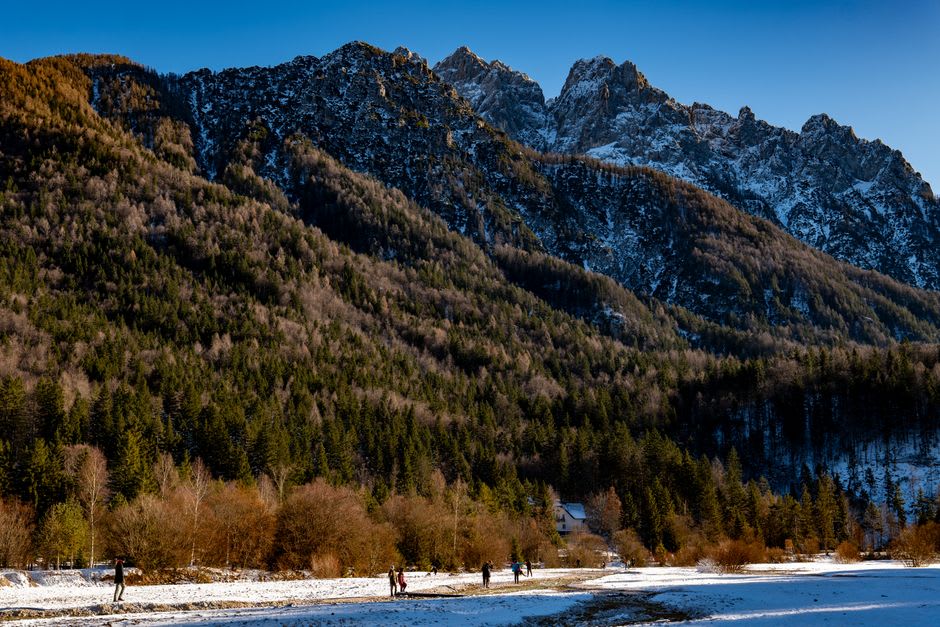
At the saddle, the road simply stops — a small parking area, a chapel, and a view that drops away on the Italian side into a different set of valleys entirely, the Julian Alps continuing on both sides of a border that from up here looks like an entirely artificial imposition on one continuous mountain range. The wind at the top was sharp enough that we didn’t linger outside for long, but the fifteen minutes we spent standing at the edge, looking down into Italy on one side and back toward the Soča Valley on the other, felt like one of the more genuinely vertiginous moments of the whole trip.
The Hut and the Silence
Near the saddle sits a small mountain refuge, closed the day we visited but clearly a lifeline for hikers continuing on toward Mangart’s summit itself, a further scramble along an exposed ridge that we did not attempt. Instead we sat on a rock near the hut eating the sandwiches we’d packed that morning, saying very little, the kind of silence that happens naturally at altitude when the view does most of the talking for you.
When to go: Late June through September only — the road is closed by snow the rest of the year and conditions at the top can turn quickly even in summer. Go early in the day before cloud typically builds over the ridge.
Keep exploring
More from Slovenia
 slovenia
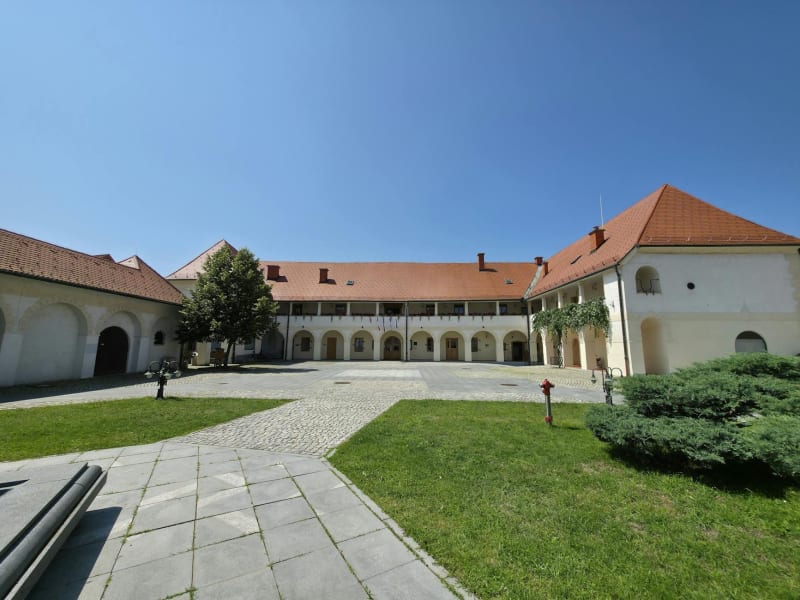
 Maribor
Home to the world's oldest grapevine — over 400 years old — this Drava riverside city lives beautifully between tradition and transformation.
Explore slovenia
 Matkov Kot
The least-visited of the three glacial valleys radiating from Solčava, a narrow bowl beneath the jagged peak of Ojstrica where a single farmhouse restaurant is the only sign anyone else knows the place exists.
Explore slovenia
 Menina Planina
A broad, gentle alpine plateau above the Savinja Valley, less dramatic than Velika Planina and precisely for that reason almost entirely without tourists — a place for long, easy walks and a mountain hut with a view that outperforms its modest fame.
Explore slovenia
 Metelkova
A squatted former military barracks turned autonomous cultural zone, covered wall to wall in murals and running on its own chaotic, defiant energy.
Explore slovenia
 Metlika
The capital of Bela Krajina sits against the Kolpa River and the Croatian border, its distinct folk costume, wine, and white birch landscape marking it as culturally apart from the rest of Dolenjska.
Explore slovenia
 Moravske Toplice
A thermal spa town in the flat farmland of Prekmurje where black, mineral-rich water bubbles up from two kilometers underground and the pace of life drops to match the temperature of the pools.
Explore