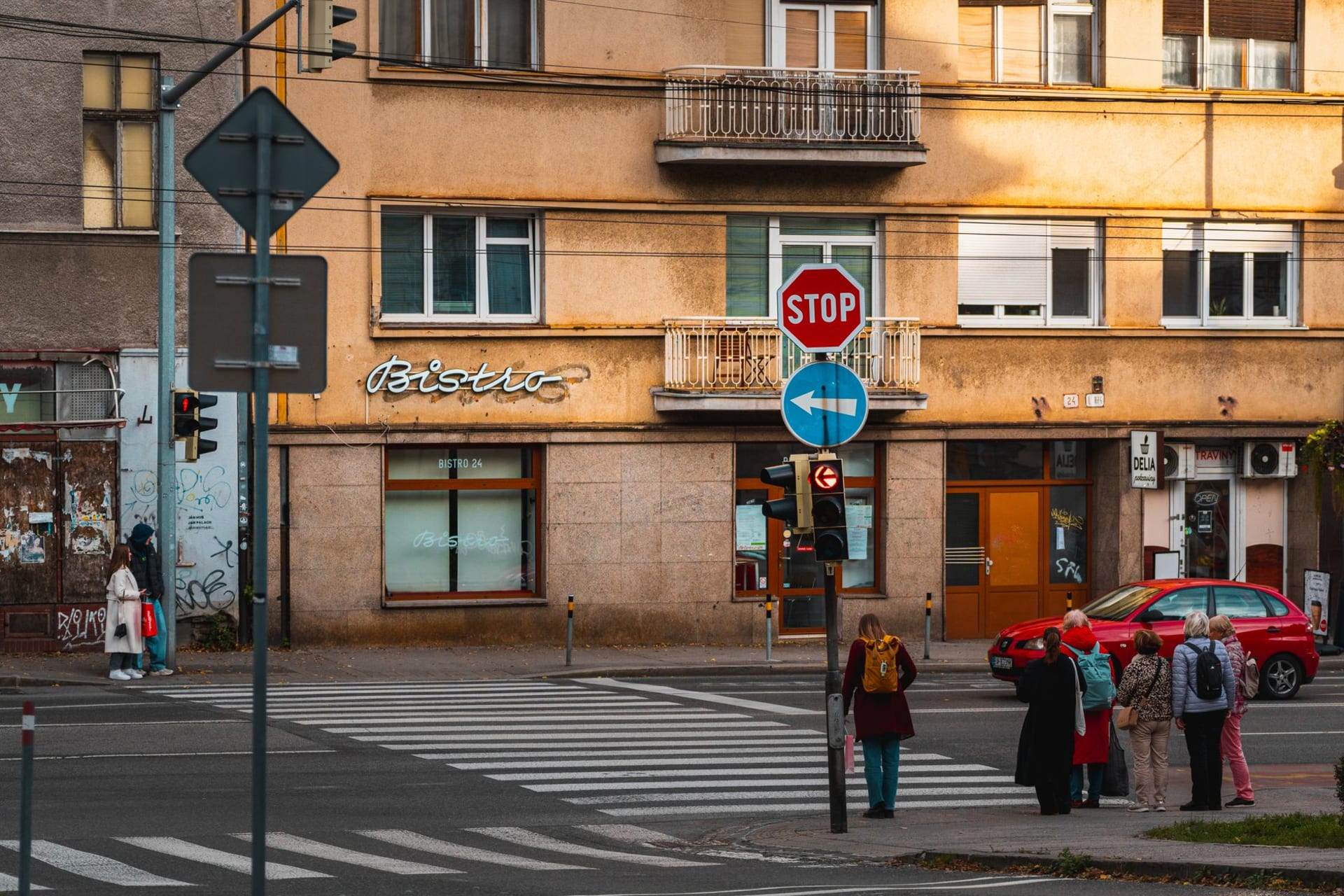
Arriving from the wrong direction
Most travelers arrive in Košice from Bratislava — a five-hour train ride through the center of the country — and by the time they pull into the station, they’ve passed through enough villages and switchback valleys to understand that Slovakia is not a small place. Košice sits in the far east, near the Ukrainian and Hungarian borders, and that geographical position gives it a different cultural texture: more Central European baroque, more Magyar architectural influence, more Orthodox church cupolas visible on the horizon.
The city center announced itself to me immediately as a place that had been designed around human movement. Hlavná Street — the main drag — is a pedestrian boulevard nearly a kilometer long, wide enough that it never feels crowded, lined with trees and café tables and buildings in every style from Gothic to art nouveau to late Soviet concrete. I arrived on a Tuesday evening and the street was busy in that particular way that suggests this is where people actually spend their free time, not just where tourists are herded.
St. Elisabeth Cathedral
The cathedral is the largest Gothic church in Slovakia and the easternmost Gothic cathedral in Europe, facts that would be merely trivia except that the building itself backs them up completely. The twin towers — one finished to a proper spire, one capped differently in a way that gives the facade an asymmetric personality — dominate the skyline for blocks in every direction. Inside, the nave is cool and very tall, with the specific quiet of stone buildings that have absorbed seven centuries of human attention.
The crypt below the cathedral holds the remains of Ferenc Rákóczi II, the Hungarian prince who led a major revolt against Habsburg rule in the early eighteenth century. His sarcophagus is a national pilgrimage site for Hungarians, which explains the Hungarian tour groups you’ll sometimes encounter in the lower church. History in Košice is layered and contested in exactly this way — the city has been Czech, Hungarian, and Slovak over the past century — and that layering makes it considerably more interesting than a city with a simpler past.
The food situation
Košice has developed a restaurant scene that rewards wandering off the obvious choices. The streets behind the cathedral hide a collection of small restaurants where the cooking tends toward Hungarian-Slovak crossover: game goulash with dense bread dumplings, stuffed cabbage rolls in a paprika-heavy sauce, freshwater fish from the Hornád river. I found a wine bar on a side street serving Tokaj wines from the Slovak side of the appellation — Slovakia’s piece of that famous wine region sits just south of here — and the dry Furmint, poured cold, was a genuine discovery.
The covered market on Štúrova is worth visiting in the morning when the vegetable vendors are in full swing. Local farmers bring produce from the surrounding Košice basin, a fertile agricultural plain, and the variety at that market — multiple varieties of paprika, unusual root vegetables, fresh sheep’s cheese — is a reminder that this corner of Slovakia feeds itself differently from the west.
Streets worth getting lost in
The old town beyond Hlavná Street repays wandering. There’s a state theater that looks like it belongs in Vienna, a plague column in a small square, and the occasional monastery courtyard that opens unexpectedly behind an otherwise plain gate. The city’s Jewish history is visible in a restored synagogue on Puškinova Street — one of the largest in Central Europe — which operates now as a concert venue and exhibition space.
When to go: May and June for temperate weather and minimal crowds. September is excellent — harvest season in the surrounding wine region, warm days, cool evenings. July and August are busy with domestic tourists. Košice winters are cold and the city takes on a different character — darker, more interior, not unpleasant if you dress for it.