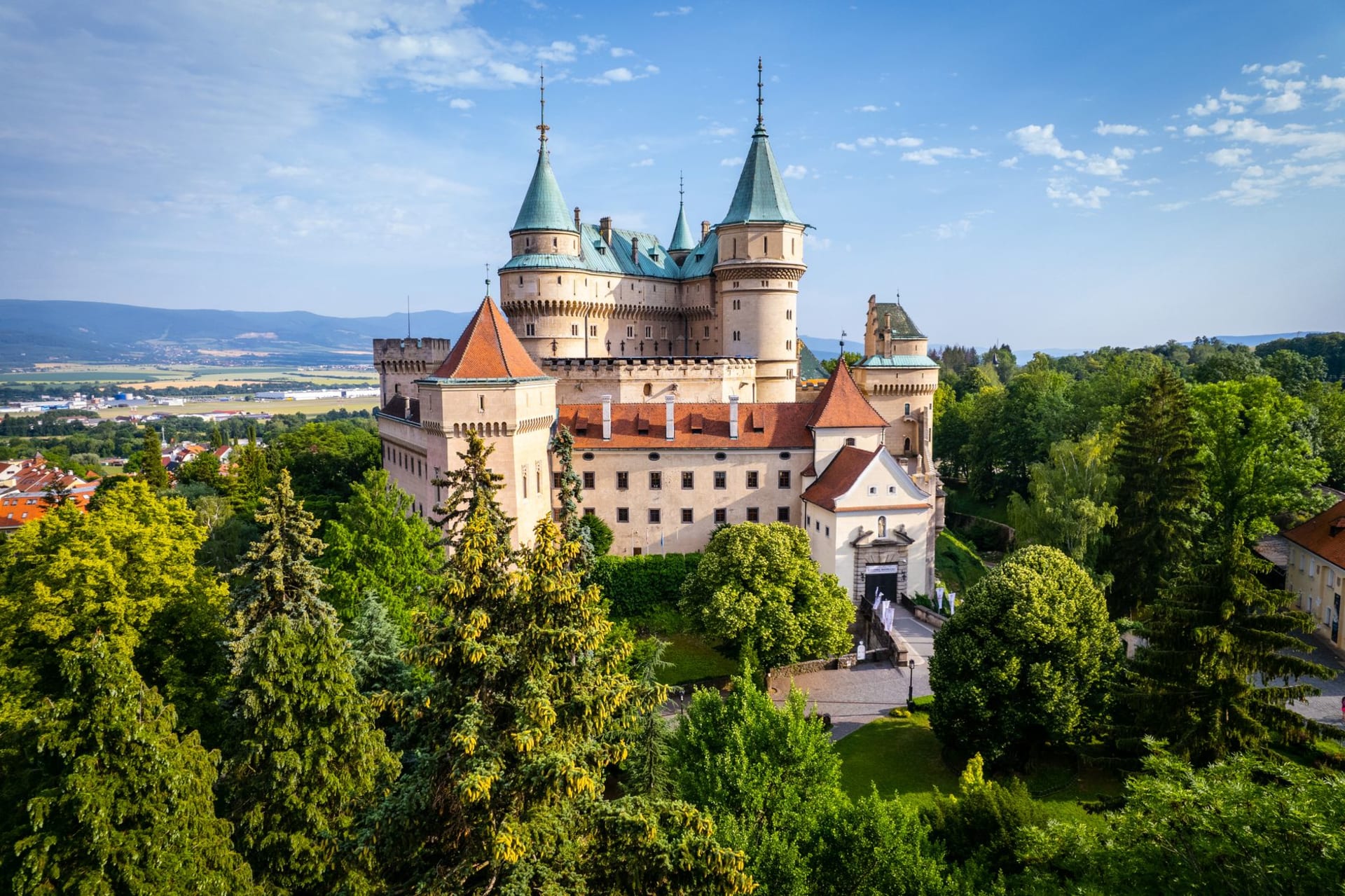
The most theatrical castle in Slovakia
There’s a tendency, when encountering a castle that looks this cinematic, to assume it’s a fake — a Disney-ification of medieval history, built for photographs rather than defense. Bojnice breaks this assumption. The site has been fortified since the twelfth century. But the version that exists today — the one with the crenellated towers and the Gothic Revival window tracery and the drawbridge — is almost entirely the work of one person: Count Ján František Pálffy, who acquired the castle in 1852 and spent the next fifty years and most of his fortune transforming it into a monument to romantic medievalism.
Pálffy had spent time in the Loire Valley and returned to Slovakia with specific ideas about what a castle should look like. He brought French architects, imported stonework, installed frescoes and carved wooden interiors, dug an artificially deepened moat around the base of the hill, and planted the surrounding park with deliberate picturesqueness. He died in 1908 before the restoration was complete, which means the castle is — in a strange way — an unfinished love letter to a vision that was itself a reconstruction of something that never quite existed.
Inside the walls
The castle interior is open for tours, and the contrast between the exuberant exterior and the actual rooms inside is instructive. Some spaces are opulently furnished in the nineteenth-century romantic mode: carved heraldic fireplaces, tapestries, painted ceilings in shades of deep red and gold. Others feel more austere, the walls showing their age, the collections of weapons and armor displayed with the matter-of-fact practicality of a place that was also, at various points, actually used for living.
The Golden Hall, where Pálffy kept his art collection, retains some of its original atmosphere. The chapel, built over a natural cave that descends below the castle rock, is genuinely uncanny — you descend stone stairs into the earth and find an altar set at the base of a cavern. Stalactites overhead, candlelight on limestone walls. It’s the most quietly memorable room in the building.
The zoo and the park
I hadn’t expected to care about the zoo that operates in the castle grounds, but it turned out to be one of the more thoughtful I’ve visited in Central Europe. The enclosures are set into the natural hillside terrain, and the animal collection leans toward European species — brown bears, European bison, lynx — that feel contextually appropriate to the landscape. The bear enclosures specifically are built into forested slopes rather than flat concrete paddocks, which makes a difference.
The surrounding park is pleasant for an hour’s walk before or after the castle tour. Mature chestnut and linden trees, a few ornamental ponds, and enough space to decompress from the concentrated theatricality of the castle itself.
Bojnice town
The town below the hill is a spa resort — Bojnice has thermal springs — and the main street has that slightly faded elegance that Central European spa towns wear well. A few hotels in Habsburg-era buildings, a handful of decent restaurants, and the particular atmosphere of a place where people come specifically to slow down. I ate trout from the local rivers at a restaurant that had been operating since 1970, according to the plaque outside, and the preparation was simple and correct.
In May the castle hosts an international festival of ghosts and spirits — a costumed event that leans fully into the building’s theatrical potential and draws surprisingly large crowds. Worth timing a visit around, if that sort of thing appeals.
When to go: April through October, with May (for the ghost festival) and late summer offering the best experiences. The castle stays open year-round but reduced winter hours limit what you can see. Spring brings the surrounding chestnut trees into bloom, which frames the towers particularly well.