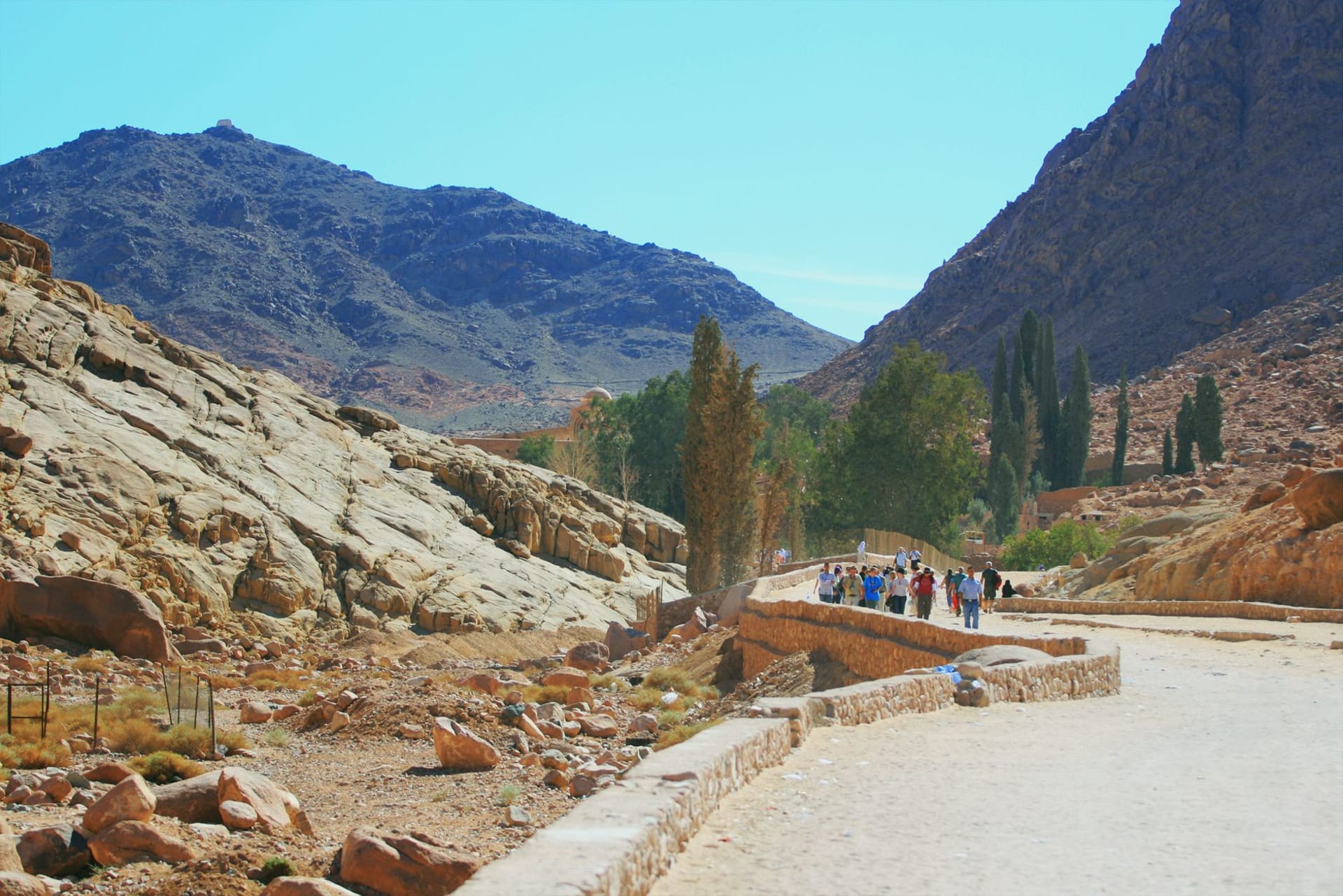
St. Catherine's Monastery
"Fourteen hundred years of continuous occupation, and the library smells exactly how you'd hope."
The Oldest Wall Still Standing
The monastery was built on the orders of Emperor Justinian between 548 and 565 CE on the site where, the tradition holds, Moses encountered the burning bush. The walls Justinian’s engineers raised are the same walls standing today. That kind of unbroken continuity is hard to locate anywhere else on earth — this is not a reconstructed monument but a live institution, a community of Greek Orthodox monks who have been here, through Islamic conquest and Crusader incursion and Ottoman rule and Egyptian nationalism, without interruption.
I arrived in the early morning, before the tour buses came up from Sharm, and stood in the outer courtyard in a silence qualified only by pigeons and the distant sound of a bell. The scale is smaller than you expect. This is not a cathedral complex; it’s a walled village, compact and functional, built to survive in a place that wanted nothing to do with human habitation.
The Burning Bush and the Library
The Bush is still there — or rather, a descendant of the original Rubus sanctus rosebush is still growing in the courtyard behind the basilica, at the exact spot where the tradition places the theophany. The monks point out that no cutting from this bush has ever been successfully rooted elsewhere. Whether you find this significant or simply botanical, the bush is very much alive, and green, and growing through the window of the small Chapel of the Burning Bush built around it.
The library is one of the great repositories of early Christian manuscripts in the world — second only to the Vatican in the count of pre-ninth-century texts. Most of it is not accessible to visitors, which is correct. What you can see, in a small museum off the main courtyard, is enough: illuminated gospel books, imperial decrees on vellum, an icon collection that includes some of the oldest surviving examples of the encaustic technique anywhere.
The Codex Sinaiticus, the fourth-century Greek Bible that is among the most important manuscripts in existence, was “acquired” from this monastery by the German scholar Constantin von Tischendorf in the nineteenth century and now lives primarily in the British Library in London. The monks have not forgotten this. The subject comes up if you ask.
The Town and the High Plateau
The nearby village of St. Catherine is a small Bedouin settlement turned service town, with guesthouses, a few restaurants, and the administrative infrastructure of a place people use as a base for the mountain. The surrounding high plateau — around 1,600 meters — has a climate unlike anything else in the Sinai: cold winters with occasional snow, cool summers, a highland austerity that feels more Central Asian than Middle Eastern.
Lia and I stayed two nights in a small guesthouse run by a Bedouin family who served dinner on a low table in the main room: slow-cooked lamb, lentil soup, flatbread from a clay oven, and strong tea. The grandmother sat in the corner watching a Turkish soap opera on a small television with the sound turned low. It was one of those evenings that felt exactly like what travel is supposed to produce.
Visiting
The monastery is open mornings only, closed Fridays and Sundays and on Greek Orthodox feast days (which are numerous). Dress code is enforced at the gate. Photography inside the basilica is not permitted, and rightly so.
When to go: Spring (March–April) and autumn (October–November) for the best hiking weather on the surrounding plateau. Winter brings cold and occasional snow, which makes the granite landscape genuinely dramatic. Summer is manageable at altitude but the surrounding desert is ferocious.