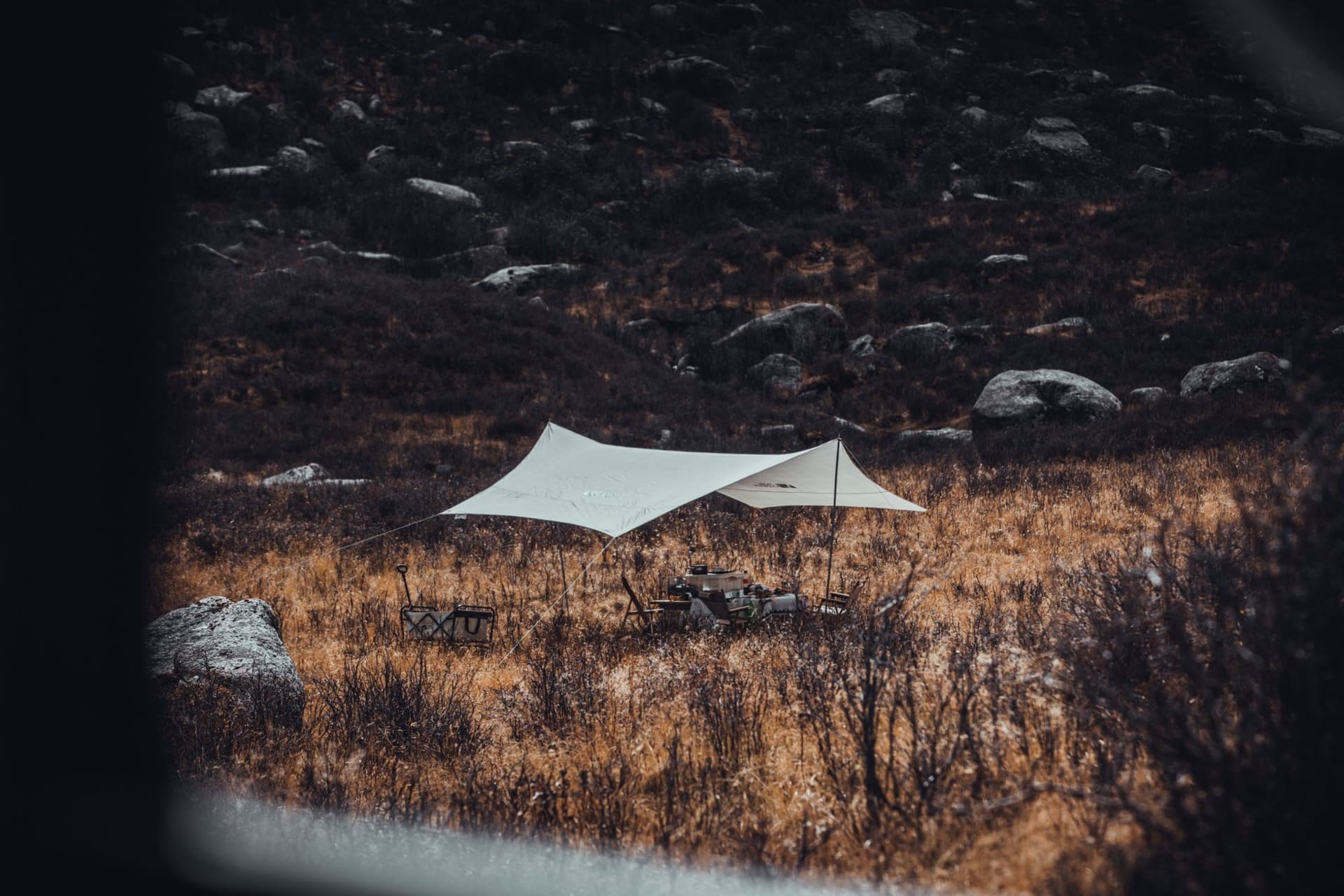
Geech Camp
"At 3,600 meters the world gets very simple: eat, sleep, breathe, walk."
Into the Afroalpine
The trail from Sankaber to Geech covers around fourteen kilometers and climbs roughly three hundred and fifty meters. On the map it looks like nothing. In practice, at altitude, with a day pack and a mule carrying your tent, it takes the better part of a day and uses muscles you forgot you had. The landscape changes as you go — the heather and hagenia forest of the lower plateau gives way to open moorland, then to the high Afroalpine zone where the giant lobelia begins to dominate.
The lobelias at Geech stopped me the first time I rounded a bend and saw a field of them — tall stalks, some reaching four or five meters, with rosettes at the top that look botanical and alien in equal measure. They grow slowly, take years to flower, and die after blooming once. Most of the landscape around Geech is covered in them. Walking through at dusk, with the fog coming in off the escarpment, feels like being the last person in a very large arboretum that nobody has tended for centuries.
The Camp Itself
Geech camp sits just back from the cliff edge, protected slightly from the wind by a small rise. The stone shelters are basic — a sleeping platform, a roof, no insulation. At 3,600 meters the nights are cold enough that my water bottle inside the tent was partly frozen by four in the morning. I slept in everything I had and was still aware of the cold in a background way, the way you’re aware of a sound that won’t stop.
The ranger post here has a logbook and a small fire in the evening. I sat with the scout and a cook named Abebe who made a surprisingly good lentil stew on a camp stove and seemed amused by my inability to eat it without burning my mouth. The conversation was limited by language but expansive in other ways — a lot of pointing at ridgelines, a lot of mimicking animal shapes with hands.
Viewpoints That Earn the Altitude
The classic walk from Geech is to Imet Gogo, a viewpoint peak about two hours east that provides one of the most photographed vistas in the Simiens. But the escarpment walk directly from camp is worth an hour of your time regardless. The cliff edge near Geech has a series of natural terraces where the rock has fractured and receded, and from these you can look south into the deep valley and north along the plateau rim simultaneously.
On my second morning at Geech I woke at five-thirty and walked to the closest overlook point in the dark. I sat on a flat rock and waited. The valley below was solid with cloud at first, the escarpment emerging as islands. Then the sun hit the far ridgeline and the cloud began to thin, and for about twenty minutes everything below was in motion — burning off, shifting, pooling in the lower sections while the upper valley cleared.
Acclimatization Matters Here
Geech is where altitude starts making itself known. I was fine — I had taken two days to reach this point — but a French couple I met here had rushed from Debark in one long day and were both moving slowly with headaches. Geech is not the place to push through those symptoms. The days here are good rest days: short walks, big meals, early sleep.
When to go: Geech is a mandatory camp on most Simien itineraries and is accessible year-round in principle, though the wet season (June–September) brings heavy afternoon rain and poor visibility. October through March offers the clearest skies and the most reliable trekking conditions. Nights are coldest in December and January — expect below -5°C.