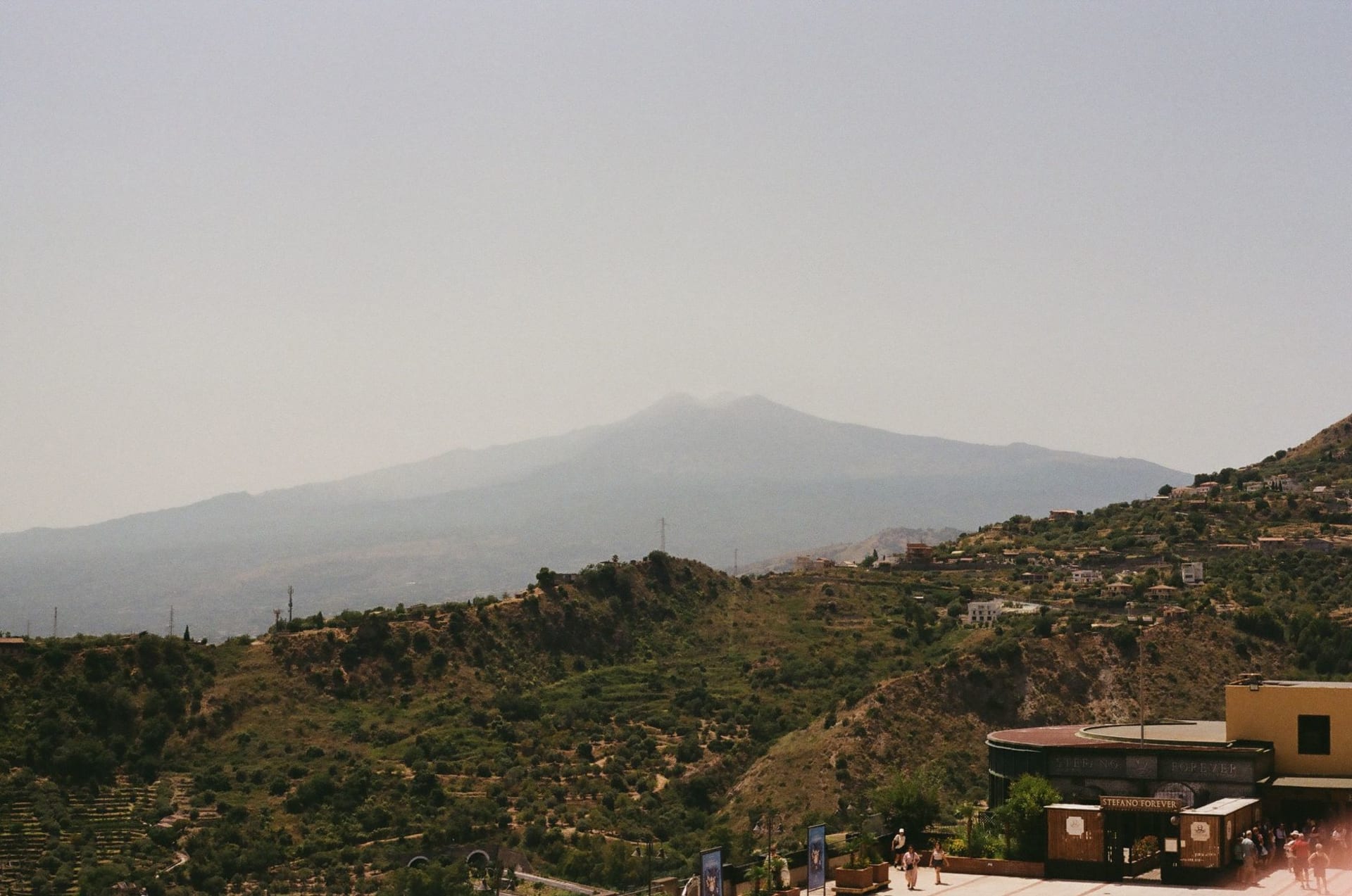
Etna doesn’t look dangerous from a distance. It just looks enormous — a wide volcanic cone above the eastern skyline of Sicily that you notice from everywhere and calibrate your position by instinctively, the way you use mountains. Then you get closer and start noticing the lava fields: acres of black, jagged, undifferentiated rock, treeless, colorless, still carrying the texture of the flow that produced it. Some of those flows are from the 1990s. Some are older. Etna doesn’t stop.
Going Up
The southern approach via Nicolosi and the cable car is the most established route and the most crowded. I went via the north side, through Linguaglossa on the Circumetnea railway — a narrow-gauge train that loops around the base of the mountain through towns that exist because of the volcanic soil and in spite of the proximity to it. The northern slope is less developed and the craters accessible from that side feel less like a tourist attraction and more like what they actually are.
From the cable car station on the south (2500m), guides take groups to the summit craters at around 3300m. The terrain up there is Mars-adjacent: black cinder, sulfur vents, wind that comes from nowhere and disappears. I wore too little and borrowed a guide’s extra layer. The smell is sharp and mineral, somewhere between a struck match and a hot spring.
Lia did not come up to the summit. She stayed at the crater observatory at 1900m and said the views of the coast from there were better anyway. She wasn’t wrong, but the summit is the summit.
The Wine
This is the part that caught me off guard. The volcanic soils of Etna produce wine that is unlike the rest of Sicily — higher elevation, older vines, a minerality that you can taste as a fact rather than a description. Nerello Mascalese is the main red grape, grown in contrade (small plots) on the slope that are named and mapped with a seriousness that the Burgundians would recognize.
I visited a small producer near Randazzo on the north slope. The cellar was cut into lava rock. The wine tasted of iron and wild strawberry and something else I couldn’t name. I bought six bottles and then worried about carrying them home for the rest of the trip.
The Towns on the Slopes
Zafferana Etnea, on the eastern slope, is a pleasant town with a honey festival in October and good views of the lava fields below it — the 1992 lava flow stopped at the edge of town after a military intervention attempted to divert it with barriers. The barriers didn’t do much; the lava just stopped on its own. They left the barriers there anyway.
Bronte, on the western slope, is the pistachio capital of Italy. The nuts grow in the volcanic soil and are intensely green and sweet. I bought pistachio cream in a jar that I ate with a spoon like a guilty conscience.
Practical Logistics
Guided summit hikes are strongly recommended over solo exploration — Etna is active and crater conditions change. Multiple agencies operate from Catania. The Circumetnea train is a good way to see the lower slopes without driving.
When to go: Spring (April-May) and autumn (September-October) offer the best conditions — clear skies, manageable temperatures at altitude, and snow on the upper craters without closing access. In winter the mountain is heavily snow-covered and some routes close. Summer is fine but hazy; the views are better in shoulder season.