Catania
"The fish market in Catania is not a market. It's a performance. Everyone knows their part."
Catania is built on black lava stone because that’s what Etna provides. The streets are dark, the buildings are dark, and then the baroque was layered on top of all of this in the 18th century after the 1693 earthquake demolished the original city — white limestone columns and ornate facades set against the black basalt ground, which gives the whole center a dramatic contrast that seems calculated but is purely geological.
La Pescheria
The fish market at La Pescheria, behind Piazza del Duomo, is the reason to be in Catania by nine in the morning. It operates in a series of low buildings and open counters over what was once the course of the Amenano river, and it runs in a style that I can only describe as operatic: the vendors shout the names and prices of what they have in a kind of extended call that becomes musical by repetition, swordfish heads are propped upright with the eyes still clear, the purple of fresh octopus and the silver of sardines and the dark red of fresh tuna sit in ice that catches the morning light and throws it back.
I stood at the edge of it for twenty minutes before buying anything, which is the right approach. The market has a rhythm. Once you understand it, you can navigate — the inner ring for fish, the outer stalls for produce, the exit near the fountain where the Amenano water still seeps through an iron grate below street level.
I bought a piece of swordfish and asked a restaurant nearby if they’d cook it. They did. This is apparently normal in the neighborhood.
The Baroque Streets
Via dei Crociferi is the baroque set piece — a street of churches and monasteries running north from the Duomo, each building competing with the others in facade ambition. It should feel excessive and probably does to some people. I found it exhilarating. The Cattedrale di Sant’Agata, patron saint of Catania, has a facade that manages to be both formal and slightly unhinged, which feels right for a city with this kind of energy.
The lava stone beneath the baroque is everywhere in details: the dark blocks used for ground level, the contrast of black stone with white carved elements on facades, the basalt of the streets themselves worn to a dull sheen by traffic.
The Volcano Above
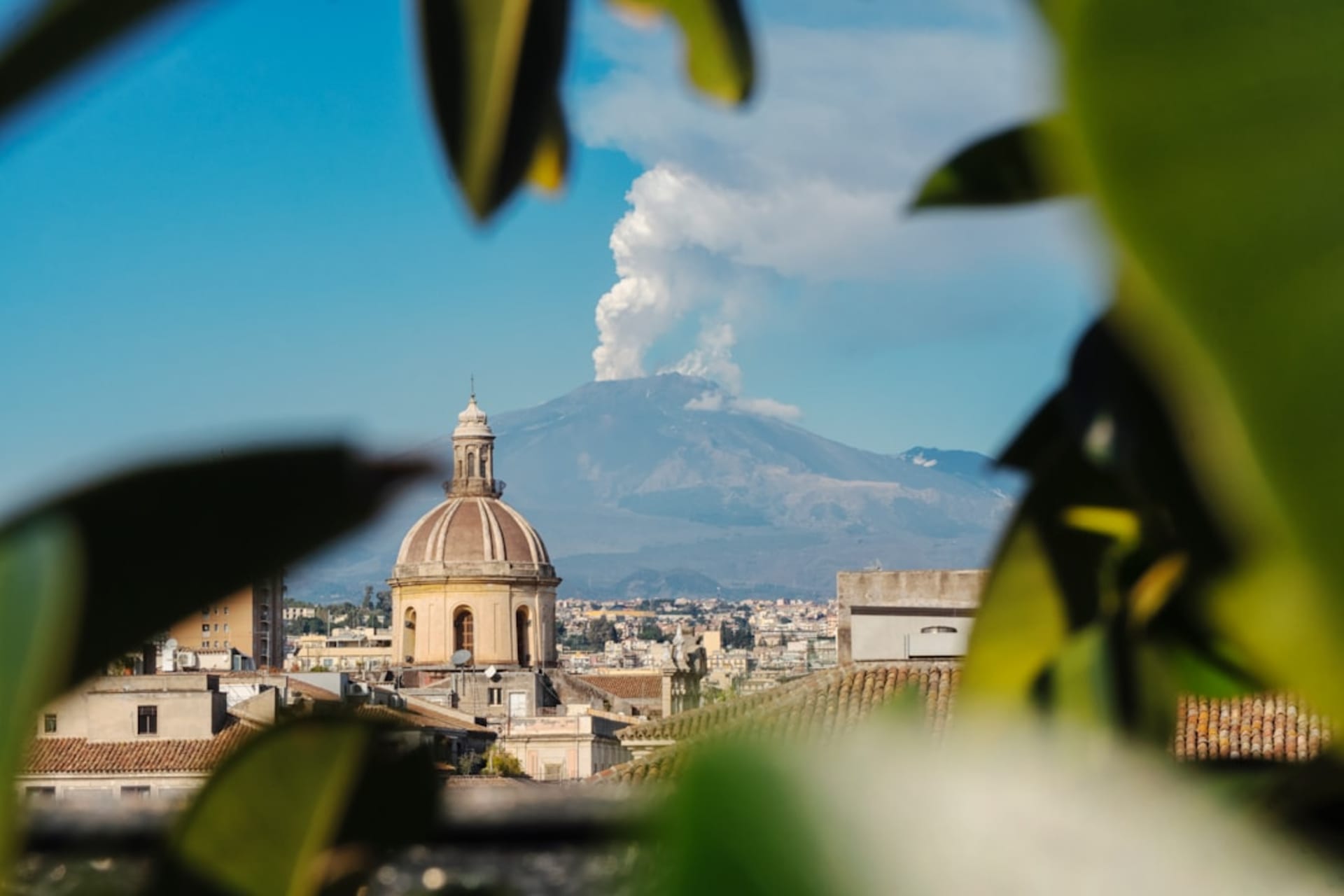
Etna is visible from everywhere in Catania on a clear day — a grey-white cone above the northern skyline, usually trailing a thin line of vapor from the summit. The mountain functions as a clock and a compass: you look up to see what it’s doing, you orient by where it sits. The relationship between the city and the volcano that has destroyed parts of it multiple times is not simple. It’s the source of the soil, the stone, the aesthetic of the city, and a permanent low-level threat.
The Circumetnea train departs from a small station near the city center and circles the base of the mountain — a better way to understand the geography than driving.
Eating Well
Catania has the food culture of a serious port city. The arancino here is round (versus Palermo’s oval), and both cities will explain at length why their version is correct. The horse meat sandwiches at a few traditional stalls in the market area are worth knowing about if you’re open to them. The granita culture is more serious than anywhere else in Sicily — multiple flavors, the consistency thick and specific, served with a brioche that you tear and dip.
When to go: Catania works year-round as a city. For the market and the streets, spring and autumn are best. The Feast of Sant’Agata in early February is one of the most intense religious festivals in Italy — the city shuts down for three days, the streets fill with candlelit processions, and the devotion is absolutely real and completely overwhelming to witness.