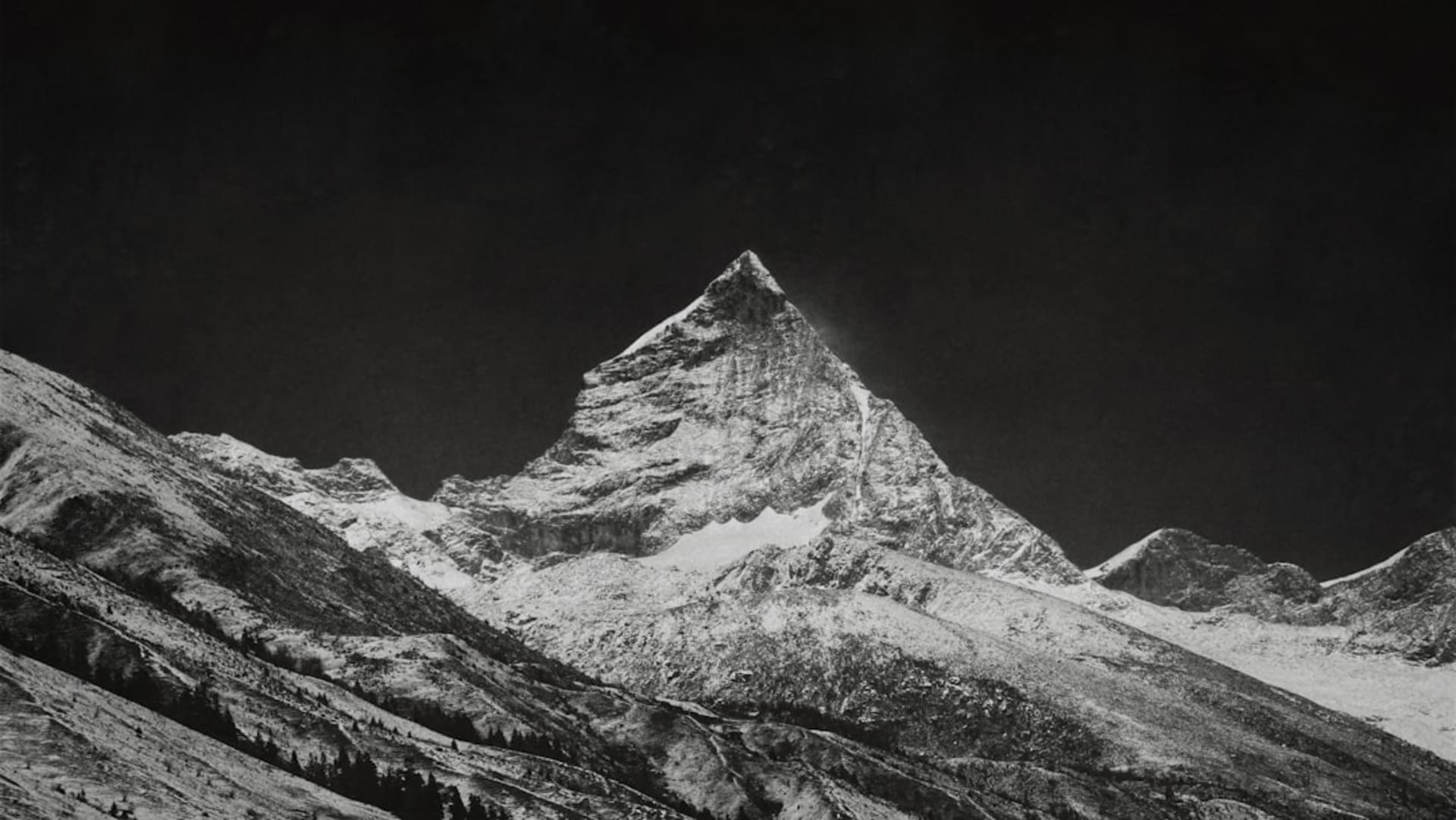
Siguniang Mountain
"The youngest peak is the tallest. The sisters are ranked in reverse order of height. The myth, whatever version you hear, always involves unrequited love and stone."
Four Sisters, Four Peaks
Siguniang — the Four Girls Mountain — is the name for both the massif and the highest of its four peaks, which tops out at 6,250 meters. The name comes from a folk story: four beautiful sisters turned to stone to protect their valley from demons, and the peaks are what remained. Different villages tell the story differently. The constants are the transformation and the sacrifice. What’s left is the highest mountain in the Qionglai range, visible from a hundred kilometers away on a clear day, cutting a clean white triangle against whatever color the sky decides to be.
The base area sits at roughly 3,100 meters — high enough to slow you down if you’ve come directly from low altitude, low enough that acclimatization is a day’s matter rather than a week’s. The town of Rilong is the jumping-off point, a string of guesthouses and trekking shops along the main road with a functional rather than picturesque character. You don’t come for the town.
The Three Valleys
Three valleys fan out from Rilong and each has its own permit and its own personality. Shuangqiao Valley is the most accessible — a road runs the length of it, minibuses shuttle visitors to the viewpoints, and the walk is flat enough that it attracts everyone from families with toddlers to elderly tour groups. Don’t dismiss it for this: the views of the peaks from the upper end of the valley are legitimate, and the autumn birch trees — white trunks, yellow leaves against the snow peaks — are compositionally perfect in a way that feels almost unfair.
Changping Valley is quieter and longer, accessible on horseback or on foot. The trail runs past Tibetan farmhouses to the Haizi — a glacial lake at the valley’s head — where the four peaks appear reflected in the water when conditions cooperate. The path skirts the edge of a forest that smells of pine resin and cold creek water, and there are sections where the only sounds are your own footsteps and whatever bird is making that two-note call from the trees.
Bipeng Valley is the least visited, which means it’s the one worth finding. The road in is rougher, the facilities minimal, and the valley itself broader and wilder-feeling, with high grazing meadows and the sense that the yaks you encounter have seen few enough strangers that they look at you with genuine interest.
Trekking Above the Valleys
For the serious hiker, the ridge between Shuangqiao and Changping offers views of all four peaks simultaneously — a circuit that takes a long day and requires a guide for the upper section. I did the first two-thirds of it with a local guide named Tsering who spoke fragments of English and excellent body-language and knew where every stream crossing was safe. The ridge walk above the treeline felt like being on the roof of something significant. Wind, altitude, no shade, and four snow peaks arranged in a semicircle around the sky. I have a photograph from up there that Lia used as her phone wallpaper for six months.
The Light, Hour by Hour
The quality of light in these valleys is the secret reason photographers plan their trips around it. Morning brings low-angle gold across the birch forest; midday flattens to silver-white and the peaks look cut out of paper; afternoon brings cloud that rolls in from the west and wraps the summits in moving fog; and evening, when the clouds briefly part, turns the snow peaks pink and then red in about four minutes. I sat at the valley entrance one evening and watched those four minutes happen. The man selling instant noodles from a cart next to me had watched it happen ten thousand times and still looked at it.
When to go: October is peak season for the autumn foliage in Shuangqiao Valley — book guesthouses at least two weeks ahead. June and July see wildflowers in the high meadows but also afternoon thunderstorms. Winter closes some of the higher trails but the snow on the peaks and forest is exceptional for photography. Spring (April–May) offers blooming rhododendrons on the lower slopes and thin crowds.