Emei Shan
"The monkey took my water bottle with a confidence that told me this wasn't his first robbery."
The Ascent Begins at Sea Level
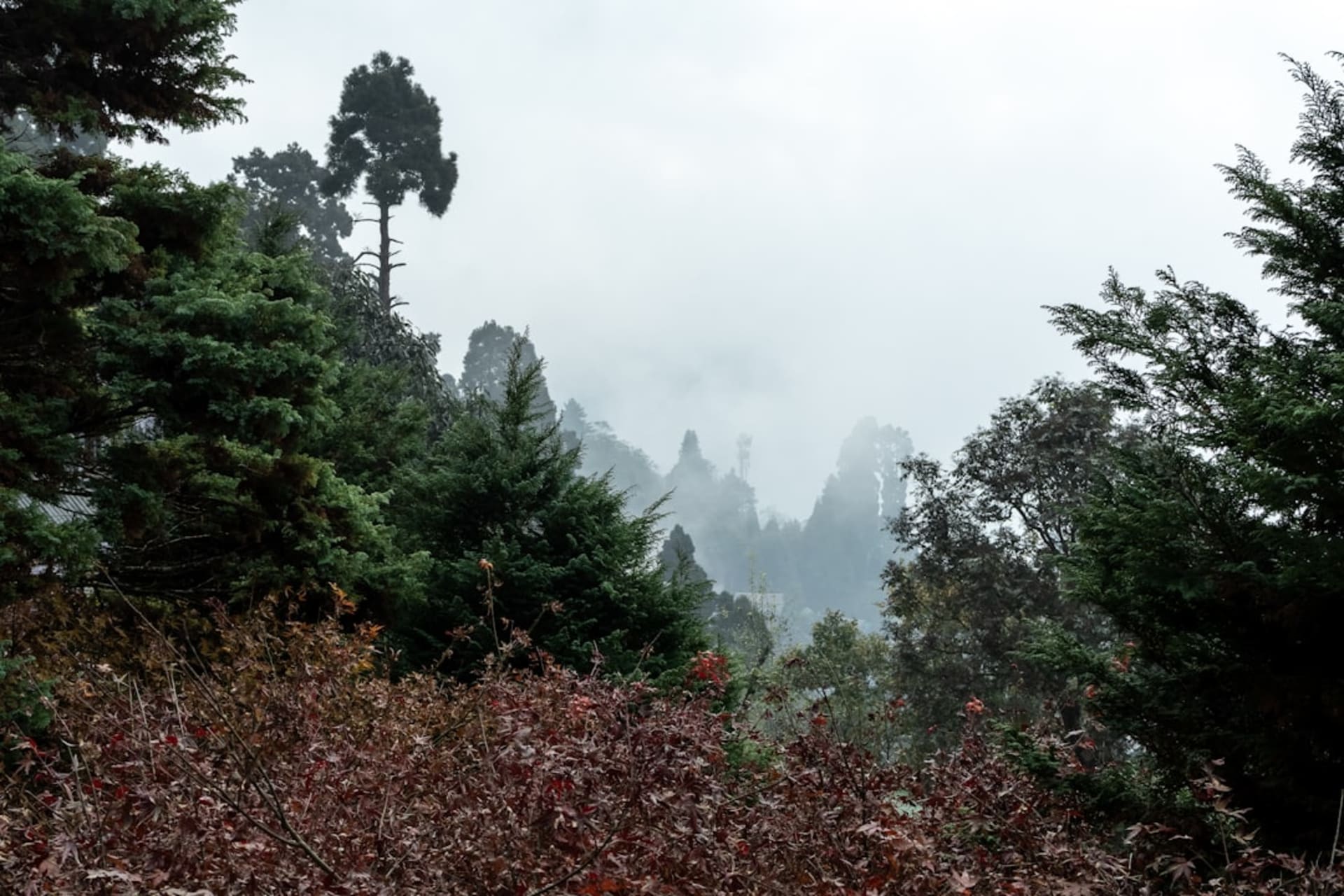
Mount Emei rises to 3,099 meters from a subtropical base where banana trees grow in temple courtyards. That vertical range is most of the mountain’s character — you pass through four climate zones in a single day of walking, which means you can start in humidity thick enough to chew and arrive at the summit in a wind that feels borrowed from somewhere much further north. I did the climb over two days, sleeping at Wannian Temple partway up, waking at 4 a.m. to the sound of monks reciting morning sutras through thin walls.
The lower trails smell of damp earth, incense, and the faintly sweet rot of bamboo. Mist clings to everything. The stone steps — worn smooth by centuries of pilgrims — glisten even in dry weather. I passed an elderly woman in a red jacket who was moving faster than me with a walking staff, which I tried not to find humbling and failed.
The Macaques
Nobody tells you how organized they are. The Tibetan macaques at Emei Shan operate with a level of institutional efficiency that suggests they’ve been running this operation for generations — because they have. They sit on the handrails and in the middle of the path with a calm that reads as territorial rather than curious. Signs at the trailhead warn you not to carry visible food. I made the mistake of a water bottle in the outer pocket of my pack. A large male removed it with a single motion and retreated to a rock to examine his prize, looking genuinely disappointed when he figured out it wasn’t edible.
The advice to carry a stick is not excessive. Hold it casually, not aggressively. The macaques are watching the calculation.
Cloud Sea at the Summit
The summit area — Jīndǐng, the Golden Summit — is reached by cable car from the upper station, a mercy after a day and a half of climbing. The Huazang Temple sits at the peak, bronze-gilded and enormous, with statues of Samantabhadra on a ten-elephant plinth that you can walk around in the wind while trying to stay upright. When cloud conditions cooperate, you’re looking out over a rolling sea of mist with only peaks poking through — the so-called “Buddha’s Halo,” a circular rainbow caused by the diffraction of sunlight through cloud, appears here on specific mornings when the light angle is right. I didn’t see it on my visit. The woman in the red jacket told me she’d been coming for thirty years and had seen it twice.
Sleeping in the Mountain
The mid-mountain monasteries accept travelers, and spending a night at Wannian or Qingyin Pavilion changes the experience entirely. The crowds thin dramatically after 5 p.m. when the day-trippers descend. In the evening, the temples are for the monks and the serious pilgrims — incense smoke drifting sideways in the mountain air, candlelight through paper screens, the percussion of the wooden fish drum from the prayer hall. Breakfast is rice congee with pickled vegetables, served in a canteen where nobody speaks much, and it’s exactly what you want after a cold night at altitude.
When to go: April and May for rhododendrons in bloom along the lower slopes. October brings clear skies and the best chance of cloud sea views from the summit. Avoid Chinese Golden Week (first week of October) unless you’re comfortable with crowds thick enough to turn the staircase into a slow conveyor belt. Winter summit visits are possible but require crampons — the steps ice over.