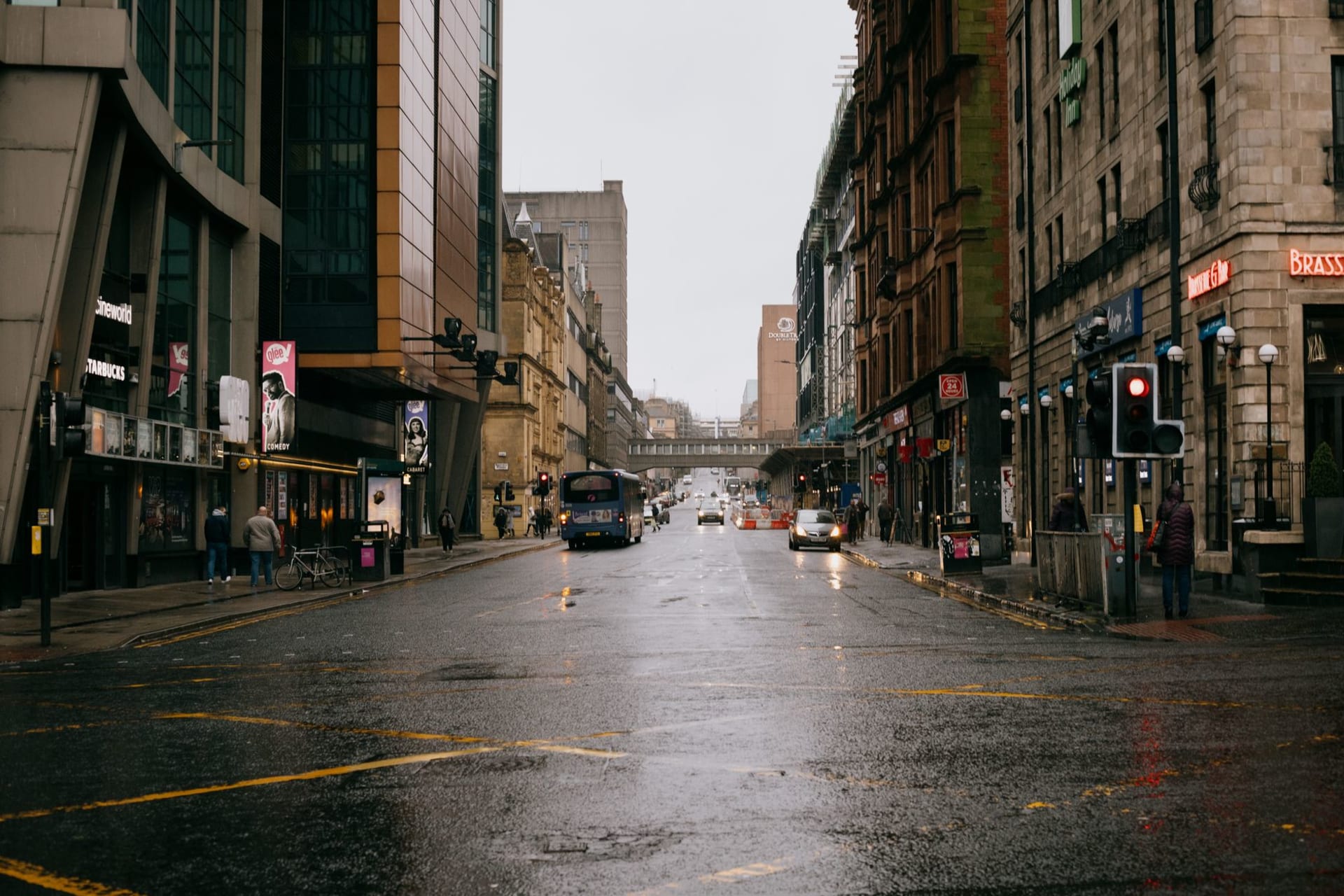
I will admit I arrived in Glasgow with a Frenchman’s prejudice: I assumed it would be Edinburgh’s rougher cousin, a place to pass through on the way to the Highlands. Lia, who had read more than me as usual, told me to give it two days. It took about two hours. We came out of Queen Street station into a wall of soft rain and a busker absolutely demolishing a Proclaimers song, and a stranger in a tracksuit told us, unprompted and with total sincerity, that we’d picked the best city in the world. I didn’t believe him yet. By the time we left I more or less did.
Sandstone and Mackintosh
Glasgow is a Victorian city built on shipbuilding money, and it shows in the architecture — great blackened sandstone tenements, ornate facades, a civic grandeur that feels almost too big for a place this unpretentious. The blond and red sandstone goes amber when the sun finally breaks through, which it does roughly twice a week.
The thing I’d actually come to see was Charles Rennie Mackintosh. His Glasgow School of Art burned in 2014 and again in 2018, which is a genuine tragedy, but his fingerprints are everywhere else. We had tea and a plate of teacakes at the Mackintosh at the Willow on Sauchiehall Street, the reconstructed tearooms he designed down to the cutlery, all high-backed chairs and silver and that severe rose motif. Lia said it was the most elegant room she’d sat in since Vienna. I said the scones were better than Vienna’s. We were both right.

The West End and the Curry
The West End, out around the university, is where I’d live if I lived here. The University of Glasgow looks like Hogwarts and predates it by about five centuries, all spires and cloisters on a hill above the River Kelvin. Below it sits Kelvingrove, a free museum in a cathedral of red sandstone, where you’ll find Dalí’s Christ of Saint John of the Cross hanging near a stuffed elephant and a Spitfire bolted to the ceiling. There is no logic to it and it is wonderful.
Then there is the food, which nobody warns you about. Glasgow takes its curry seriously — the city more or less invented the chicken tikka masala, depending on who you ask, and the Indian and Pakistani restaurants along the south side and Gibson Street are the real thing. We ate at a busy place where the waiter clocked my accent and brought extra naan “for the Frenchman who’ll complain about the bread,” which was both rude and correct.

What stayed with me was the talk. Glaswegians will speak to you anywhere — the bus, the queue, the urinal, it doesn’t matter — and the accent takes a day to tune into and then becomes the best soundtrack in Britain.
When to go: May, June, or September for the longest, driest days, though “dry” is relative. The city’s festivals — Celtic Connections in January, the West End Festival in June — are worth timing a visit around. Bring a proper waterproof and abandon the idea of an umbrella; the wind here treats them as a personal insult.