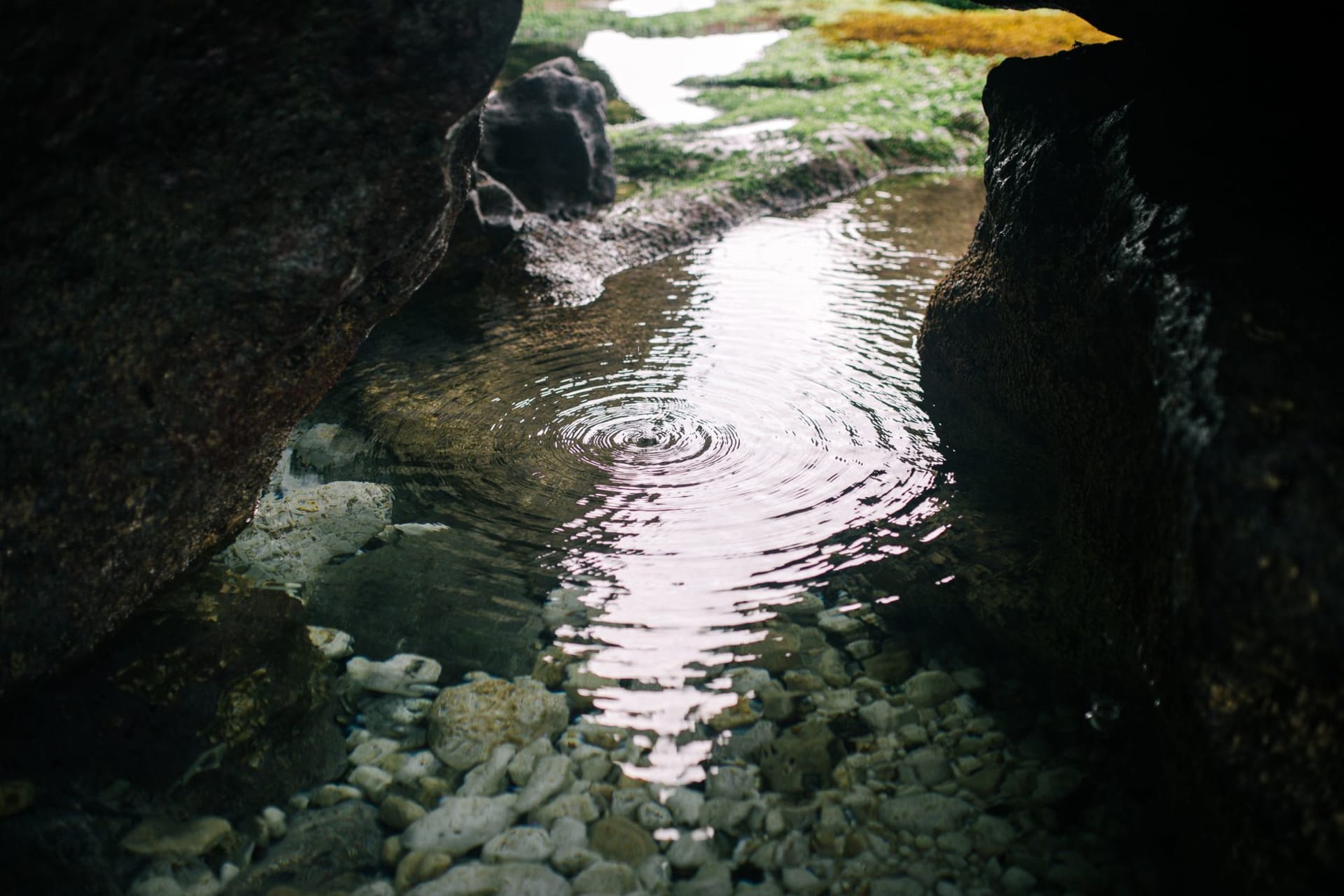
Piula Cave Pool
"Cold, clear, freshwater, in a cave, under a church — I don't know what category this falls into but I know I want to go back."
The Methodist church at Piula sits on a low cliff above the north coast road, white-painted, unremarkable from the outside. You park in the shade of the palms and follow a path down toward the water, and then the path turns and goes under the cliff face and suddenly you are inside. The cave is a volcanic chamber, roughly oval, maybe twenty meters across at its widest, and it holds a pool of spring water so clear that the bottom — which drops to perhaps three meters at center — is visible in the kind of sharp, unambiguous detail that makes you feel slightly undeserving of it. The water is cold. Not refreshing-ocean-cold but actually cold, the way that underground freshwater is cold — a different quality of temperature, something that feels as if it came from a long distance to get here.

The cave connects to the ocean through a submerged passage at its base, which means that at high tide the saltwater comes in and at low tide the freshwater sits unmixed above it — you can dive down and, if you know to look for it, feel the thermocline between the two water bodies, the cold and the warm exchanging places in slow vertical gradations. Local children treat the cave as a swimming hole, which is its most accurate designation. When I was there, three boys were jumping from a ledge on the far side into the deepest part of the pool, the splash echoing off the cave walls in a way that made the sound arrive twice, once as thud and once as reverberation. An elderly woman sat on the steps at the entrance and watched them with the specific expression of someone who has watched children jump off that ledge for forty years and found it continuously satisfying.

The setting is its own argument. A freshwater cave beneath an active Methodist church on a volcanic island in the middle of the Pacific — the combination of the sacred and the geological and the purely physical pleasure of swimming in cold clear water is so improbable that it works as a kind of summary of what makes Samoa strange and good. The small entrance fee goes to the church community. You can leave your things on the steps and they will still be there when you come out. The drive east from Piula along the north coast road runs through a sequence of villages that each have their own beach access, their own fale arrangements, and their own particular quality of late-morning light off the water.
When to go: Year-round, though the cave can flood partially during heavy rain when the spring surges. Go early — by mid-morning, local families and school groups arrive. The pool is best in the dry season when visibility is clearest.