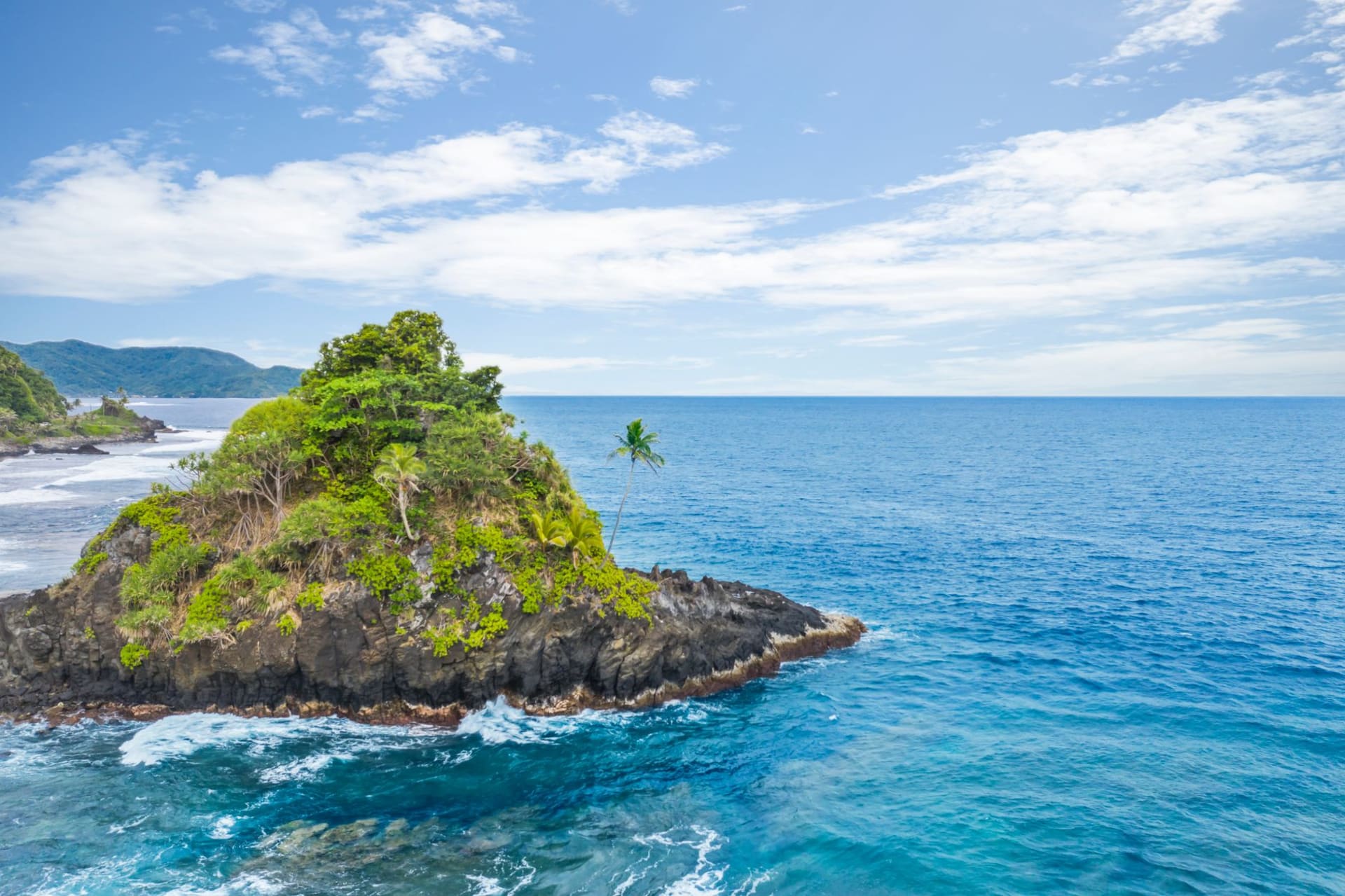
Pacific
Samoa
"The Pacific I imagined doesn't exist — Samoa is something rawer."
The flight from Auckland drops you into Faleolo just after dawn, and the humidity hits before the doors are fully open. I’d been in Mexico long enough to think I knew heat, knew tropical coast, knew the particular slowness that salt air imposes on everything. Samoa reset all of that. The air here is thick in a different way — vegetal, almost alive — and the drive into Apia along the coast road is forty minutes of sugarcane, breadfruit trees, open-sided fales, and the kind of silence between villages that makes you feel like you’ve arrived somewhere that genuinely doesn’t care whether you showed up or not.
What surprises most people, I think, is how little Samoa performs for visitors. There’s no strip of resort hotels pretending the lagoon belongs to them. In the villages, the fale — that open, post-and-beam pavilion that serves as living room, dining room, and bedroom simultaneously — sits just meters from the road, life fully visible. Kids do homework on mats. Elders play cards. Someone is always cooking something over a fire. The fa’asamoa, the Samoan way, isn’t a cultural product for sale in a gift shop — it’s the actual operating system of the place, and if you stay long enough, you start to understand why Samoans who’ve moved to Auckland or Los Angeles often describe feeling incomplete without it.
The To Sua Ocean Trench on Upolu’s southern coast is the image that ends up on every postcard, and for once the reality lives up to it: a circular pool of impossible blue-green water, connected to the open sea through a lava tube you can swim through if the tide cooperates. You reach it by descending a wooden ladder bolted into the volcanic rock face. The surrounding gardens belong to the family that has maintained the site for generations, and the small entrance fee goes directly to them. Eat oka — raw fish cured in coconut cream and lime — at the roadside stalls nearby. Drink from a fresh coconut someone will open with a machete while you’re still dripping. This is not difficult.
When to go: May through October is the dry season and the clearest window for snorkeling and road trips around Upolu and Savai’i. Avoid January and February if you’re not prepared for cyclone-adjacent humidity and rain that comes horizontally. The shoulder months of April and November can be stunning and are dramatically less crowded.
What most guides get wrong: They position Samoa as a budget alternative to Fiji or Bora Bora, which misframes everything. Samoa isn’t a cheaper version of somewhere else. There are fewer infinity pools and fewer beach bars, yes. What there is instead is a genuinely intact Polynesian culture that has so far resisted the full package-tourism conversion. Samoans are deeply warm but not performatively hospitable — there’s a difference, and it matters. Go expecting a country with its own logic, not a paradise that forgot to install the swim-up bars.