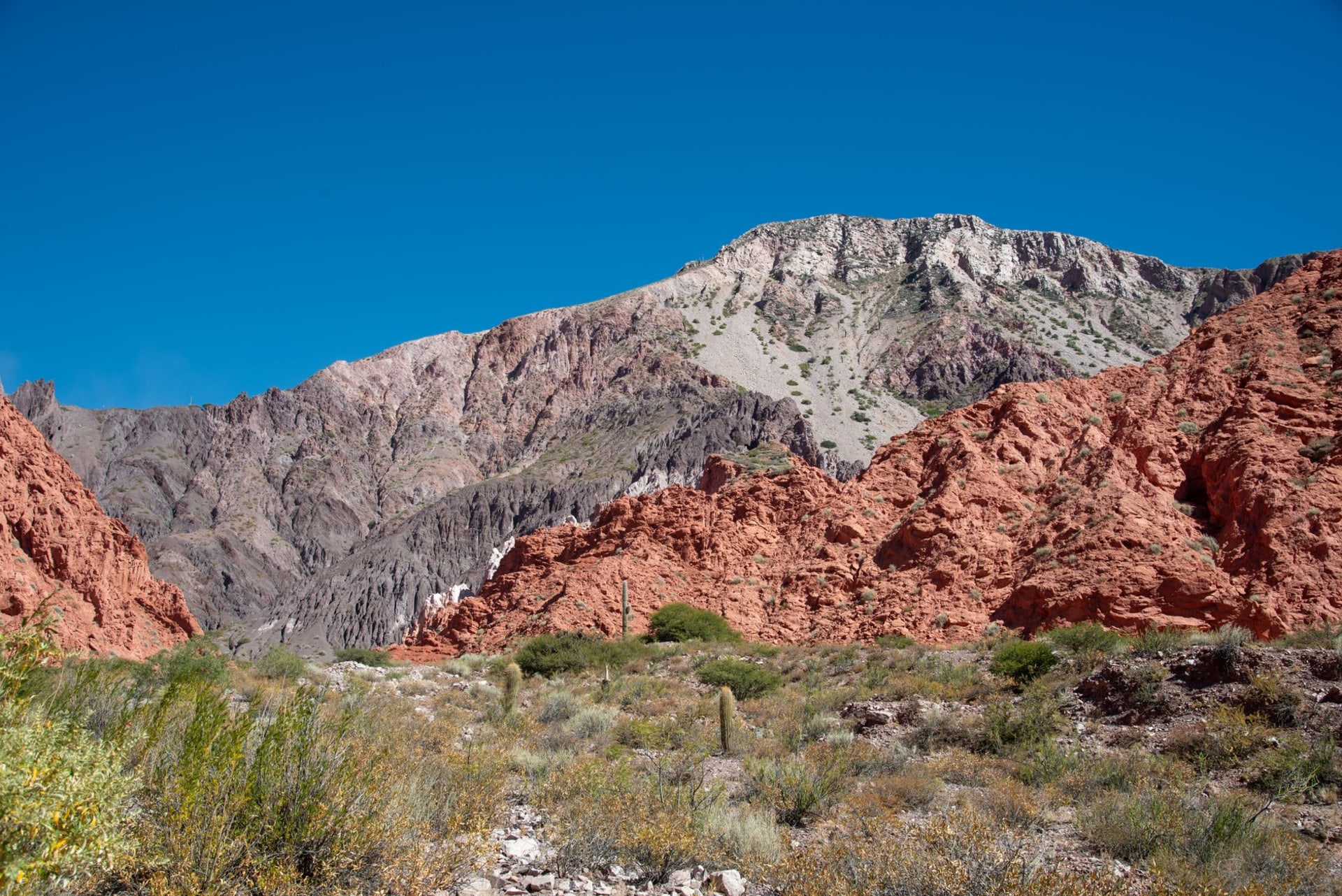
Quebrada de las Conchas
"Someone was singing inside El Anfiteatro when I arrived, just testing the echo, and the gorge turned their voice into something immense."
The route guide called it a scenic drive and I took that to mean pleasant. It is not pleasant in the way a lake or a garden is pleasant. It is something more violent than that — a geological argument conducted at full volume across fifty kilometres of canyon, the Rio de las Conchas having spent several million years cutting through the sandstone until it exposed the full stratigraphy of the earth’s history in these walls. I drove it from Salta southward, which means you enter the gorge cold and the landscape escalates around you in a way that keeps preventing you from making progress toward Cafayate.

The named formations are the organizing principle of the canyon and each one earns its name. Los Castillos — the Castles — are a series of stacked sandstone towers that appear around a bend in the road and look genuinely constructed, the stratification horizontal across their faces like courses of masonry. I stopped here and walked around the base of them in the midday heat, touching the rock, trying to understand the scale. Los Colorados is a stretch where the canyon walls go from rust to scarlet in the direct sun, a colour that does not look geological, that looks like something painted. Then El Anfiteatro: a natural bowl carved into the cliff face, a hundred metres across, with smooth curved walls and an acoustics situation that is, objectively, inexplicable. A French couple had arrived just before me and one of them was singing something — not performing, just testing — and the sound filled the bowl and came back changed, richer, somehow larger. We all stood there in a slightly embarrassed silence afterward.
La Garganta del Diablo — the Devil’s Throat — is the climax: a slot canyon narrow enough that you have to turn sideways in places, the walls rising sheer on both sides, the sky reduced to a strip of blue directly above. The air is cooler inside and the colour of the rock shifts to deeper burgundy in the enclosed space. Water has done this — water that is now mostly gone, the river running at a fraction of its historical volume. The evidence of what it was capable of is everywhere in the stone.

The light in this canyon is the operational variable. At midday the colours flatten under harsh vertical sun and the canyon looks like a set. In the late afternoon, with the sun at an oblique angle, the formations go from terracotta to amber to a deep red that approaches purple, and the shadows pool in the formations with a depth that photographs catch but cannot fully render. I did the northern half of the canyon in the morning and the southern formations in the late afternoon and this division — unplanned — turned out to be exactly right.
When to go: April through November in the dry season is the standard recommendation. The best light is in autumn (April-May) and spring (September-October) when the sun angle is lower. Note that during the January-February rainy season the canyon is accessible but can flood rapidly — the road hugs the river and flash floods do occur. Morning fog in winter creates an atmosphere in the canyon that is genuinely eerie and worth the cold.