
Iruya
"There are no cars in the village. You arrive and the road simply ends and then there is only the mountain and the sound of the river below."
A mountain village perched on a cliff edge that you can only reach by a dirt road so vertiginous it feels like the place is protecting itself.

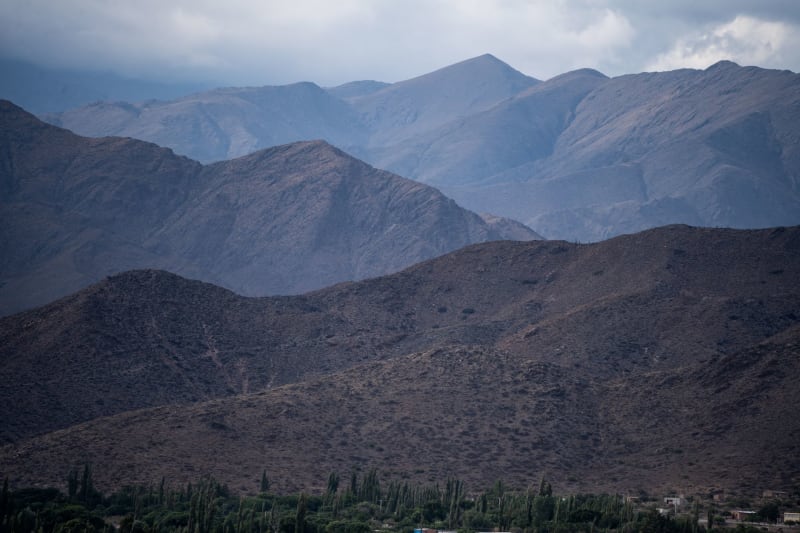
The road from Humahuaca to Iruya takes two hours to cover seventy-seven kilometres. This ratio tells you something. It climbs from the Quebrada to a pass at 4,000 metres on a track of loose rock and vertiginous switchbacks that genuinely requires a vehicle with clearance and, ideally, a driver who has done it before. I hired a 4WD from a man named Gustavo in Humahuaca who had been making the run for fifteen years and who drove the narrow sections — the ones where the track hangs above a drop of several hundred metres — with one hand on the wheel while telling me about his daughter’s school play. The view from the pass is one of the strangest I’ve encountered: the Quebrada visible behind, the mountains of the Iruya range ahead in layers of violet and grey, the scale so large that the absence of any human reference point becomes disorienting.

Iruya sits at 2,780 metres in a narrow gorge where two rivers meet, and it has been there, more or less continuously, since before the Spanish arrived. There are no cars in the village itself — the road ends at a parking area at the edge, and from there you walk narrow stone lanes between whitewashed houses that spill down the cliff face toward the river. The sound the village makes is not a city sound: goats, wind, the distant water, the creak of a door. I arrived in the afternoon and the light on the cliff opposite was doing the Andean thing — turning the rock through amber and into ochre — and I stood at the edge of the village and understood for a moment the logic of building here, this defended, this remote, this specifically itself.
The population is around nine hundred, mostly indigenous Kolla and mestizo, and the economy runs on subsistence agriculture, some small-scale tourism, and the weaving that has been practiced here for centuries. The women who sit outside their doors with drop spindles are not performing for travellers — this is a functional operation, wool to yarn to cloth to sale. I bought a small piece, woven in the natural colours of black and undyed grey llama fleece, from a woman who told me without particular pride that her grandmother had taught her and her daughter was learning. The continuity of that statement went somewhere in me that I wasn’t expecting.

There are two or three small hospedajes and a handful of places to eat — the food is simple and the electricity is not entirely reliable. I ate dinner by candlelight not because the restaurant was atmospheric but because the generator had gone down, and the owner brought out food from a kitchen she was navigating by memory. The locro was exceptional. The stars, when I went outside afterward, were the most stars I have seen from a place with that many people in it.
When to go: April through October in dry season — the access road is essentially impassable in the January-March rainy season, and even in dry season it requires a 4WD or public bus that runs twice daily from Humahuaca. The festival of the Virgen del Rosario in October draws pilgrims from surrounding villages for three days of procession, music and ritual that is extraordinary if you can get a room — book weeks in advance.
Keep exploring
More from Salta & Northwest Argentina
 salta-region
Los Cardones National Park
A high plateau of cardón cacti so tall and numerous they turn the drive to Cachi into something between a landscape painting and a fever dream.
Explore salta-region
Molinos
A near-silent adobe village on the dirt stretch of Ruta 40 in the Calchaquí Valleys, built around a white colonial church and the high-altitude vineyards that surround it.
Explore salta-region
Purmamarca
A village of six hundred people at the foot of a hill that bleeds seven geological colours — arrive before dawn or share it with fifty tour vans.
Explore salta-region
Quebrada de las Conchas
Fifty kilometres of sandstone canyon between Salta and Cafayate where the rock has been carved into amphitheatres, castles and devil's throats by a river that barely exists anymore.
Explore salta-region
Quebrada del Toro
A narrow, wind-scoured canyon where road and railway climb together from the Lerma Valley toward the puna, walls striped in ochre and rust.
Explore salta-region
Salinas Grandes
Salt flats at 3,400 metres on the Puna where the white goes so far in every direction that your eyes start looking for an edge and cannot find one.
Explore