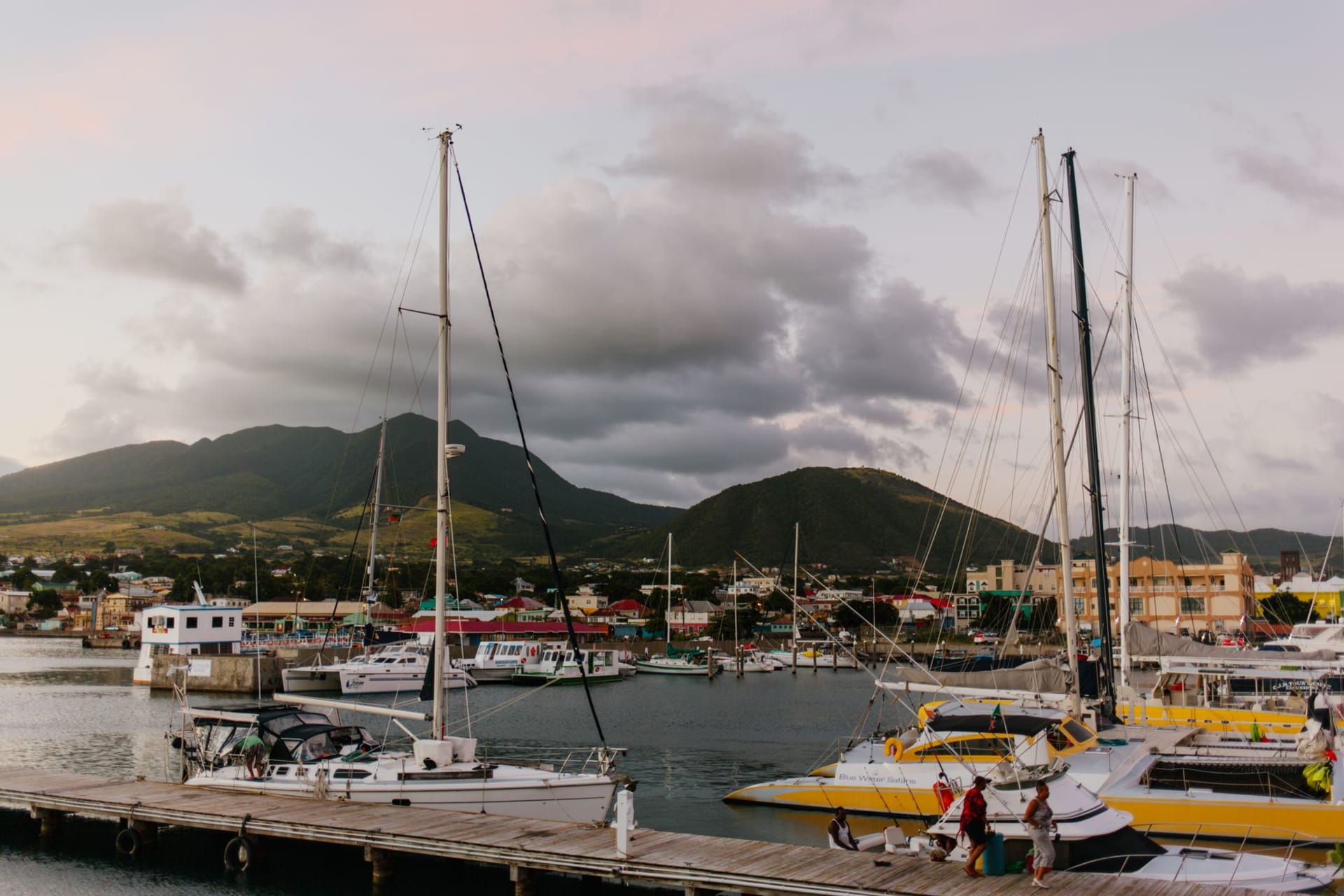
Nevis Peak
"The cloud never really leaves the summit. The locals call it the island's hat, and the hat never comes off."
Every time you look up on Nevis, there it is. The peak rises to 985 meters from a nearly perfect cone and it almost never appears without its crown of cloud — a gray-white ring that sits like a lid just below the summit and gives the mountain a permanently mysterious quality, as if it is withholding something. I saw it from the ferry crossing from Saint Kitts, from the beach at Pinney’s, from the road outside Charlestown — always with that cloud. It started to feel like a condition rather than weather.
The hike to the summit begins near the village of Zion or from the Golden Rock area, and it climbs through a landscape that changes character as you gain altitude. The lower slopes are scrubby dry forest — mahogany, tamarind, the occasional silk cotton tree with its buttressed roots spreading across the path. Then it transitions into more humid forest, darker, the canopy closing overhead, the air cooling degree by degree.

Higher still, the cloud forest takes over. The trees are shorter here, draped in bromeliads and mosses so dense that the trunks are barely visible. Water drips from everything even when it is not raining, because at this altitude the cloud condenses directly onto the vegetation. The ground is sodden and the roots are treacherous and the light is gray-green and diffuse in a way that makes you feel slightly underwater. I watched a small cluster of hummingbirds working a flowering vine just at the point where the cloud starts — they were at home in it in a way I was not.
The summit itself is usually inside cloud when you get there, which means the view is often nothing — white, wet, disorienting. On rare clear days, you can apparently see Saint Kitts and half the Leeward Islands. I did not get that day. I got cloud, and the particular satisfaction of having climbed through something elemental. A guide told me the summit clears maybe three or four times a month. The forest, he said, is the experience — not just the endpoint.

The descent is harder on the knees than the climb, and the root system is merciless on wet days. I was back at the road in about five hours from start to finish, completely soaked through from the cloud forest drip, and satisfied in the specific way that a proper physical effort produces — tired in the right places.
When to go: January through April gives the best chance of clear skies at the summit, though cloud can arrive at any season. Hire a local guide — the trail is not consistently marked and routes through the cloud forest shift. Start early in the morning; the combination of heat and humidity in the upper section becomes more taxing as the day goes on.