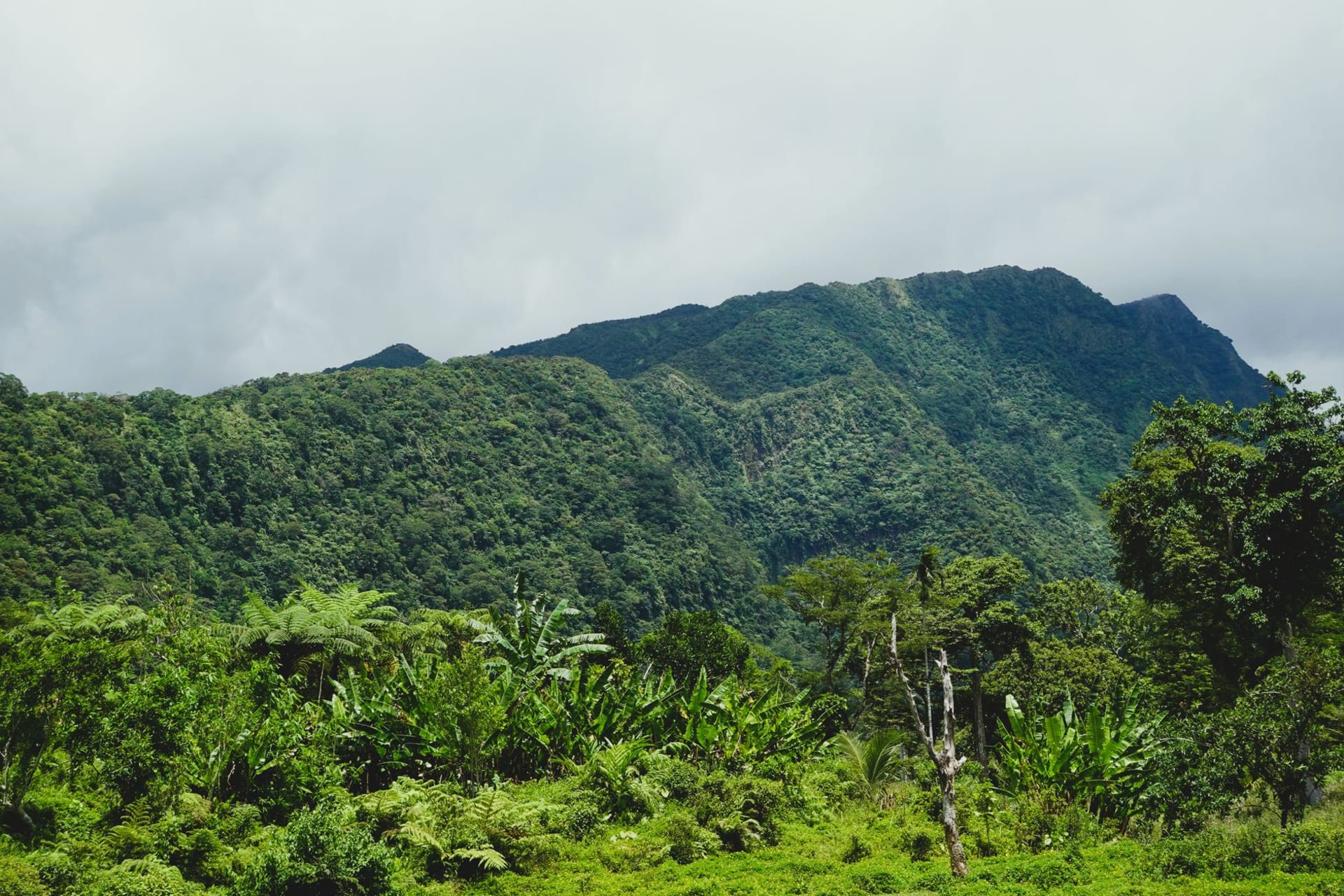
Mount Liamuiga
"The Kalinago called it the Fertile Land. Standing inside the crater, looking down at the lake, you understand why."
Mount Liamuiga is the kind of name that rolls around in the mouth. I had to ask three times how to pronounce it — lee-ah-MOO-ee-gah — and the third time the taxi driver taking me toward the trailhead at Belmont Estate laughed in a way that suggested he had given this pronunciation lesson before. The mountain was called Mount Misery by the British for three centuries, which tells you something about the colonial imagination. Liamuiga — the Kalinago name meaning “fertile land” — was restored after independence. That restoration matters.
The trail starts in former sugarcane land, then moves quickly into the lower rainforest. The vegetation on Saint Kitts’ windward slopes holds moisture in a way that makes everything intensely green — not the decorative green of a garden but the layered, competing, relentless green of a tropical forest that has had centuries to become itself. Heliconias, tree ferns, mahogany trees with canopies wide enough to create their own light. The soil underfoot is dark and rich and loose, and the roots that cross the trail are the kind that snap ankles if you are not paying attention.

At around 600 meters, the forest changes. The trees become shorter, the cloud begins, and the moss takes over — covering every surface, making the upper forest feel padded and muffled, like a room that absorbs sound. The crater rim, when you reach it after about three hours from the trailhead, reveals suddenly: you step from dense forest onto a ledge and there below is a perfect volcanic crater, roughly 300 meters across, with a small green lake at the bottom and steep walls dropping away from where you are standing.
I climbed down into the crater using ropes fixed to trees at the rim — it is steep enough to require them. The lake is cool, the water slightly mineral-smelling, surrounded by vegetation that has colonized the inner walls since the last eruption, which geologists date to around 1692. The silence inside the crater is complete in the way that enclosed spaces at high altitude sometimes are. There were birds calling in the rim forest above and the sound reached down into the crater distorted, as if from a different room.

Going back up the crater walls takes more out of you than going down. The summit of the rim at 1156 meters is the highest point in Saint Kitts, and on a clear day the view extends across most of the northern Leeward Islands. I got partial cloud, which was still more than enough.
When to go: January through April for the best weather windows, though cloud arrives regardless of season. Hire a guide from Belmont Estate or through a local tour operator — the trail requires navigation, and the ropes at the crater rim need someone who knows the route. Bring hiking boots and expect to be thoroughly wet by the time you are back at the trailhead.