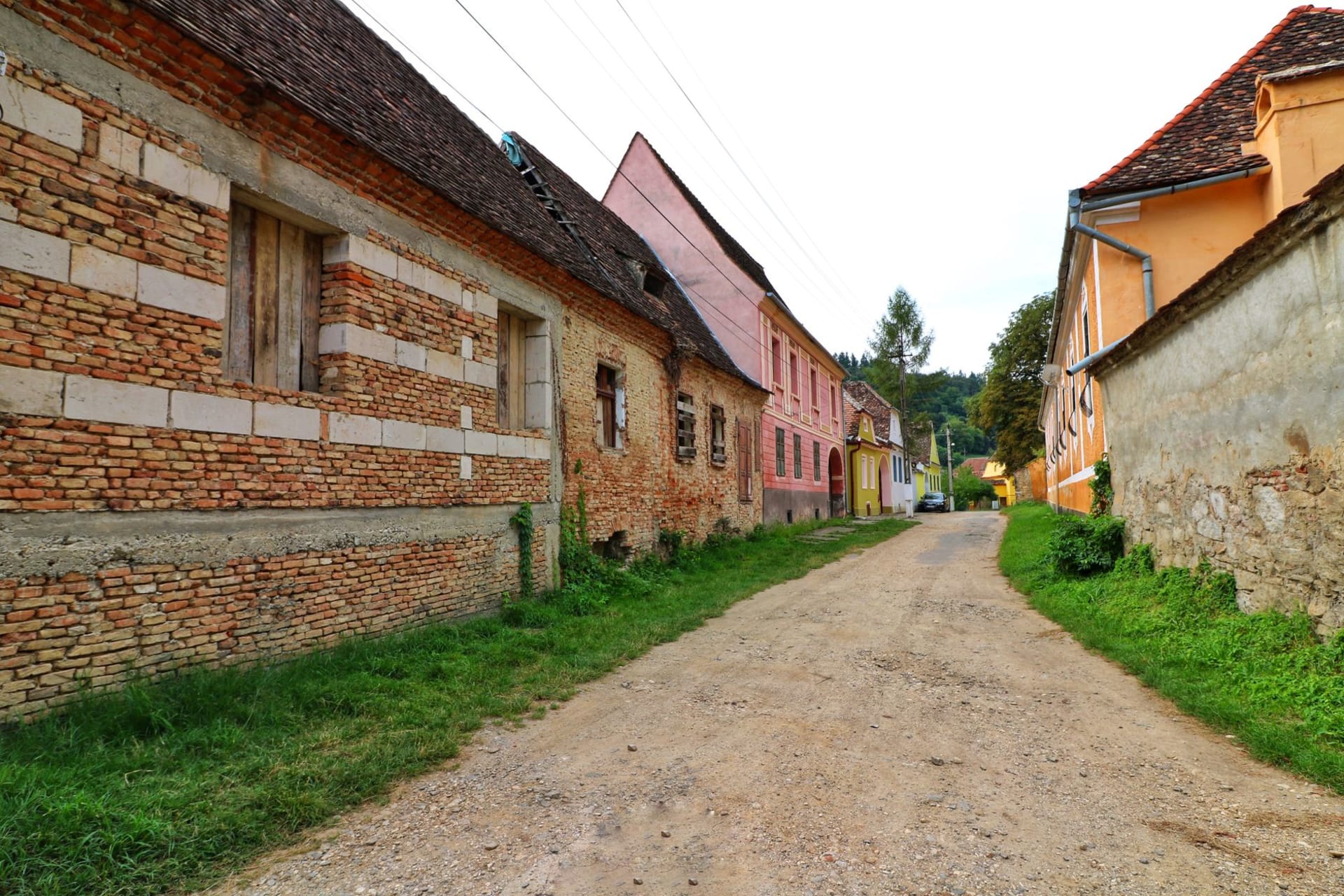
I will tell you the thing about Sibiu that no guidebook quite prepares you for: the roofs have eyes. All across the old town, the steep tiled roofs are punctured by narrow, hooded dormer windows shaped exactly like half-closed eyelids, and the effect, especially after a glass of Transylvanian wine, is that the entire city is watching you with sleepy suspicion. Lia spotted them first, pointed up, and then we couldn’t stop seeing them. It is the single most charming and faintly unsettling architectural quirk I’ve come across in Europe, and it set the tone for a town I now rank among my favorites on the continent.
A German city in Romania
Sibiu — Hermannstadt to the Saxons who built it — is one of the great surprises of Transylvania. Founded by German settlers in the 12th century, it was for centuries the most important city of the Transylvanian Saxons, a wealthy guild town of merchants and craftsmen, and it still looks and feels distinctly Central European rather than Balkan. The signs are bilingual. The architecture is sober, prosperous, Germanic. After the fall of communism most of the remaining Saxons emigrated to Germany, leaving the town a little hollowed out, but a major restoration ahead of its 2007 turn as European Capital of Culture brought the old center back to a glow.
The heart of it is three linked squares stepping down a hill. The Piața Mare, the Large Square, is vast and ringed with pastel facades and the Baroque bulk of the Brukenthal Palace, which holds one of Romania’s oldest and finest art collections. Below it, the smaller Piața Mică huddles around the Council Tower, and from there the streets tumble down to the lower town through arched passages.

The bridge and the lower town
My favorite corner was the Bridge of Lies — a small iron footbridge, the oldest of its kind in Romania, where local legend says the structure will collapse if anyone standing on it tells a lie. Naturally Lia made me stand in the middle and account for the cost of a leather jacket I’d bought in Florence and slightly misrepresented. The bridge held. I maintain this proves my innocence; she maintains it proves only that the bridge is made of iron.
The lower town, reached down stepped lanes and under those arched passages, is a different and quieter world of small workshops, cobbled streets, and crumbling stucco — the working town beneath the merchant grandeur of the upper. We had goulash and a dark local beer in a vaulted cellar there, and I watched the light go amber on the old walls through a window and thought, not for the first time on this trip, that Romania is wildly underrated.

Going, practically
Sibiu sits in central Transylvania and makes an excellent base — it’s an easy drive to the fortified Saxon churches of the surrounding villages and the start of the spectacular Transfăgărășan mountain road. The old town is compact and entirely walkable. Come in summer for the squares at their liveliest, or December, when one of Romania’s best Christmas markets fills the Large Square. Climb the Council Tower for the view over those watching roofs — and try to keep your conscience clear on the Bridge of Lies.