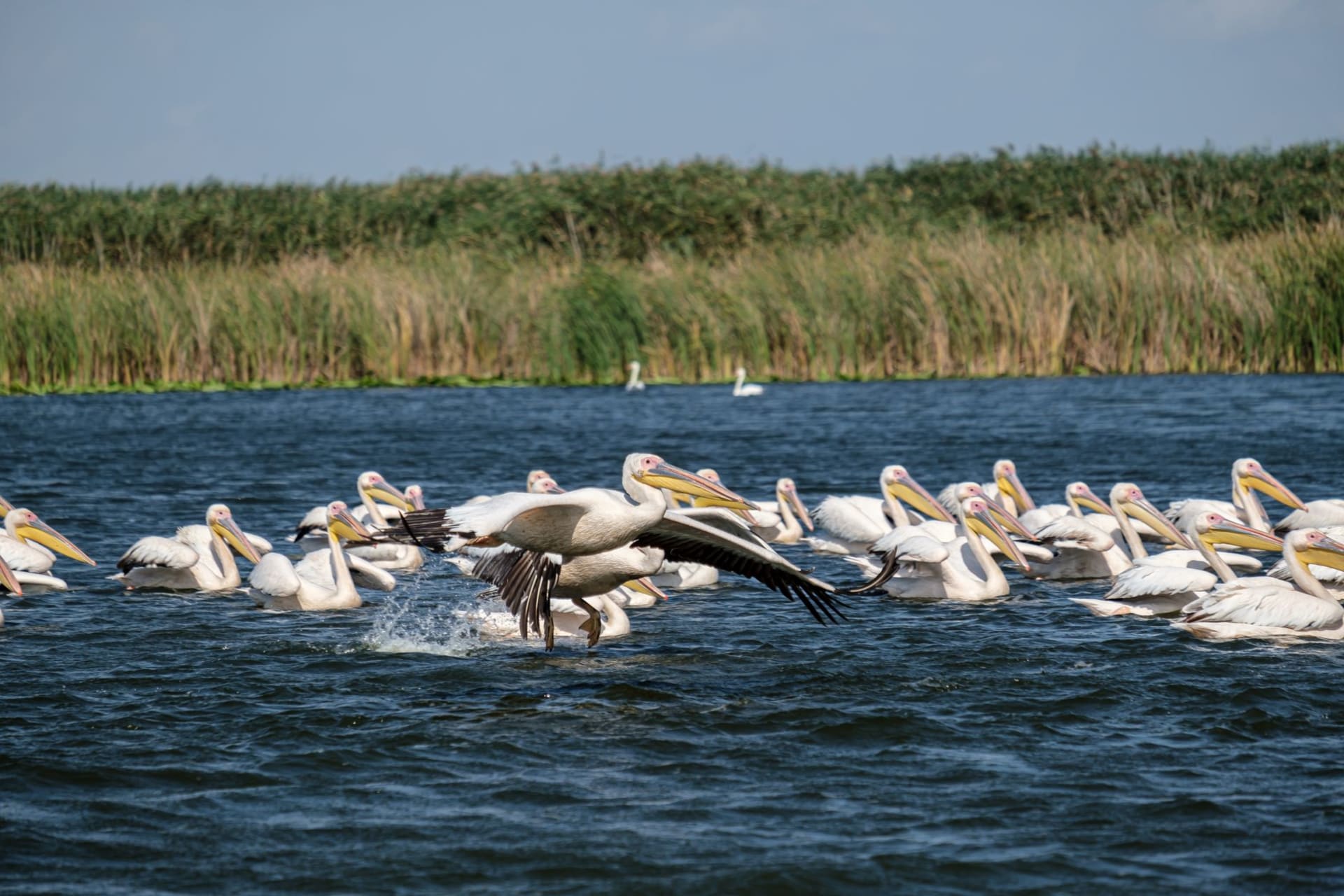
Where Europe's greatest river meets the Black Sea in a labyrinth of channels, floating reed islands, and the continent's richest birdlife.
I arrived in Tulcea on a Tuesday afternoon with mud on my boots before I’d even reached the water. The port city sits at the edge of the delta like a waiting room — unremarkable on its own, electric with what it promises. From the quay, wooden fishing boats and slower tourist pontoons push off into the Bratul Sulina, the main navigable arm of the Danube, and within twenty minutes the last cell tower disappears and Europe as I know it simply ends.
A World Built on Water
The delta doesn’t behave like land. The ground shifts underfoot, whole islands of compacted reeds drifting imperceptibly season to season. The villages — Crisan, Mila 23, Sfantu Gheorghe — are reached only by boat, their houses painted the pale blue and mustard yellow that seems to belong to a different century. In Crisan I ate borș de pește, a sour carp soup sharp with lovage, at a wooden table that leaned slightly toward the river as if the house itself was listening to the current. The soup came with a hunk of mamaliga, the dense polenta that anchors every meal in the delta, and a small glass of palinca the owner poured without asking.
The smell of the delta is specific and impossible to mistake: reed pollen, black mud warmed by afternoon sun, diesel from the boat engine cooling in its housing. It catches in the back of the throat in a way I found myself missing the moment we left.
Birds Without Number
I am not a birder. Lia packed a field guide as a joke, or half a joke — by the second morning she was holding it with genuine concentration. The Danube Delta hosts over 300 species, and the colony at Rosca-Buhaiova is one of the largest white pelican breeding grounds in the world. We watched them from a flat-bottomed barca paddled by a guide named Costel, who spoke no French and minimal English but communicated everything necessary by the angle of his head and a kind of reverent quiet he imposed on the boat without ever asking for it.
The unexpected thing was not the pelicans. It was the pygmy cormorants — small, almost awkward birds I’d never heard of — drying their wings on a dead willow not three meters from the hull. Close enough to see the iridescent green of their feathers.
The Stillness That Changes You
There’s a particular silence in the delta after the engine cuts — not empty silence but layered, full of reed warblers and distant herons and water moving against the hull. It resets something. I spent a long time just sitting with it.
When to go: Late April through June for peak birdwatching during breeding season, and again in September when the summer crowds thin and the light turns amber and low across the channels.