Bucharest
"Bucharest is not yet finished, and that unfinished quality is exactly what makes it fascinating."
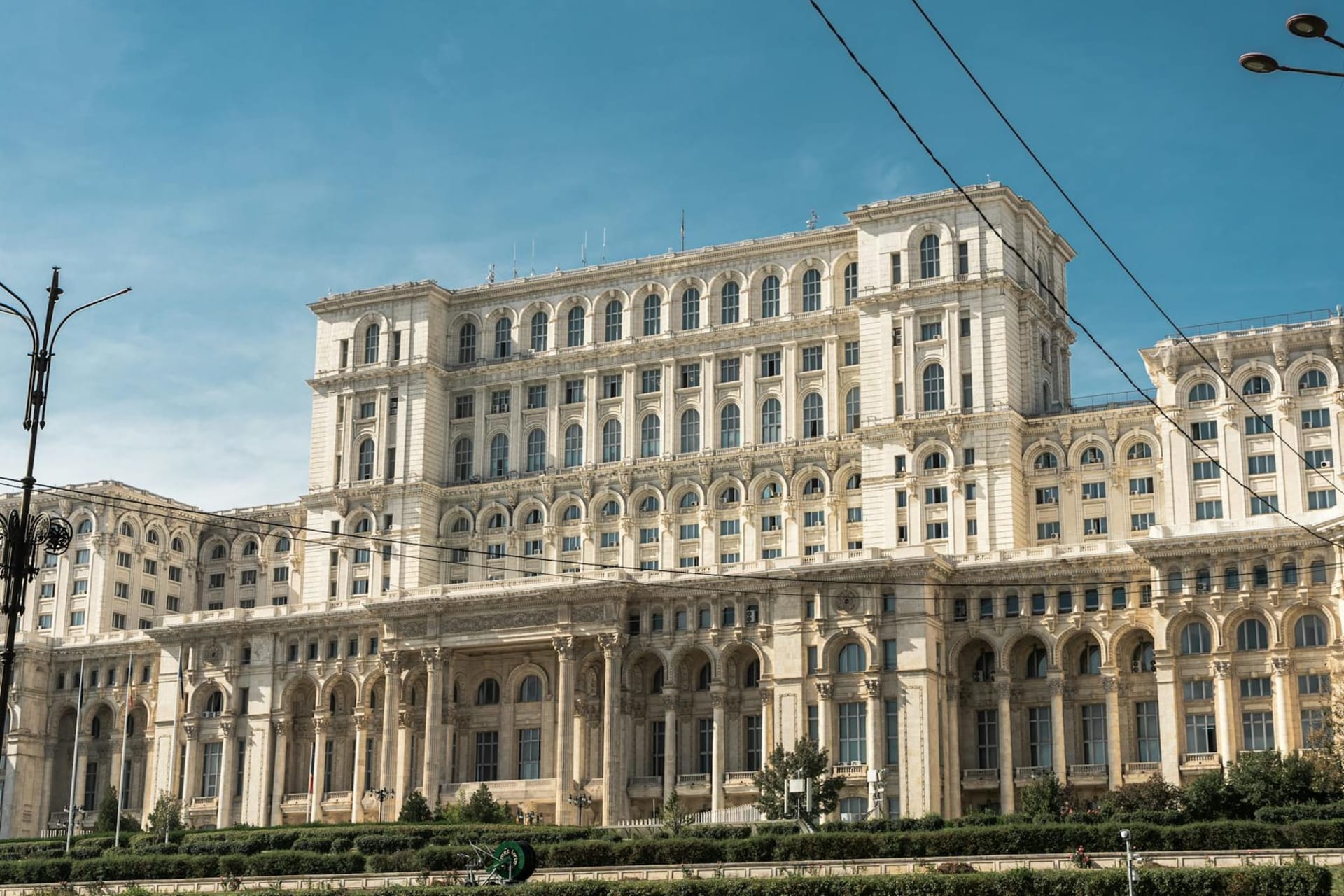
A city of radical contrasts — Belle Époque mansions crumble beside Ceausescu's megalomaniac Palace of Parliament in a capital still becoming itself.
I did not expect to feel fond of Bucharest so quickly. Cities that have suffered — really suffered, the kind of suffering that rewrites skylines and reshapes people — often hold you at arm’s length for a while. Bucharest let me in by the second afternoon.
The Weight of the Palace
Nothing prepares you for the Palace of Parliament. You turn a corner on Calea 13 Septembrie and the thing simply materializes: twelve stories of marble and contempt, the second-largest administrative building on earth, built by a dictator who leveled an entire historic quarter — monasteries, houses, a hill — to place it there. Lia stood beside me on the esplanade and said nothing for a long moment. That silence felt like the right response. The scale is not impressive so much as it is a kind of argument, and a disturbing one. Inside, chandeliers the weight of small aircraft hang above corridors nobody fully uses. The excess is so complete it circles back around to something almost poetic.
Belle Époque Underneath
Walk north toward Calea Victoriei and Bucharest becomes something else entirely. French-influenced facades from the 1890s line the boulevard, their wrought-iron balconies sagging slightly, paint gone chalky in the Wallachian sun. This was once called the Paris of the East, and you can still feel the aspiration embedded in the stonework even where the plaster is crumbling. I found a cafe on Strada Brezoianu with a pressed tin ceiling and ordered a tuica — the local plum brandy — before noon, which felt entirely appropriate. It arrived warm, which I did not expect, and tasted of woodsmoke and something fermented at the bottom of autumn.
The surprise that stayed with me longest, though, was the food market at Piata Obor on a Saturday morning. I had read nothing about it. We stumbled in looking for coffee and found instead an enormous covered hall dense with vendors selling smoked telemea cheese wrapped in cloth, jars of raw honeycombs, bundles of dried lovage, and whole roasted sunflower heads. An elderly woman pressed a slice of cozonac — the braided sweet bread — into my hand without asking. It was the best thing I ate in Romania.
A City Mid-Sentence
What Bucharest does not do is resolve. The renovation scaffolding goes up and comes down without obvious progress. A modernist block sits between two restored mansions like a gap in a smile. There is construction noise and then silence and then construction again. I found this quality — the city mid-sentence — genuinely energizing rather than frustrating. It is a place still deciding what it wants to be, and that openness gives it a vitality that finished cities sometimes lose.
When to go: May and early June bring mild temperatures and the linden trees in flower along the boulevards, filling the air with a heavy, almost narcotic sweetness. September is equally good — golden light, lower crowds, and the outdoor terraces still full well into the evening.