The Deutsches Eck — the German Corner — is where two great rivers meet: the Moselle arriving from the west with its Luxembourgish waters, the Rhine running south to north in its gorge, and at their confluence a sharp promontory of land where an equestrian statue of Kaiser Wilhelm I stares across the water with the certainty of someone who has never been wrong about anything. The statue is a reproduction (the original was destroyed in 1945 and replaced in 1993), and it is impractically large. But the geography beneath it is the real thing: standing on the promontory between the two rivers, you can watch both currents merge, the Moselle’s green water visibly darkening as it joins the Rhine’s grey-blue, the line between them remaining distinct for a hundred meters downstream before the colors finally blend and forget themselves.

Koblenz is a proper city — population one hundred and thirteen thousand — which distinguishes it from every other stop on the Middle Rhine and brings its own pleasures. There are department stores and traffic lights and Starbucks, yes, but there is also the Altstadt: a compact quarter of restored Baroque buildings around the Jesuitenplatz and the Florinsmarkt, where the weekly market spreads across the square and the cheese vendor will give you three samples before beginning to expect a purchase. The city was almost entirely destroyed in the Second World War and rebuilt with care in the postwar decades, which shows in the architecture — it is old in form but young in execution, a quality that takes some adjustment.
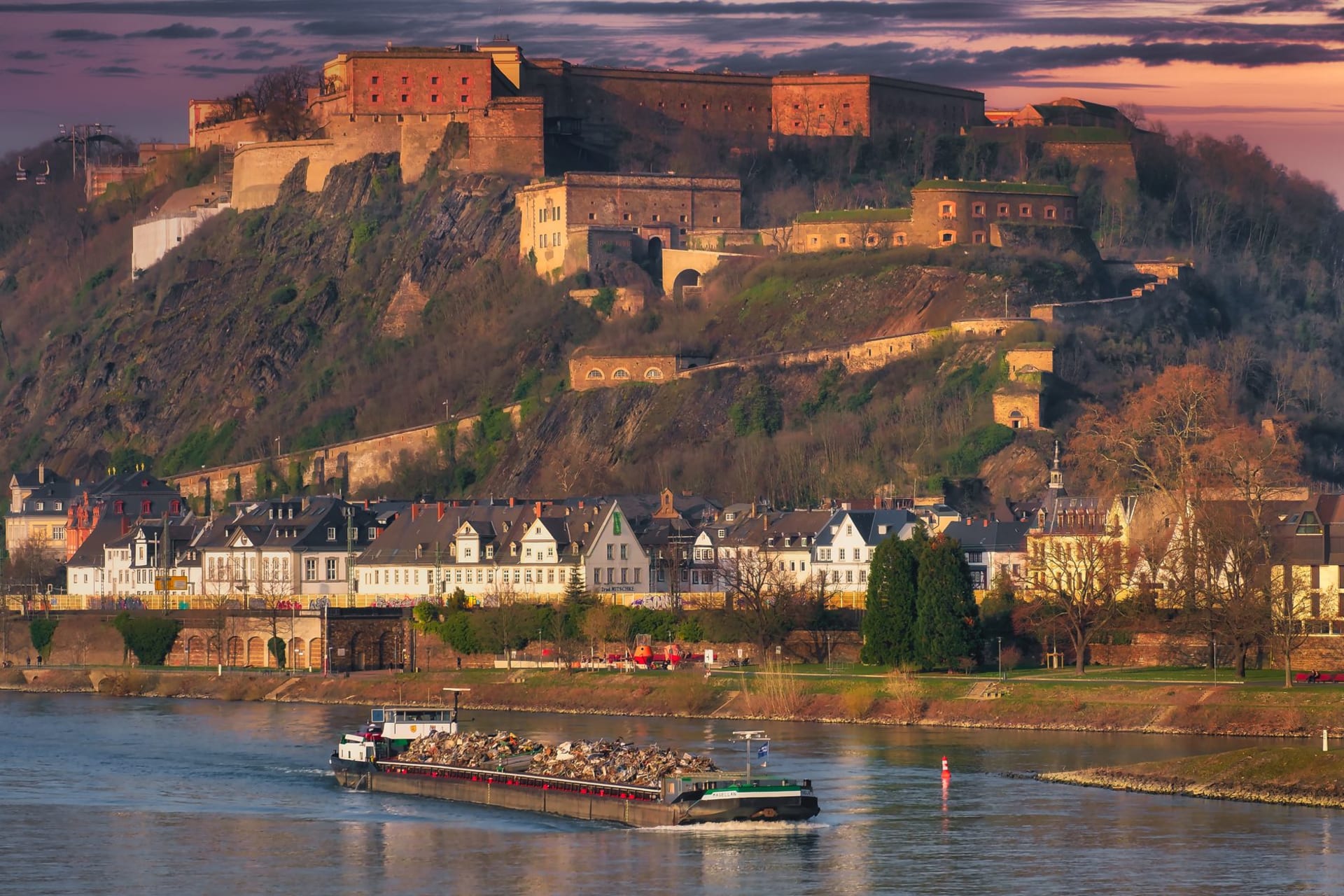
Ehrenbreitstein Fortress, on the opposite bank and accessible by cable car, is the largest preserved fortress in Germany and sits at an elevation that makes the Koblenz skyline look like a scale model below. The cable car crossing above the Rhine confluence is one of those prosaic transit solutions that turns out to be quietly spectacular: four minutes of suspended air above the meeting of two rivers, with the gorge opening south and the Moselle valley bending west, and the city below going about its business without particularly noticing you.

In the old town, a Weinwirtschaft near the Liebfrauenkirche was serving Mosel Spätburgunder by the glass alongside a Flammkuchen topped with smoked trout and crème fraiche. The couple at the table next to mine appeared to be in the middle of a detailed, earnest, and ongoing debate about whether they preferred the Moselle or the Rhine as a wine region. This being Germany, I assumed they had been having this debate for some time and would continue until both rivers ran dry. I ordered another glass and did not interrupt them.
When to go: Early October brings harvest festival atmosphere to the Altstadt. May is excellent for the cable car and fortress without the cruise-ship crowds. The Christmas market in December is one of the Rhine’s more atmospheric ones — find the stand serving Riesling-spiked punch rather than the synthetic Glühwein, and the whole thing becomes considerably better.