Piton de la Fournaise
"The volcano erupts because it hasn't finished building the island."
One of the world's most active volcanoes — hike to the crater rim and watch the island still being born.
We left Bourg-Murat before dawn, the car thermometer reading eleven degrees — which on a tropical island felt like a provocation. Lia had the window cracked anyway. The Route du Volcan climbs through silver forest and then above the treeline entirely, depositing you at the Pas de Bellecombe-Jacob parking area while it’s still dark enough to see Orion tilted at an unfamiliar angle over the caldera edge. I stood there with bad coffee from a thermos and felt, for the first time in a long while, appropriately small.
The Enclos Fouqué
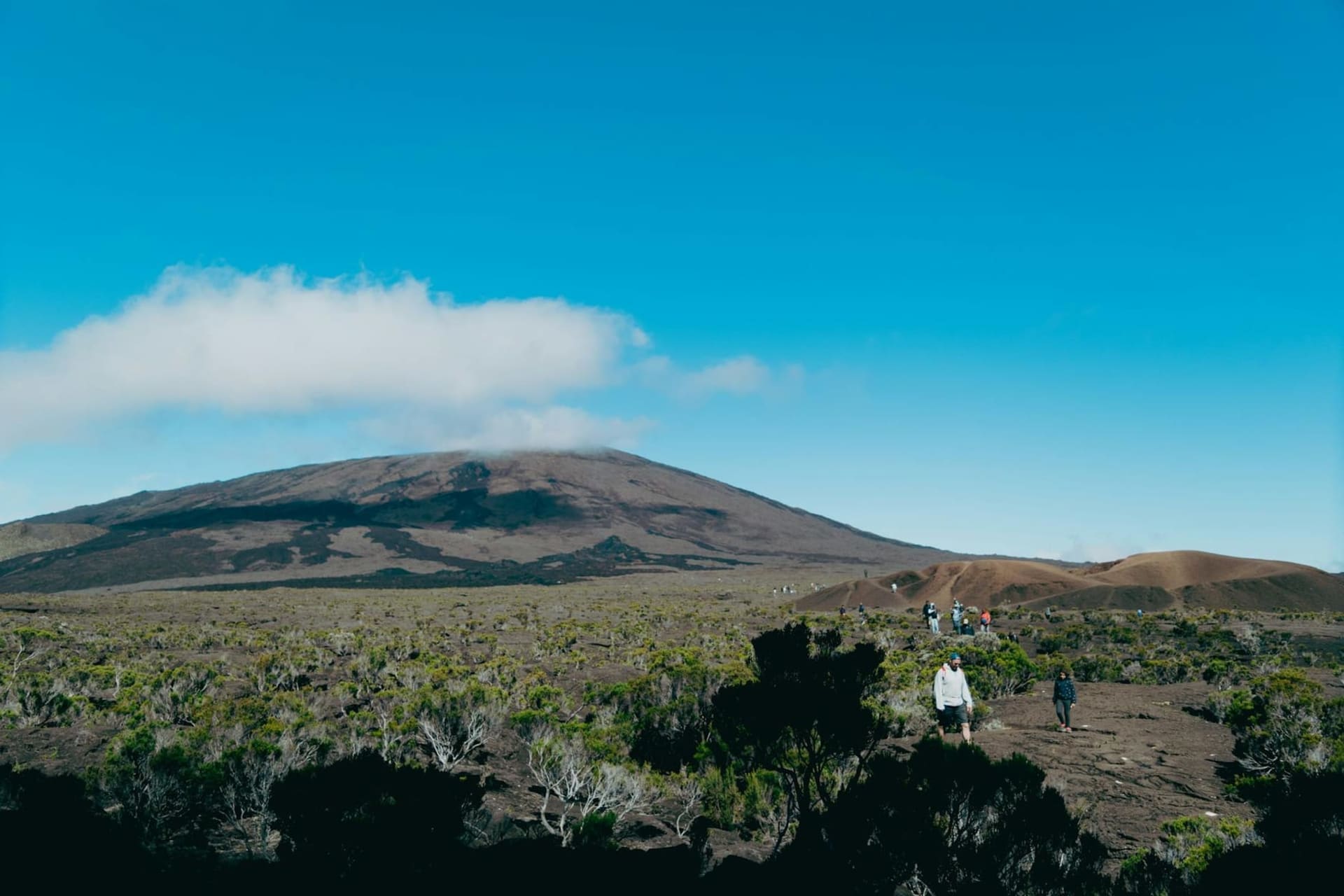
The descent into the Enclos Fouqué caldera is the strangest walk I’ve taken anywhere. From the belvedere, you drop five hundred steps carved into the cliff wall, and then you’re on the caldera floor — a vast plain of hardened lava stretching several kilometers, moonscape-grey in the early light, broken by rope-lava coils and pressure ridges and the occasional cairn marking the trail. The rock underfoot makes a hollow sound when you step wrong. Nothing grows. The wind carries sulfur in small, sharp doses.
The trail to the summit crater — the Cratère Dolomieu — runs roughly two hours across this floor, climbing steadily over older eruption fields where the lava has oxidized into reds and rusts. I kept stopping to look back at the caldera walls, at the way the cloud rolled along the rim but never dropped in. The sky inside the Enclos is always different from the sky outside it. It’s its own atmosphere.
What the Crater Sounds Like
I hadn’t expected sound. I expected the visual spectacle — the yawning pit, the scale — but not the low, sub-audible thrum that I felt in my sternum before I consciously heard anything. Standing at the edge of the Cratère Dolomieu, which measures roughly one kilometer across and drops two hundred meters, there’s a persistent vibration. Gas venting from fumaroles along the inner walls. The volcano breathing.
The crater rim was the unexpected thing. I’d imagined it raw and unstable, a place you approached cautiously and left quickly. Instead, Lia and I sat on solidified lava at the edge for nearly an hour. The wind shifted, and for a few minutes the sulfur was so sharp it stung the eyes. Then it would clear, and the depth of the pit would snap back into focus, and neither of us said much.
After the Descent
By the time we climbed back out of the Enclos and reached the Gîte du Volcan on the plateau, the afternoon clouds had moved in — standard Réunion behavior. We ate rougail saucisse from the gîte kitchen: smoked sausages in a tomato-tomato sauce with a heat that sat in the back of the throat and didn’t leave. I had a second portion. The hike earns it.
The road back to the coast drops two thousand meters in forty kilometers, passing through tree heather, cryptomeria forest, and the thermal mists of the Plaine des Cafres before the island turns tropical again and the sugarcane begins and you can smell the ocean. It took the full descent for my legs to remember what flat ground felt like.
When to go: May to November, during Réunion’s dry season, offers the most reliable summit visibility. The volcano erupts irregularly — check the Observatoire Volcanologique du Piton de la Fournaise website before planning the caldera hike, as access is closed during active eruptions.