Dahab
"The Blue Hole has killed more divers than it should have and it still draws a crowd every morning — there is something almost honest about that."
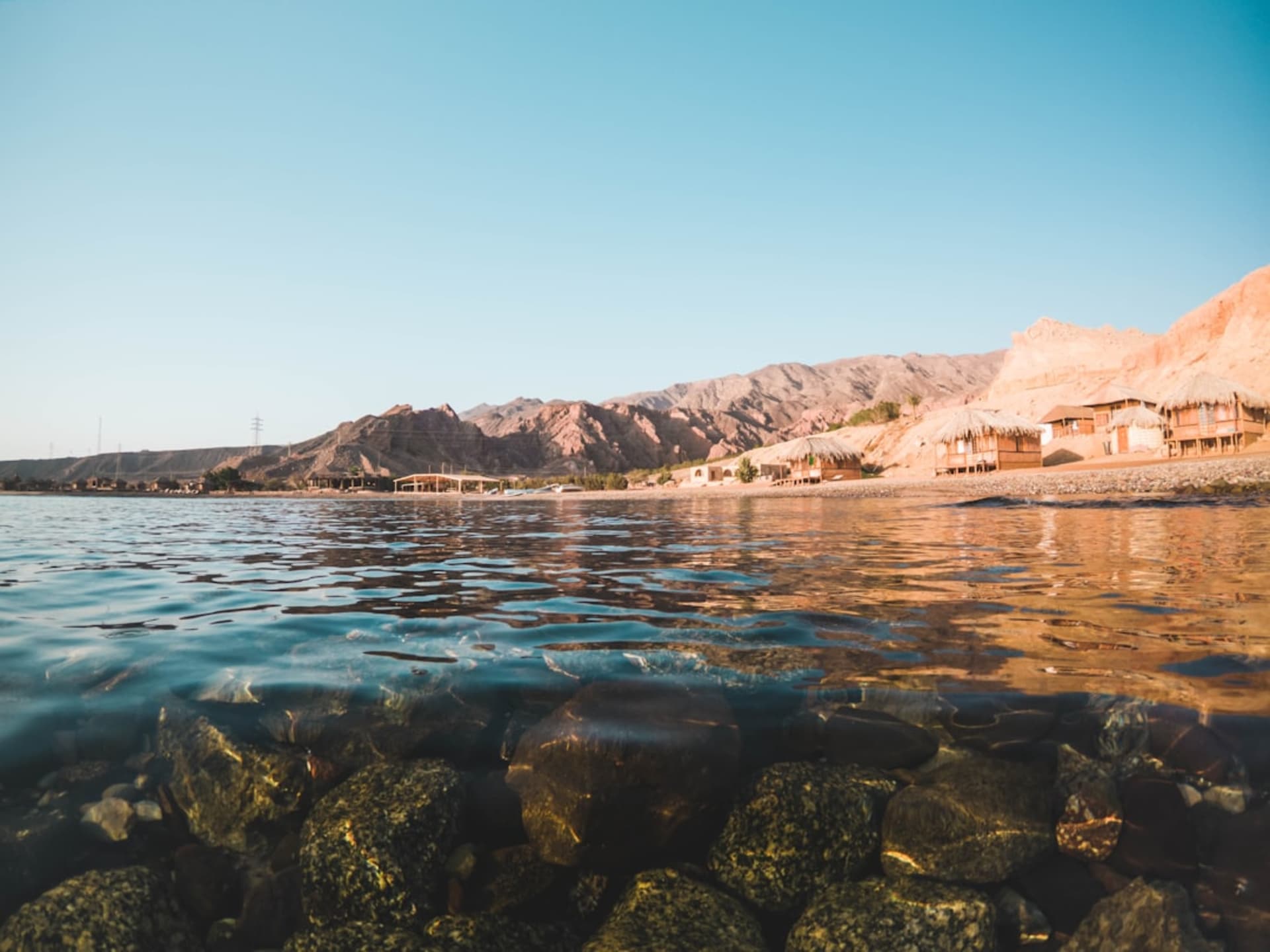
I arrived on the evening bus from Sharm, which deposits you at a roundabout with no particular ceremony, and walked toward the water with my bag still on my back. The promenade came into view gradually — a long string of cushioned platforms right at the sea’s edge, low tables, people eating grilled fish with their shoes off, the Gulf of Aqaba going from orange to deep violet. A cat crossed in front of me with the unhurried indifference of an animal that has never once worried about accommodation. I found a cushion, ordered a tea, and did not move for the better part of two hours.
Dahab operates at a frequency that is difficult to explain if you have only experienced the beach resort model. There are no all-inclusive compounds here, no lobby piano bars, no swim-up drink service. What there is instead is a former Bedouin fishing village that absorbed a generation of European backpackers in the 1980s and never quite recovered — which is to say, it became something genuinely its own. The dive shops are run by Egyptians who have been doing this for thirty years, the restaurants serve slow-cooked lamb and stuffed vine leaves alongside the inevitable banana pancake, and the afternoon light on the Sinai mountains across the water turns them a colour I have only seen in Rajasthan.

The Blue Hole is fifteen minutes north by pickup truck, and you go because you have to, because not going would be a kind of failure of nerve. It is a submarine sinkhole — sixty-some meters in diameter, one hundred and thirty meters deep — ringed by a coral arch at twenty-six meters that has claimed the lives of overconfident freedivers and technical divers for decades. I am a recreational diver with no death wish, so I stopped at the arch, hovered there for a moment looking down into a blue that gets darker and then just stops being visible, and came back up to drink weak coffee at the café above the hole. The café is exactly where it should be: perched on the cliff, plastic chairs, a view that renders all interior decoration irrelevant.
The rest of the reef system running through town — the Canyon, the Lighthouse — offers world-class wall diving without the psychological theatre of the Blue Hole. At the Lighthouse site, two minutes into the water from shore, you drop past coral fans bigger than dining tables, through clouds of anthias, past lionfish posed on ledges with the studied casualness of creatures who have never needed to hurry. I did four dives in two days and none of them were the same dive.

In the evenings I ate at whatever restaurant had fish displayed outside that looked fresh — usually some variation on red snapper grilled whole over charcoal, served with a plate of Egyptian salad (chopped tomato and cucumber and parsley, nothing else needed), and bread that came out of the oven warm. The tea was always too sweet, which I stopped fighting after the first day. The nights were warm enough to sit outside until midnight, which is what everyone did.
When to go: March through May and September through November give you warm water (around 24°C), good visibility, and air temperatures that do not punish you for leaving the sea. Summer (June–August) reaches forty degrees — the water stays fine but the afternoons are genuinely brutal. Winter brings wind off the mountains that locals call a blessing; divers often prefer it for the clarity.