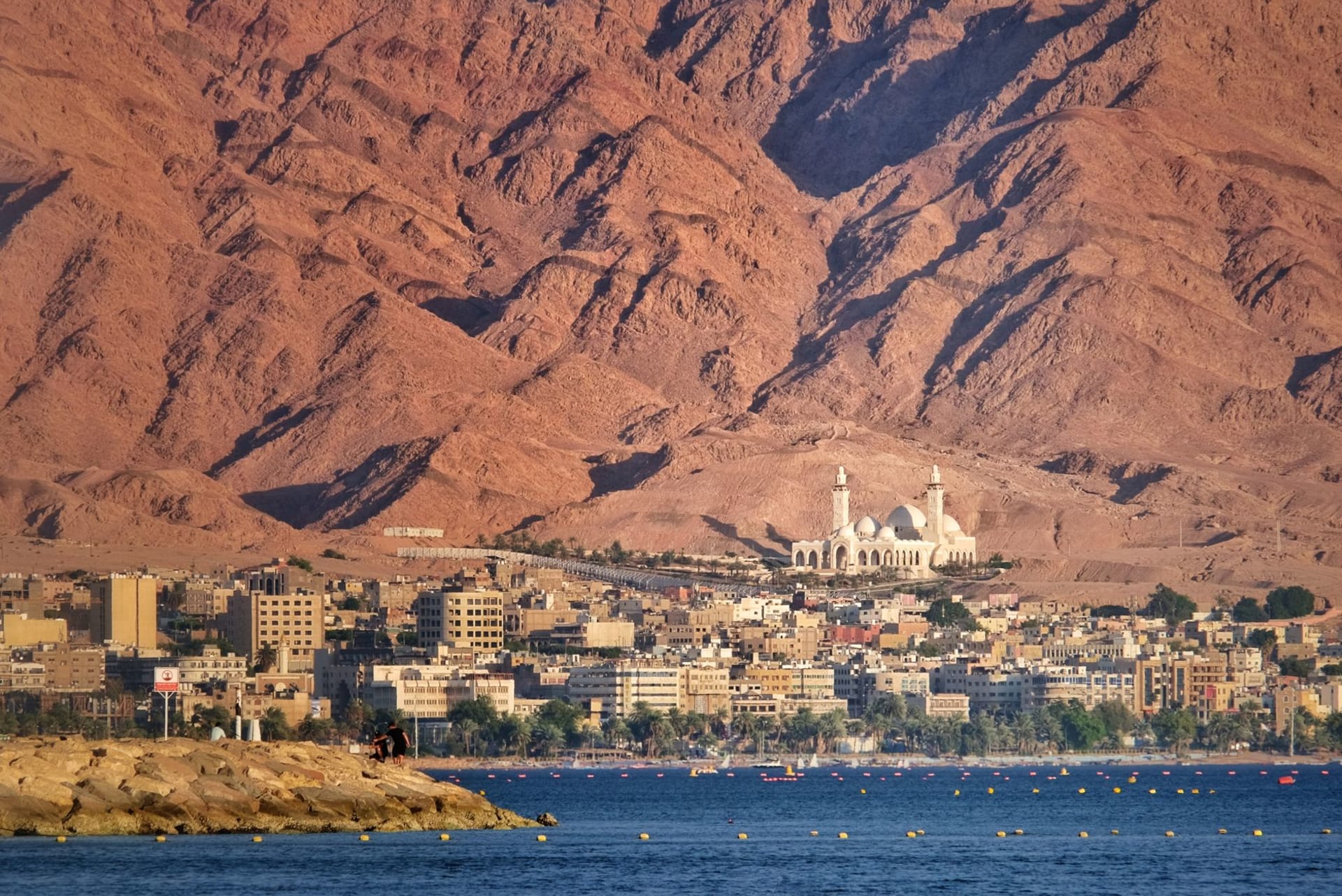
Aqaba
"Four countries share this patch of water, and somehow it still feels like the quietest corner of the Middle East."
I came to Aqaba on the fast ferry from Nuweiba, which is an experience in miniature: you leave an Egyptian port, cross thirty kilometers of water, and arrive in Jordan, having transited the Gulf of Aqaba in two hours. The ferry terminal on the Jordanian side is functional and unhurried, the immigration officers politely bored, and within forty minutes of docking I was walking along the Aqaba corniche eating a man’ouche from a street cart, the Gulf glittering to my right, the hills of Saudi Arabia visible to the south. This is the geography of Aqaba: impossibly compressed, four countries in one field of vision, the Middle East at its smallest.
The city itself is more modest than its strategic position suggests. It is working-class and unhurried, with a market district that sells everything from spices to outboard motor parts, a pleasant corniche lined with palms, and a castle — the Mamluk fort rebuilt by the Ottomans — that sits in the center of town with the air of something that has survived long enough to stop worrying about the present. The old center has cafés where men play backgammon, fruit sellers who will peel an orange for you while you wait, and a general atmosphere that feels Levantine rather than Gulf — human-scaled, locally oriented, unconcerned with international tourism.

The diving is, in the context of the Red Sea, genuinely underrated. The reefs south of town are accessible directly from shore — you wade in from the beach, put your face down, and within a few minutes the coral begins. What Aqaba’s reef lacks in the sheer wall drama of Ras Mohammed it compensates for in variety: the Cedar Pride, a Jordanian navy vessel deliberately sunk to create an artificial reef, now lies at twenty meters covered in soft coral and inhabited by schools of lionfish and grouper who have decided the wreck constitutes a permanent address. The Japanese Garden site, named by early divers for its intricacy, packs an improbable number of species into a relatively small area.
What I keep returning to, though, is the view from the beach. Stand on the public beach at the south of town and look across the water: to the west is Nuweiba and Egypt, to the southwest is Saudi Arabia, and to the north the Israeli city of Eilat is visible — its hotels lit in the evenings, the mountains behind it purple in the afternoon. Jordan, Egypt, Israel, Saudi Arabia, all within a few kilometers of each other, sharing one warm blue-green sea. The political complexity of the region becomes, from this vantage point, almost geometrically small.

In the evenings I ate in the restaurants along the main street south of the fort — mansaf (lamb with rice and dried yogurt sauce, the Jordanian national dish, served on enormous communal platters), grilled chicken from rotisseries that had been turning since morning, and the local fish, hammour, which is grouper, prepared simply with garlic and lemon. The tea is sage tea here, not mint, and it takes some adjustment before it becomes what you want at the end of the day.
When to go: October through April for comfortable temperatures and good diving visibility. July and August are brutally hot — Aqaba sits in a bowl of desert and heat accumulates. Winter (December–February) brings cool evenings and almost no other tourists, which is when the city feels most like itself.