Udaipur
"The City Palace at dawn from a boat on Pichola — some views make you feel like you've stumbled into a painting that hasn't dried yet."
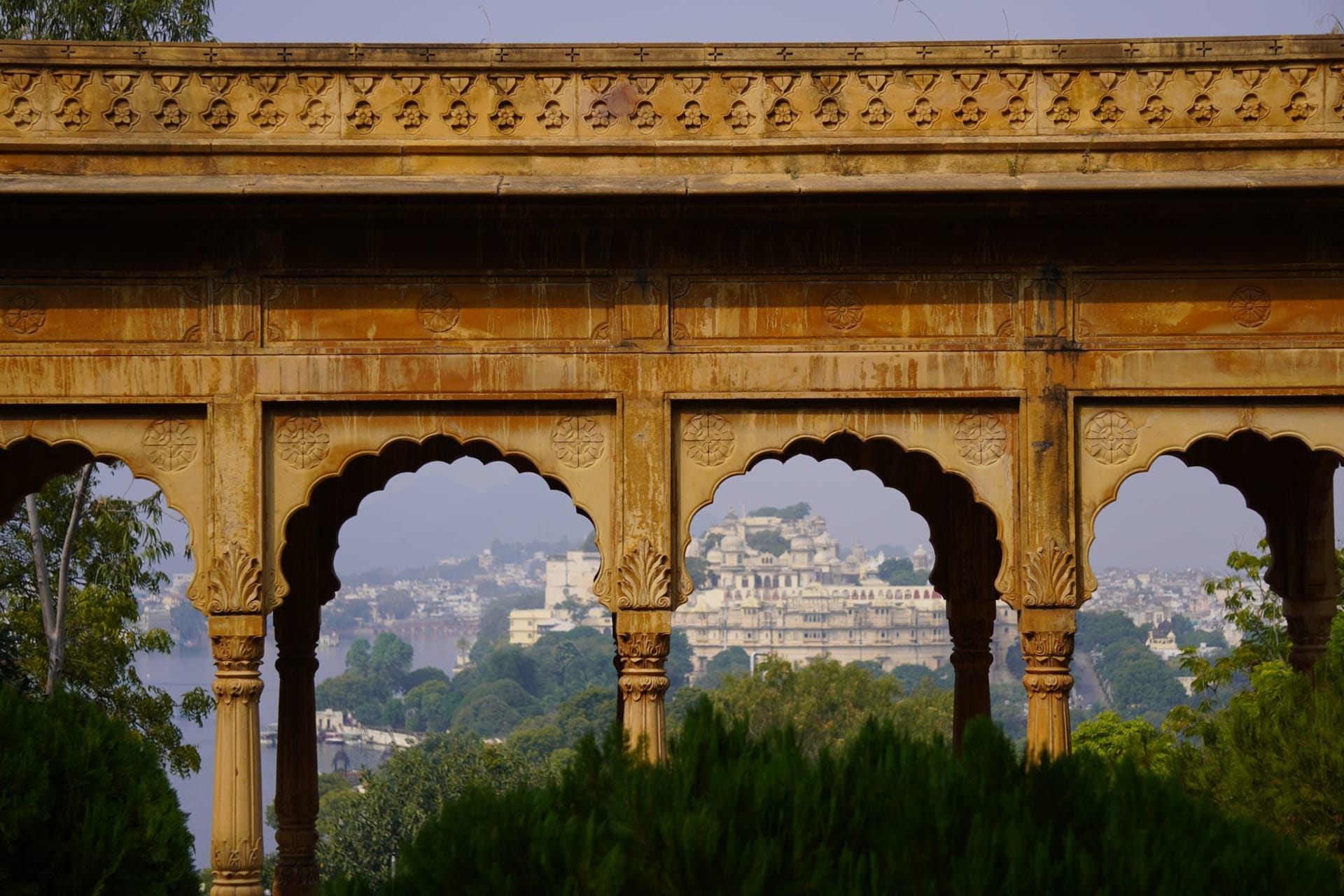
A boatman took me out onto Lake Pichola at six in the morning and the whole city came into view slowly, the way a photograph develops. The City Palace rose from the eastern shore in graduated terraces of white and honey-yellow stone, its silhouette reflected with almost photographic accuracy in the water below. There was no wind. The Lake Palace — a marble wedding cake of a building marooned in the middle of the lake — appeared gradually through the morning haze. I had seen photographs of this view so many times that I half-expected to be disappointed. I was not. There is a particular quality to Udaipur’s light in those early hours, milky and diffuse, that makes everything softer than it ought to be for a city made mostly of stone.

The old city pressed close against the lake’s eastern shore is a very different world from the lakeside views. The lanes around the Jagdish Temple — a 17th-century Vishnu temple at the top of a flight of fifty steep steps — are dense with copper sellers, flower stalls, fabric shops where bolts of printed cloth lean against doorways. The smells change every ten meters: incense giving way to fresh marigolds giving way to the warm oil of a street food cart. The temple itself is always busy, the chanting audible from the street below, a rhythm that the rest of the neighbourhood seems to absorb and re-emit. I went in twice and felt the same thing both times — a kind of organised devotion that looked entirely effortless from the outside.
Outside the city walls to the north, Saheliyon Ki Bari — the Garden of the Maidens — was built for the royal ladies of the court and is something of an anomaly in Rajasthan, a garden designed around water and shade rather than military positioning or religious architecture. Marble elephants stand at the corners of the central pool, lotus-shaped fountains ring the walkways, and in the late afternoon the place fills with families and couples and children who treat it as exactly what it is: a beautiful garden in a hot city, worth visiting for no more complicated reason than that.

Evenings in Udaipur belong to the Ambrai Ghat, where dhows float tethered to iron rings and the restaurant tables extend almost to the water’s edge. I ate grilled fish from the lake and dal makhani and watched the City Palace light up as darkness came. It is one of those dinners that has nothing technically extraordinary about it and yet sticks in memory simply because the backdrop was so unreasonably good.
When to go: October through March is the comfortable window. The monsoon (July to September) floods the lake to full and turns the surrounding hills an electric green — beautiful if you don’t mind rain, and the city is dramatically less crowded. Avoid April and May when the heat arrives in earnest.