Shekhawati
"Somewhere in Nawalgarh there is a painting of a steam locomotive done by a man who had only heard one described. It is unexpectedly accurate."
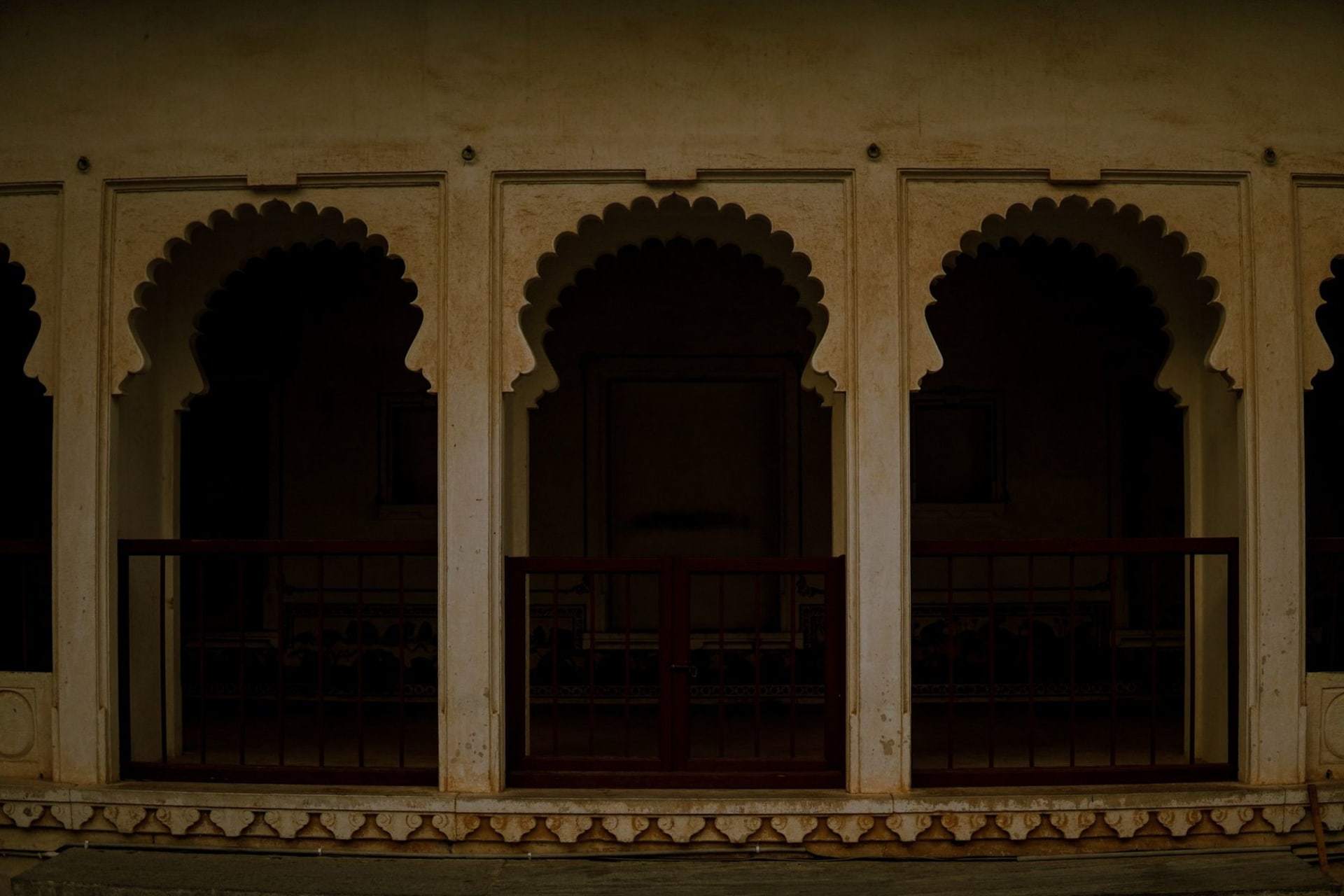
I rented a car and drove into the Shekhawati region without a specific itinerary, which turned out to be exactly the right approach. The area covers a loose triangle of semi-arid land between Sikar and Jhunjhunu, and the villages — Mandawa, Nawalgarh, Fatehpur, Dundlod — are connected by roads that run through flat land planted with mustard and millet and seem, to a first-time visitor, completely unremarkable. Then you arrive in a village and the walls begin. Every significant haveli in these towns, and there are hundreds of them, is covered from ground to roofline in frescoes painted during the 19th and early 20th centuries by the Marwari merchant families who made their fortunes in trading routes that passed through this corner of Rajasthan.

What makes the frescoes remarkable is not just their survival (many are fading but most remain legible) but what they chose to paint. Alongside the expected mythological scenes — Krishna and Radha, scenes from the Ramayana, gods on their vehicles — there are images of the modern world as it was understood by painters who had largely not seen it themselves: early automobiles with exaggeratedly large steering wheels, telegraph poles with wires running between them, European women in Victorian dress, steam locomotives painted with the confidence of someone working from a description rather than an observation. In the Morarka haveli in Nawalgarh I spent twenty minutes looking at a painting of a gramophone that its creator had clearly never encountered in person, the horn wildly disproportionate, the operator depicted with an expression of rapturous surprise. It is folk art doing its best with modernity, and the result is frequently more interesting than technically accurate.
Between villages I stopped at a dhaba — a roadside kitchen — where the cook served a thali from a blackened pot of dal that had been simmering since before I arrived and would still be simmering after I left. There were two kinds of roti, a dry vegetable sabzi, and pickles. I ate everything and drank three glasses of chai and paid almost nothing and sat there for a while longer than necessary because the light was good and the road was empty and there was no particular reason to hurry.

The best way to understand Shekhawati is as something between a museum and a living neighbourhood — the havelis are mostly private or semi-private, some abandoned, some still occupied, many in various states of upkeep. The Nawalgarh area is most accessible and the frescoes best preserved. Mandawa has been more heavily touristed and has a functioning heritage hotel inside a haveli that makes an excellent base.
When to go: November through February, when the desert is clear and cool. The mustard fields flower in December and January and turn the landscape between villages vivid yellow — one of the better backdrops in Rajasthan that nobody talks about.