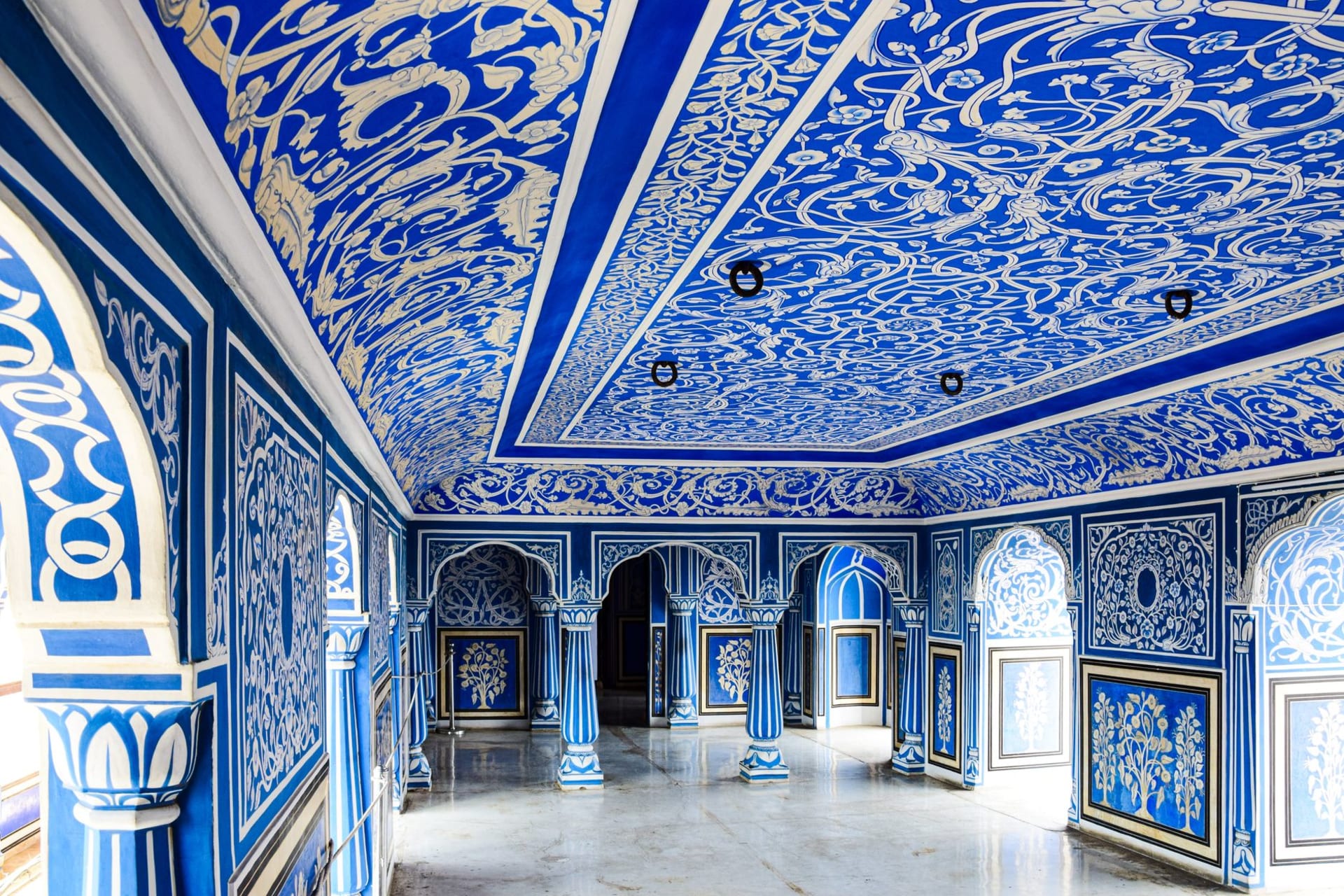
Jaipur
"The Jantar Mantar instruments are so large and so strange that you forget, briefly, they are measuring something as simple as time."
Everyone calls it the Pink City but the colour, when you arrive by road, is more accurately a deep terracotta — a warm, almost russet shade that the old city’s buildings were ordered to paint in 1876 for the visit of the Prince of Wales and apparently decided to keep permanently. I came in from the south on an early morning, and the walled city was already dense with noise: cycle rickshaws and tuk-tuks and the braying of a mule somewhere behind a wall, the whole place in motion before eight o’clock with an energy that feels less like tourism and more like a city that simply cannot help being alive.

The Amer Fort, eleven kilometres outside the city up a dry Aravalli hillside, is where Jaipur’s ambitions become clearest. The approach road winds up from a small lake and the fort reveals itself in sections — first the outer walls, then the main gate, then the succession of courtyards leading to the Sheesh Mahal, the Mirror Palace, whose ceiling is tiled entirely with tiny convex mirrors so that a single candle flame multiplies into what looks like ten thousand stars. I stood inside with my phone torch lit and turned slowly, watching the reflections scatter and regroup, and understood why the Mughal emperors were so fond of the device. The Jantar Mantar observatory in the city proper is a different order of spectacle — nineteen enormous stone instruments for tracking astronomical time, built in the 1720s by Maharaja Jai Singh II, who was apparently dissatisfied with existing tools and decided to build his own at monumental scale. The largest sundial, the Samrat Yantra, is twenty-seven meters high and accurate to two seconds. I read that figure and then stood at the base of the thing and tried to imagine the precision of thought required to build a calendar out of stone.
The old city’s bazaars exist on their own terms, indifferent to the tourist circuit happening a few streets away. The Johari Bazaar is all jewellery — silver and gold and semi-precious stones arranged in cases that line both sides of the street — while the Bapu Bazaar runs in textiles: block-printed cotton, tie-dye, the distinctive Jaipur blue pottery in turquoise and white. I spent an afternoon in a block-printing workshop in the old city, watching craftsmen press carved wooden blocks into fabric with a rhythm so practiced it looked effortless, and left with three meters of cloth I had no plan for and haven’t regretted buying.

The dal baati churma that the parent article mentions as a kind of ideal — I ate my best version of it here, in a small thali restaurant near the Hawa Mahal where the baati came straight from the clay oven, split open and drowned in ghee, and the dal was the colour of autumn leaves and tasted of something you couldn’t quite name but wanted more of immediately.
When to go: November through February is optimum — dry, clear, and manageable. The Jaipur Literature Festival in January is a genuinely extraordinary event if you’re in the country, bringing writers from across the world to one of Rajasthan’s grandest settings. Avoid April through June; the heat in Jaipur is more intense than the desert because the city holds it differently.