Jean-Talon Market
"Jean-Talon Market is where I finally understood how seriously Quebec takes its farms."
North America's largest open-air market and the best argument I know for why Montreal's food culture doesn't need Old Montreal's restaurants to prove itself.
A Montrealer friend of a friend told us not to bother with the touristic Marché Atwater and go straight to Jean-Talon instead, in Little Italy, and it was the single best piece of advice we got in the whole trip. The market occupies a huge open-air plaza ringed by permanent shops — cheesemongers, butchers, a proper Italian grocer, a spice merchant with sacks open to the air — with the seasonal farm stalls filling the centre under a lattice of steel awnings that let the light through in stripes. We went on a Saturday morning in August and the produce was almost aggressively abundant: heirloom tomatoes in six colours, corn stacked in pyramids, plums from orchards an hour outside the city, all of it priced for locals rather than tourists, which after a week of restaurant menus felt like a genuine relief.
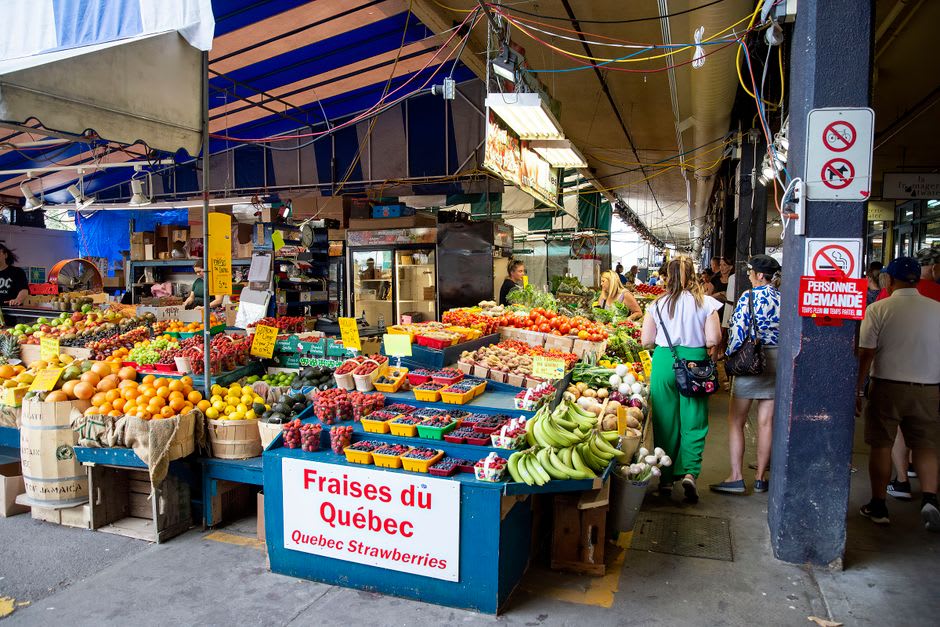
The market sits at the seam between Little Italy and Villeray, and that geography shows up in the vendors — alongside the classic Quebec farm stalls selling maple products and root vegetables, there are Italian delis with cured meats hanging in the window, a Portuguese fishmonger, and bakeries selling both tourtière and cannoli within a hundred metres of each other. Lia and I built an entire lunch out of the market itself: a wedge of raw-milk cheese from a Charlevoix producer, a baguette from the bakery at the north end, and cherries eaten standing at a barrel that served as a table, the whole thing costing less than a single restaurant starter downtown.
What struck me most was how the market functions as a genuine grocery run for the surrounding neighbourhoods, not a performance staged for visitors. Older Italian women were arguing cheerfully with the vendors about the price of eggplant, a man filled two enormous canvas bags with enough vegetables to last a family a week, and nobody paid us the slightest attention as we wandered slack-jawed through it all with our phones out.
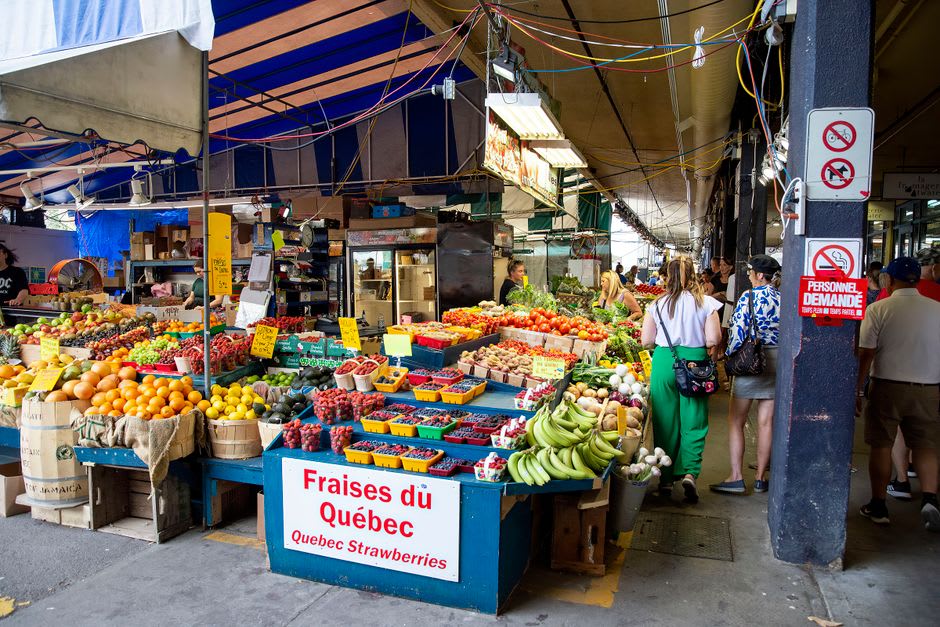
We came back a second time near closing, when the vendors start discounting what won’t keep until Monday, and left with a box of overripe peaches for almost nothing, eaten that same evening leaning over the sink because the juice ran everywhere. That, more than any restaurant meal, is the memory of Montreal food culture I’ve kept most vividly.
When to go: Year-round — it’s open through winter with root vegetables, maple products, and greenhouse produce — but June through October is peak season for Quebec’s fruit and vegetable harvest. Saturday mornings are liveliest; late afternoon on weekdays is quieter and better for genuine bargains.
Keep exploring
More from Québec
 quebec
 Kamouraska
A village so small and so photogenic that Quebec's landscape painters treat it as a genre unto itself — low tide here turns the St. Lawrence into a mile of silver mudflats and driftwood.
Explore quebec
 Knowlton
A boutique village on Lac Brome, known for its ducks, its antique shops, and a main street that rewards slow walking.
Explore quebec
 La Malbaie
A Charlevoix resort town built by wealthy summer visitors over a century ago, still carrying that slightly formal, slightly faded grandeur beside the widening St. Lawrence.
Explore quebec
 La Pulperie de Chicoutimi
The ruined pulp mill on the Saguenay's edge that once made Chicoutimi the paper capital of the world — now a museum complex holding the flood-displaced house of a regional painter.
Explore quebec
 Lac-Saint-Jean
A freshwater sea ringed by sand beaches and blueberry fields, with a culture — and a fish — entirely its own, tucked behind the Laurentians an hour north of the Saguenay fjord.
Explore quebec
 Lake Massawippi
A long glacial lake ringed by Victorian summer estates and quiet forest — the Eastern Townships at their most unhurried.
Explore