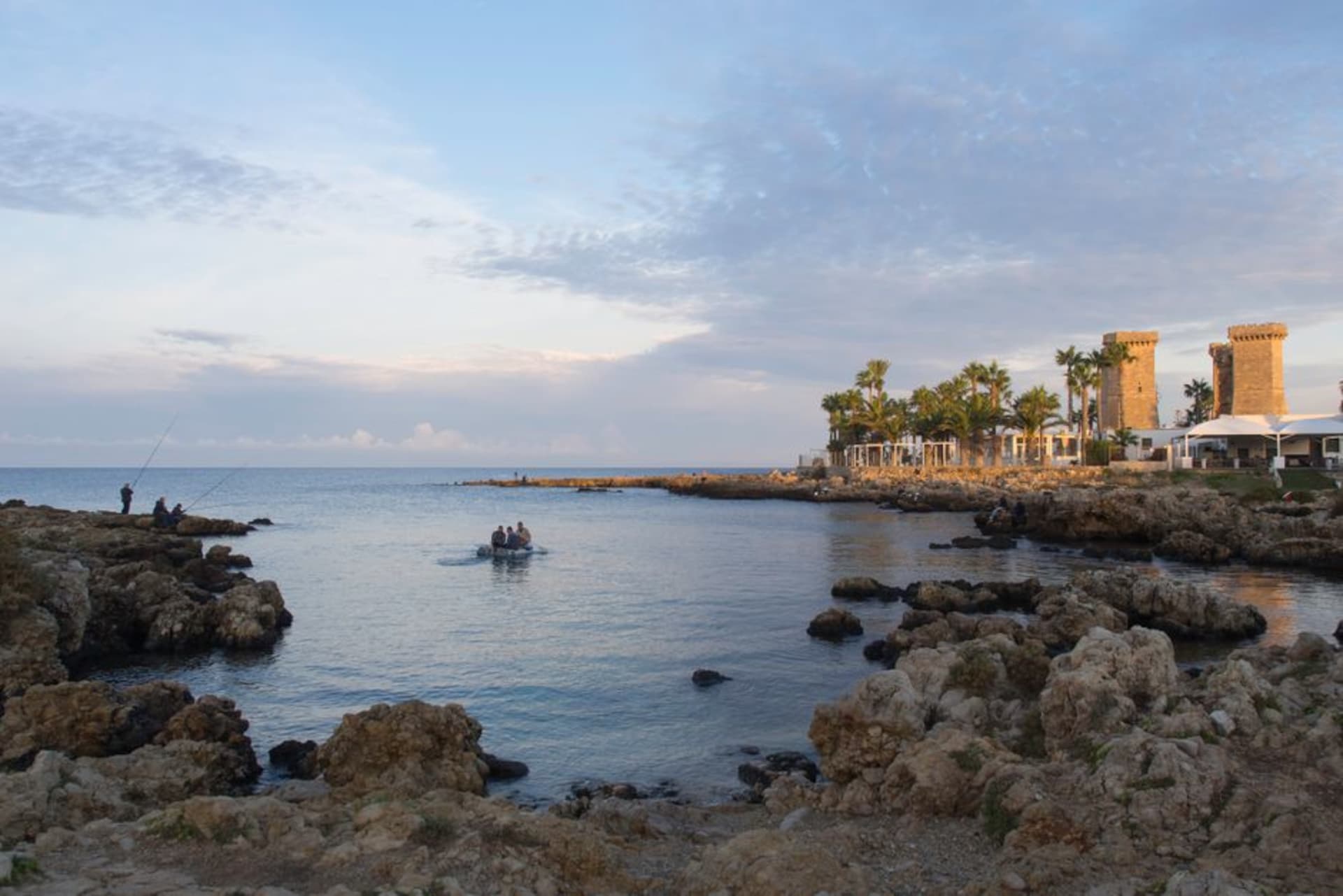
Santa Maria al Bagno
"Santa Maria al Bagno looks like a postcard until you learn what the murals on the seafront are actually about."
A quiet Ionian marina near Nardò with pastel villas, a small rocky harbour, and a set of murals telling a Jewish refugee story most visitors to this coast never hear.
Santa Maria al Bagno announces itself first as one more pretty Ionian marina — pastel liberty-style villas from the early twentieth century lining a small curved harbour, fishing boats, a modest promenade — and it took a set of ceramic murals along the seafront to send us looking into a history we hadn’t expected to find here. Between 1944 and 1947, the town hosted one of the largest displaced persons camps in Italy for Jewish Holocaust survivors awaiting passage to Palestine, and the murals, created decades later by an Israeli artist who had lived in the camp as a child, depict scenes from that period directly on the harbour wall.
We stood in front of them for a long time — a mother and child, a boat crossing, figures rebuilding a life on a coastline that must have looked, to people who had just survived the camps, almost unbearably beautiful and strange. It’s not a story that gets mentioned in most Puglia guidebooks, and the town doesn’t make a large production of it either — no museum, just a modest information panel and the murals themselves, left to speak on their own terms along an otherwise ordinary seafront.
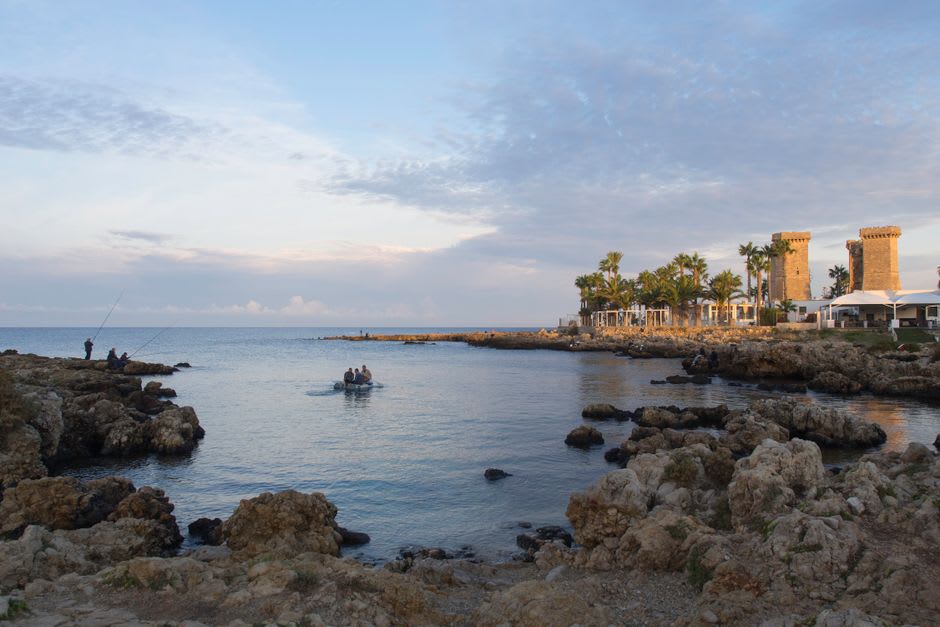
Beyond that history, Santa Maria al Bagno is simply a pleasant, low-key place to spend a few days on the Ionian coast, part of a near-continuous run of small resort towns — Santa Caterina and Sant’Isidoro on either side — that together serve Nardò’s stretch of coastline. The villas here, built by wealthy families from Nardò and Lecce as summer residences in the early 1900s, give the seafront a genteel, slightly faded elegance that’s different in character from the whitewashed cubism of Salento’s more southern towns.
The swimming here is mostly off small rocky platforms and short sandy patches rather than one long beach, which keeps things quiet even in summer — no expansive lido stretch to draw big crowds. We rented snorkel gear from a shop by the harbour and spent an afternoon along the rocks toward Santa Caterina, where a small natural sea stack sits just offshore, before eating dinner at a trattoria on the harbour that served us octopus stewed in a rich tomato sauce that neither of us has quite managed to replicate since.
When to go: June through September for swimming and the full seafront atmosphere; the town is genuinely quiet outside summer, which suits a visit focused on the murals and the villas rather than the beach. Weekday evenings in July and August are lively without ever feeling overwhelmed.