Polignano a Mare
"The cove below the old town has the quality of a dream you can't quite locate — blue and contained and slightly unreal."
There is a terrace in Polignano a Mare overhanging the cliff, a bar with white plastic chairs and a railing at the edge, and from it you look forty metres straight down into water so clear and so layered in blues and greens that the word turquoise — adequate enough word — barely covers it. The limestone cliff face is pocked with caves, the sea moving in and out of them with a sound between a sigh and a percussion. I sat at that terrace for two hours on my first morning with an espresso that went cold, watching a man in a red kayak navigate between the cave entrances below. It was one of those mornings where doing nothing was entirely sufficient as a plan.
The old town of Polignano sits on a promontory of limestone jutting into the Adriatic, and the best approach is the one that delays the view longest — enter through the old stone arch from the landward side, walk the narrow main lane, and the sea appears only in glimpses between buildings before the piazza at the edge opens to the full vertiginous panorama. The town is small enough to walk entirely in twenty minutes, but the twenty minutes keep expanding because the lanes turn into each other and the terraces keep appearing and the sea keeps finding new angles below. Domenico Modugno was born here — the man who wrote “Volare” — and there is a bronze statue of him on the cliff with his arms spread, facing out to sea, the gesture so natural for this place it looks less like a monument and more like someone caught mid-emotion.

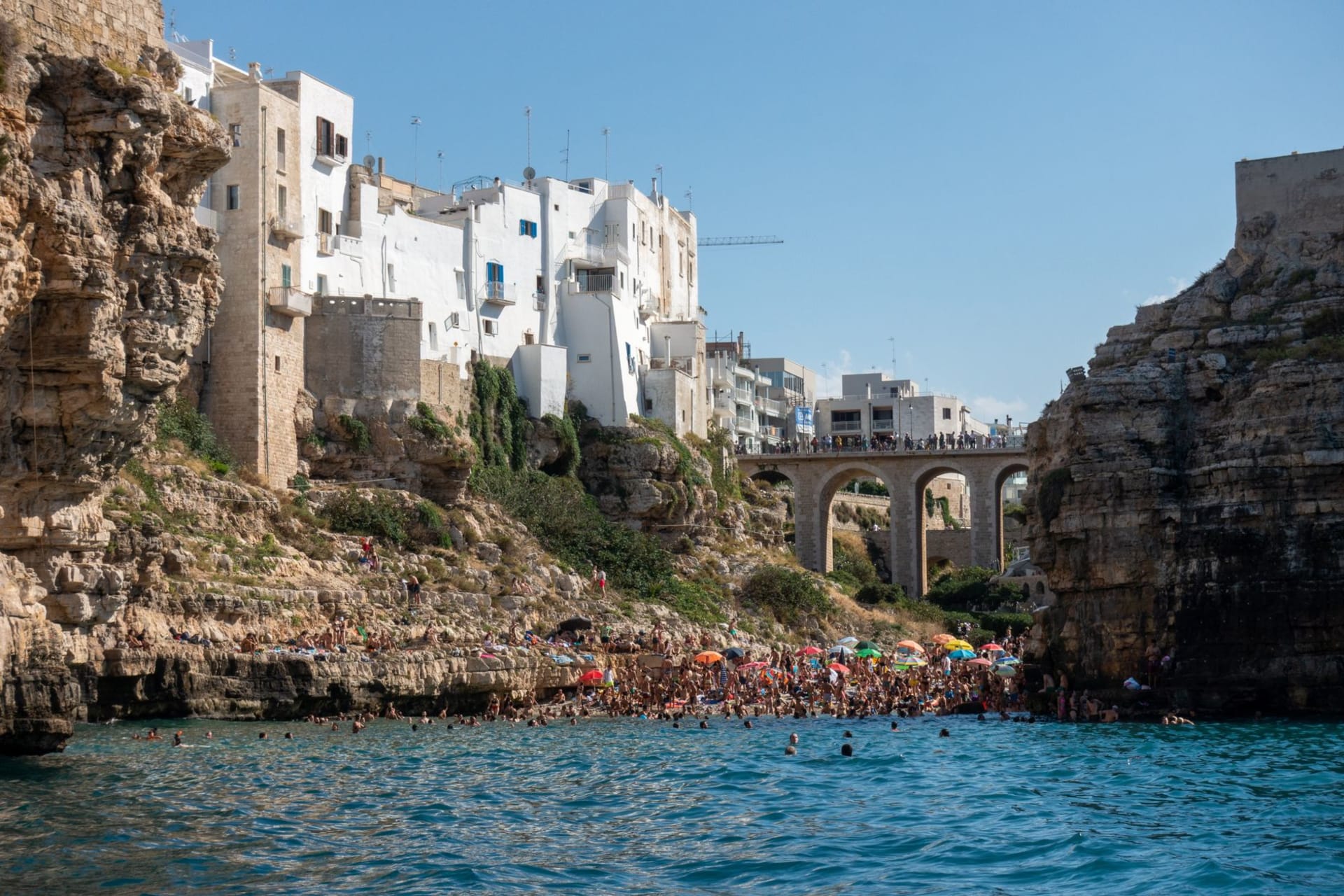
The cove of Lama Monachile, accessible by steps from the old town, is Polignano’s most famous swimming spot and looks almost aggressively photogenic in a way that could feel manipulative if the water were not genuinely that colour. Two limestone pillars flank the beach, the beach is small and pebbly, and in August it is packed with people. I went in October, when the season was technically over but the water was still warm from the summer’s accumulated heat, and I had the cove almost entirely to myself. Swam out far enough to see the cave entrance to the left and turned over on my back and looked at the sky and thought that this is what the south of Italy is for.
The food in Polignano has been elevated considerably by the town’s rise as a destination, but there is still a trattoria near the main square run by a woman of advanced age who brings what she decides you should eat rather than waiting for you to order from a menu that does not exist. I received bruschetta with sea urchin, a plate of raw anchovies dressed in lemon and wild fennel, and orecchiette with a tomato sauce that tasted of something irreducibly summer. She observed from the kitchen doorway with the expression of a person who has decided whether you will enjoy it before you have tasted it.

Further along the coast, walking south on the cliff path, the sea opens up into a series of rocky inlets less visited than the main cove. These require some scrambling to reach and the footing is uneven on wet limestone, but the reward is swimming in water that has no beach chairs nearby and no kayak rental sign above it. The bottom of these inlets is pale stone, the water lit from above into a dozen shades of green, and the silence — once you are in the water with the sound of the sea in the caves replacing all other sounds — is the best kind of silence, the kind with texture.
When to go: Late September and October are ideal — warm water, empty coves, and a town that has returned to itself after the summer crowds. June is also excellent before the peak. July and August the coves are beautiful but busy, the parking is impossible, and the prices climb with the temperature.