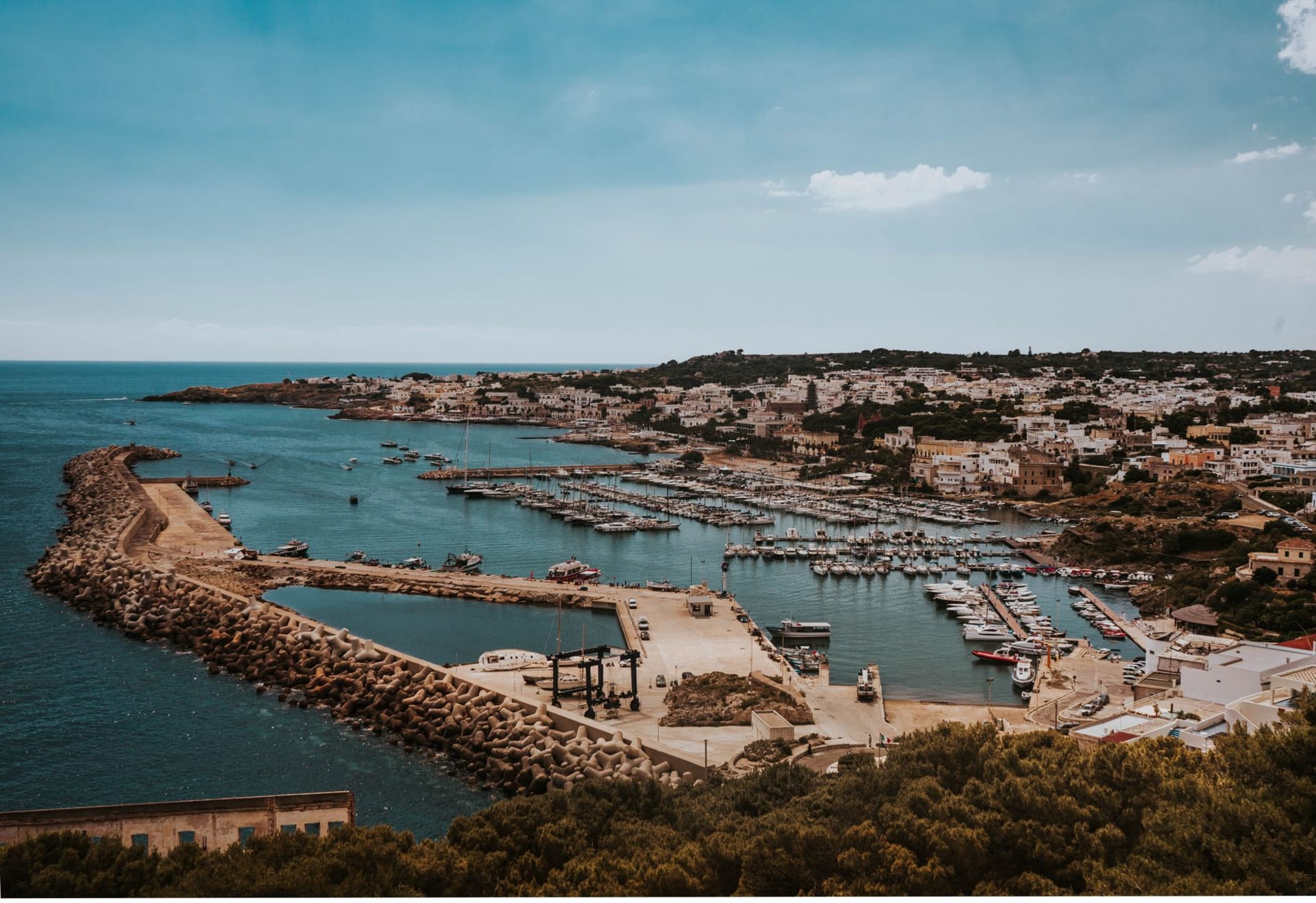
Otranto
"The floor of Otranto cathedral contains the entire medieval world — you walk across Creation every time you enter."
The mosaic floor of Otranto’s cathedral stopped me so completely that I must have stood there for ten minutes before I moved. The entire surface — nave, transept, side aisles — is covered in a twelfth-century narrative in stone: the Tree of Life rising from the central axis, Alexander the Great being lifted to heaven by two griffins, Adam and Eve, Cain and Abel, Diana hunting, the months of the year, fantastic beasts from the margins of the known world, King Arthur, the Tower of Babel, all of it woven together into a single image that functions simultaneously as a floor and as a cosmology. A monk named Pantaleone designed it, and he gave the craftsmen a hundred years of their collective imagination to work with, and the result is a document so dense with meaning that scholars are still arguing about what some of it means. I walked on top of the medieval world for an hour and felt appropriately small.
Otranto sits at the southeastern heel of Italy, the last town before the coast turns the corner toward the Ionian. The harbour faces directly east, toward Albania, visible on clear days as a grey smudge across fifty kilometres of the Adriatic’s deepest water. The crossing between here and Vlorë has carried everything over the centuries — Byzantine influence, Ottoman threat, refugees in recent decades — and the channel has a watchful quality, the sense of a border that is also a history. Standing on the harbour wall at evening, looking east as the light dropped, I felt the full peculiarity of being at the edge of Western Europe.

The old town is walled and small and beautiful, the castle of Alfonso of Aragon looming over it from the south. The Aragonese built it after the Ottoman siege of 1480, which left eight hundred Otranto citizens dead — beheaded on the hill behind the city for refusing to convert — and the skull relics of these martyrs are displayed in glass cases behind the cathedral altar, a fact I did not know going in and discovered suddenly and without preparation, which is probably the right way to encounter something like that. The castle has been restored and hosts exhibitions; the walls are walkable and give views over the harbour and down the coast to where the land curves away.
The water at Otranto is among the clearest on the Adriatic. The beaches north and south of town are long and relatively untouched by development — Torre dell’Orso to the north has a double sea stack called the Due Sorelle, and on the right morning, early, the light through the arches and the reflections in the shallows produce the kind of scene you photograph knowing the photograph will not capture it. I swam from the town beach in late September, the water still warm, the surface glassy, and floated on my back watching the castle on the promontory above.

The town has a rhythm that feels less tourist-formed than some of its neighbours. The daily market near the harbour sells fish brought in by the small fleet that still operates from the port — sea bass, octopus, a variety of small flatfish I cannot name — and the restaurants on the waterfront serve it simply, grilled with olive oil and lemon, without the elaboration that more confident tourist towns tend to apply. I ate swordfish one evening on a terrace facing the water, watching the ferry to Albania load and depart, thinking about how far that shore was and how long people have been crossing back and forth across it.
When to go: May, June, September, and October are the ideal months. The coast north of Otranto becomes genuinely busy in July and August; the town itself handles crowds better than some, but the roads to the beaches clog. The cathedral is worth visiting any time of year — the mosaic floor is indifferent to the season — but the surrounding light and coast are best in the shoulder months.