Martina Franca
"Martina Franca is the Valle d'Itria's grown-up town — less photographed than Alberobello, more architecture per square metre than anywhere else in the valley."
A Baroque hill town at the edge of the Valle d'Itria where the old centro is all curling stone facades, and the capocollo is the best cured meat I have eaten in Italy.
Lia found Martina Franca on a map almost by accident — we had been staying near Cisternino and someone at breakfast mentioned the name with a kind of reverence usually reserved for a secret. We drove over on a Tuesday morning with no plan beyond coffee, and ended up staying until the shops closed for the afternoon and reopened again. The town sits at 431 metres, the highest point in the Valle d’Itria, and the old centro storico curls around itself in a maze of Baroque stone that feels entirely disproportionate to how few tourists were walking through it.
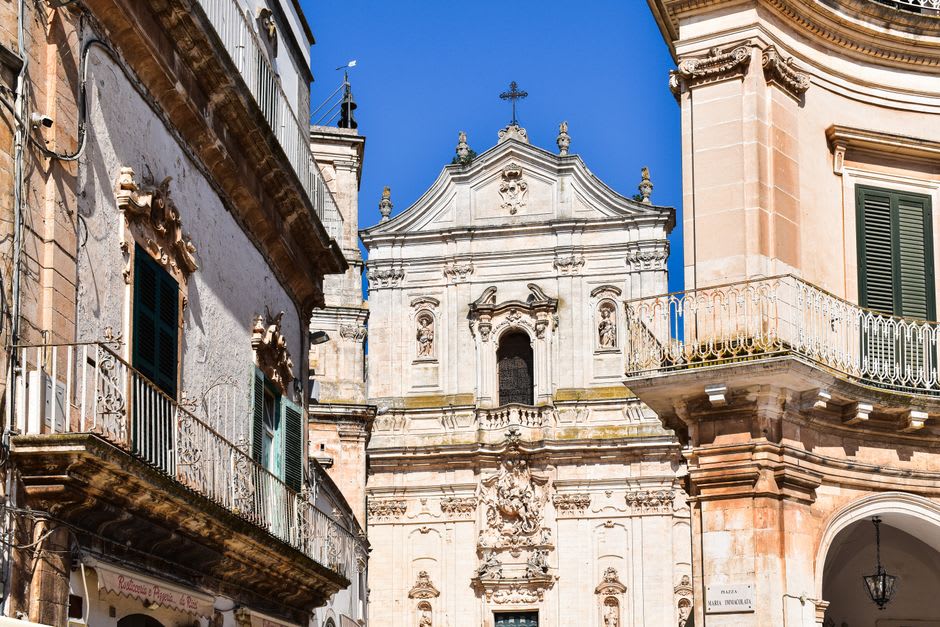
The style here has a name — barocco martinese — and it is a more restrained cousin of Lecce’s exuberant carving, all curved balconies and wrought iron and pale stone facades that catch the light differently depending on the hour. The Basilica di San Martino anchors the highest piazza, its facade busy with saints and garlands, and inside it holds a marble Pietà and a hush that outlasted our entire visit. We wandered the Palazzo Ducale gardens after, an unexpected pocket of green behind an eighteenth-century palace, and Lia pointed out that the whole town felt like it was built by people who had somewhere to be but weren’t in any hurry to get there.
We ate capocollo at a small salumeria near Piazza Roma — cured pork shoulder, smoked over almond shells and aged in local caves, sliced thin enough to see light through it — and I understood immediately why every Pugliese I had spoken to insisted this was the region’s best cured meat, better even than the more famous versions from further north. The owner let us taste four different ages before we bought anything, unbothered that we were clearly not going to buy four different ages. We ate it on a bench in Piazza XX Settembre with bread from the bakery next door, watching the town go through its early-evening errands.
The Fiera del Levante crowd and the Itria Music Festival — an opera and classical festival held every July in the Palazzo Ducale courtyard — bring a different energy in summer, but we caught the town on an ordinary week and preferred it that way. Martina Franca does not perform for visitors the way Alberobello sometimes does; it simply continues being itself, and you are welcome to watch.
When to go: Late spring or September avoid the summer heat and the festival crowds, though the Itria Music Festival in July is worth planning around if opera in a Baroque courtyard appeals to you. The town works year-round since it isn’t beach-dependent.