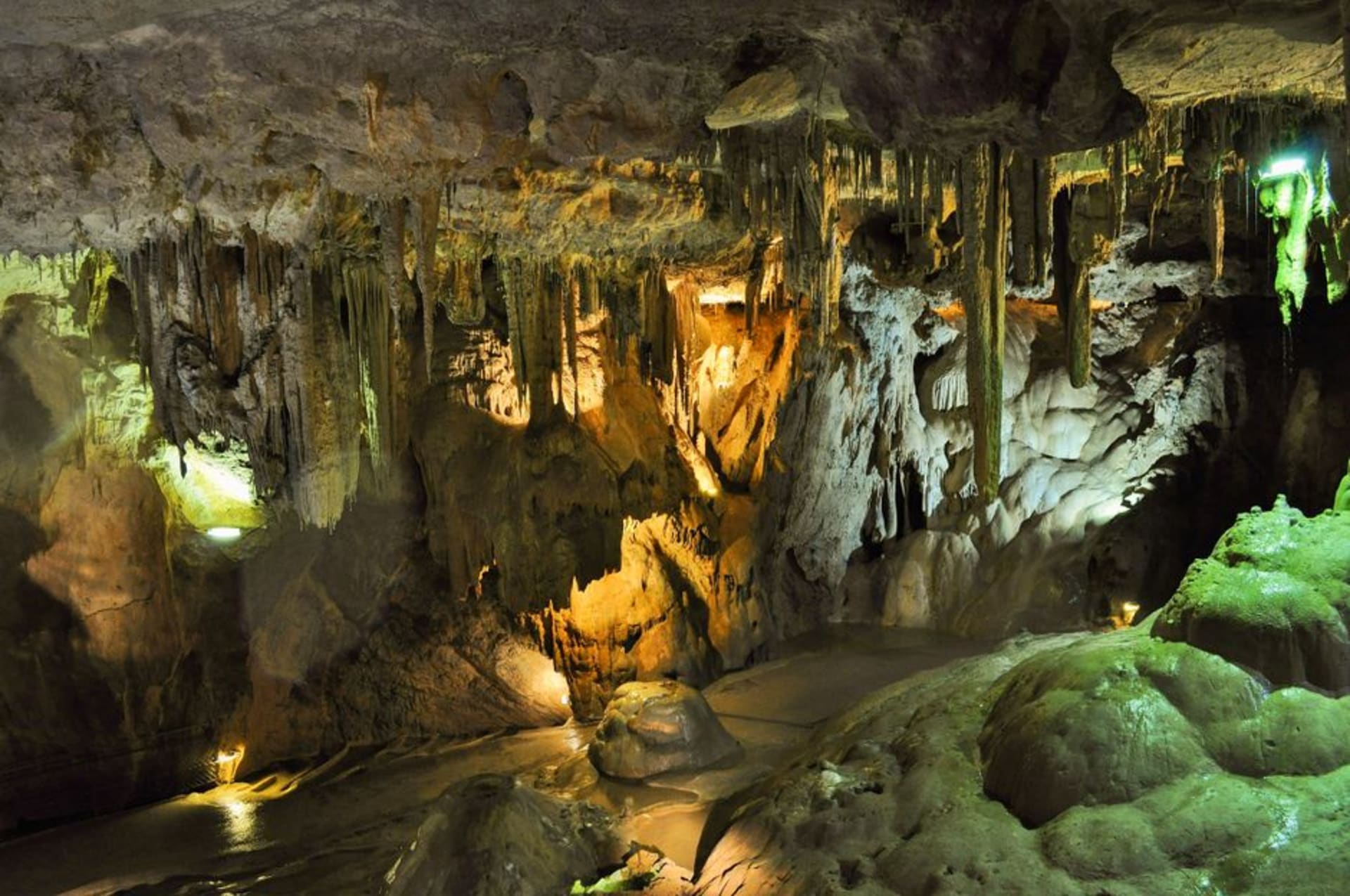
Grotte di Castellana
"The Grotta Bianca is the only place in Puglia where the ground disappears and you find yourself, for once, looking up instead of out at the sea."
A cave system beneath the Murgia plateau that drops you from Pugliese sunlight into two kilometres of stalactites, culminating in a chamber so white it looks lit from within.
It was the hottest day of our trip, the kind of heat that makes you reconsider every outdoor plan, and someone in Bari suggested we go underground. The Grotte di Castellana had been on a list I kept meaning to get to, mostly because I associate caves with mild claustrophobia and had been quietly avoiding it. Lia insisted, correctly, that a constant 18 degrees sounded better than anything above ground that afternoon, and we drove the twenty minutes from Castellana Grotte’s unremarkable little town centre to an entrance that gives almost no hint of what’s below.
The full tour runs about two kilometres and descends through a sequence of chambers that shift character every few hundred metres — the Caverna Grave, a sinkhole so large it was used as a natural rubbish dump for centuries before anyone realized what continued below it; then a corridor the guides call the Precipizio, dropping past columns of stone that took tens of thousands of years to form a few centimetres. Our guide had the dry, practiced delivery of someone who has said the same jokes to school groups for two decades, and it worked on all of us anyway.
Nothing prepared me for the Grotta Bianca, the final chamber, reached through a narrow passage that makes you duck twice before it opens into a room of alabaster-white aragonite formations, lit in a way that makes the whole space seem to generate its own pale light rather than reflect an installed one. It is short — you’re through it in ten minutes — but it is the reason people say the two-hour version of the tour is worth the extra time and the extra flight of stairs. Lia stood in the middle of it with her head back for a full minute before remembering she was holding a phone that could take a photograph.
We came back into the surface heat feeling like we had crossed some kind of border and returned, blinking, older by an afternoon we couldn’t quite account for. There’s a small archaeological museum near the entrance with prehistoric remains found in the caves — evidence that people used these chambers long before anyone thought to sell tickets — and a café where we sat afterward and rehydrated, still cold from two kilometres underground on the hottest day of the summer.
When to go: Ideal precisely on the days you’d rather avoid the sun — July and August afternoons, when the constant 18-degree cave temperature is its own reward. Book the longer two-hour tour if you can; the shorter version skips the Grotta Bianca.