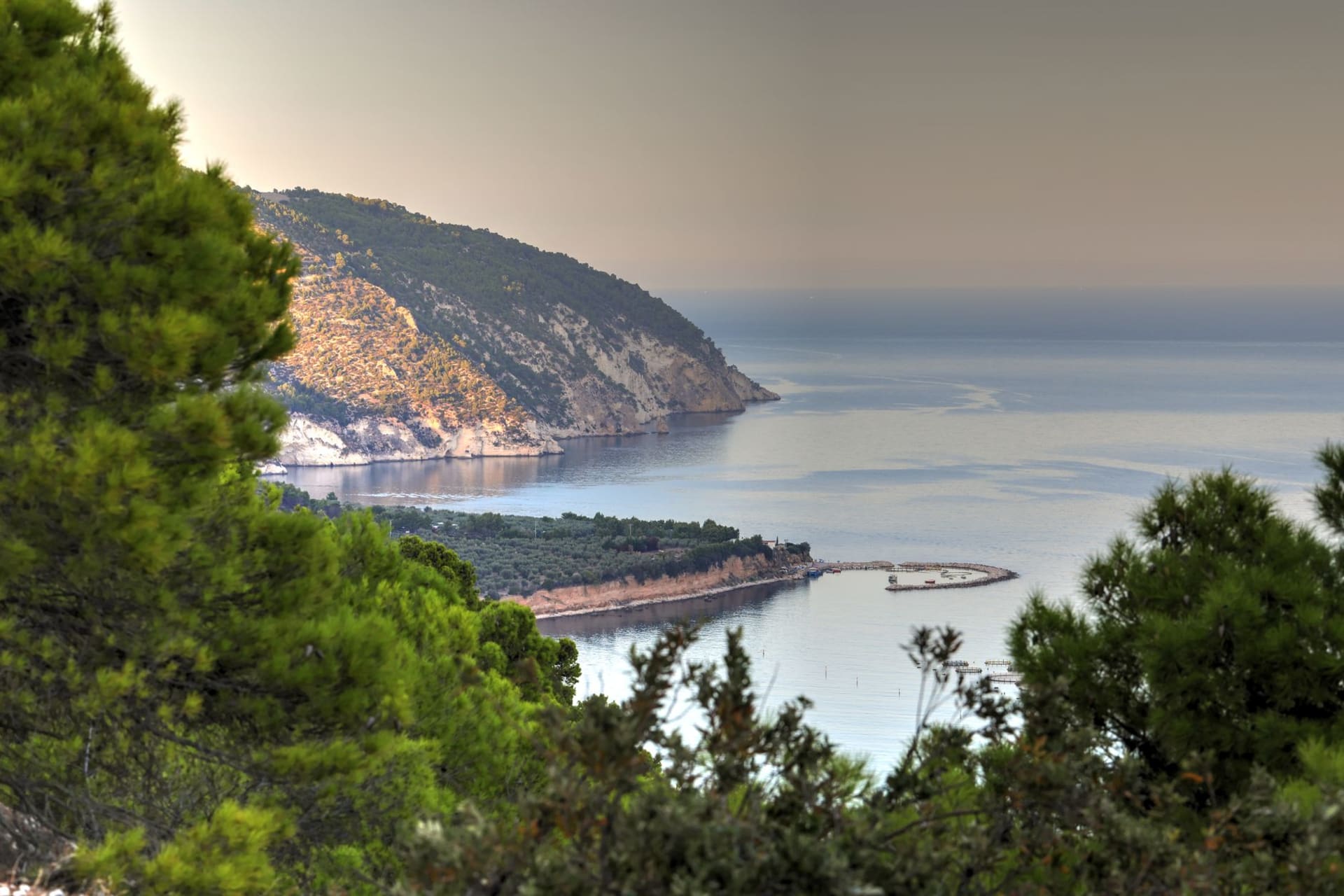
Gargano
"The Gargano feels like it was accidentally attached to Puglia — everything here is too vertical, too forested, too northern for the south."
The Gargano peninsula is the part of Puglia that does not behave like Puglia. Everything about it breaks the regional grammar: instead of flat limestone plain, a massif of limestone mountains rises to over a thousand metres; instead of olive groves, the Foresta Umbra covers the interior with an ancient mixed woodland of oak, beech, hornbeam and Aleppo pine thick enough that, standing in the middle of it in late afternoon, I had trouble believing I was in the same region as the sun-baked coast south of Bari. The trees were old and they knew it. The light came through in columns.
I approached the peninsula from the south, driving up from Foggia through the salt flats of the Margherita di Savoia — flamingos in the distance, the landscape flat and lunar — and then the road began to climb. Within ten kilometres the landscape had transformed completely: the air cooled, the trees closed in, the road narrowed to a series of curves that took both hands and considerable attention. When I finally dropped down the northern slope to Vieste on the coast, the town was perched on a white limestone promontory with the Adriatic on three sides and a stack of white rock called the Pizzomunno rising from the sea below — a monolith sixty metres high that local legend says is a man turned to stone, which local legend usually says about things like that, and which seemed right regardless of its literal truth.

The sea caves along the Gargano coast rank among the finest in the Mediterranean, and the boat trip from Vieste or Peschici — two or three hours circling the headlands — is not the tourist entertainment it sounds but something genuinely arresting. The caves have names: the Grotta della Campana, the Grotta delle Rondinelle, a series of sea passages where the water color in the interior shifts to a green so luminous it seems lit from within, as if the cave floor had its own electricity. The captain cut the engine near one entrance and let us drift, and the sound of water amplified against the cave roof and the drip from the stalactites and the slosh of the swell was the only sound for a while.
The Tremiti Islands are visible from the Gargano coast on clear days — three small islands ten miles offshore, Isole Tremiti, accessible by ferry from Vieste or Rodi Garganico. I went for a day, took the morning ferry, swam from rocks below the medieval abbey on San Nicola, ate a plate of simply grilled fish at a tiny restaurant run by a family who spoke a dialect I could not parse at all, and came back on the afternoon boat. The islands are small enough that the word “simple” serves as a complete description.

The inland town of Monte Sant’Angelo sits on the southern slope of the Gargano massif, a pilgrimage site since the fifth century when the Archangel Michael is said to have appeared in a cave in the limestone. The cave-sanctuary is now underneath a church, the approach down a staircase worn into a smooth depression by eight hundred years of pilgrims’ feet. I went on a weekday, shared the sanctuary with a small group of elderly Italian pilgrims who said their rosaries with the efficiency of people for whom this is an entirely practical activity, and felt something about the accumulated weight of human need concentrated in one underground space that I cannot quite reduce to a sentence.
When to go: May, June, and September are ideal — the sea is swimmable, the roads are manageable, and the Foresta Umbra is at its finest in the full leaf of early summer. July and August the coast becomes genuinely crowded, particularly around Vieste and Peschici; if you go in peak season, base yourself inland in Monte Sant’Angelo or Rodi Garganico for breathing room. Spring wildflowers in the Foresta Umbra are worth planning for.