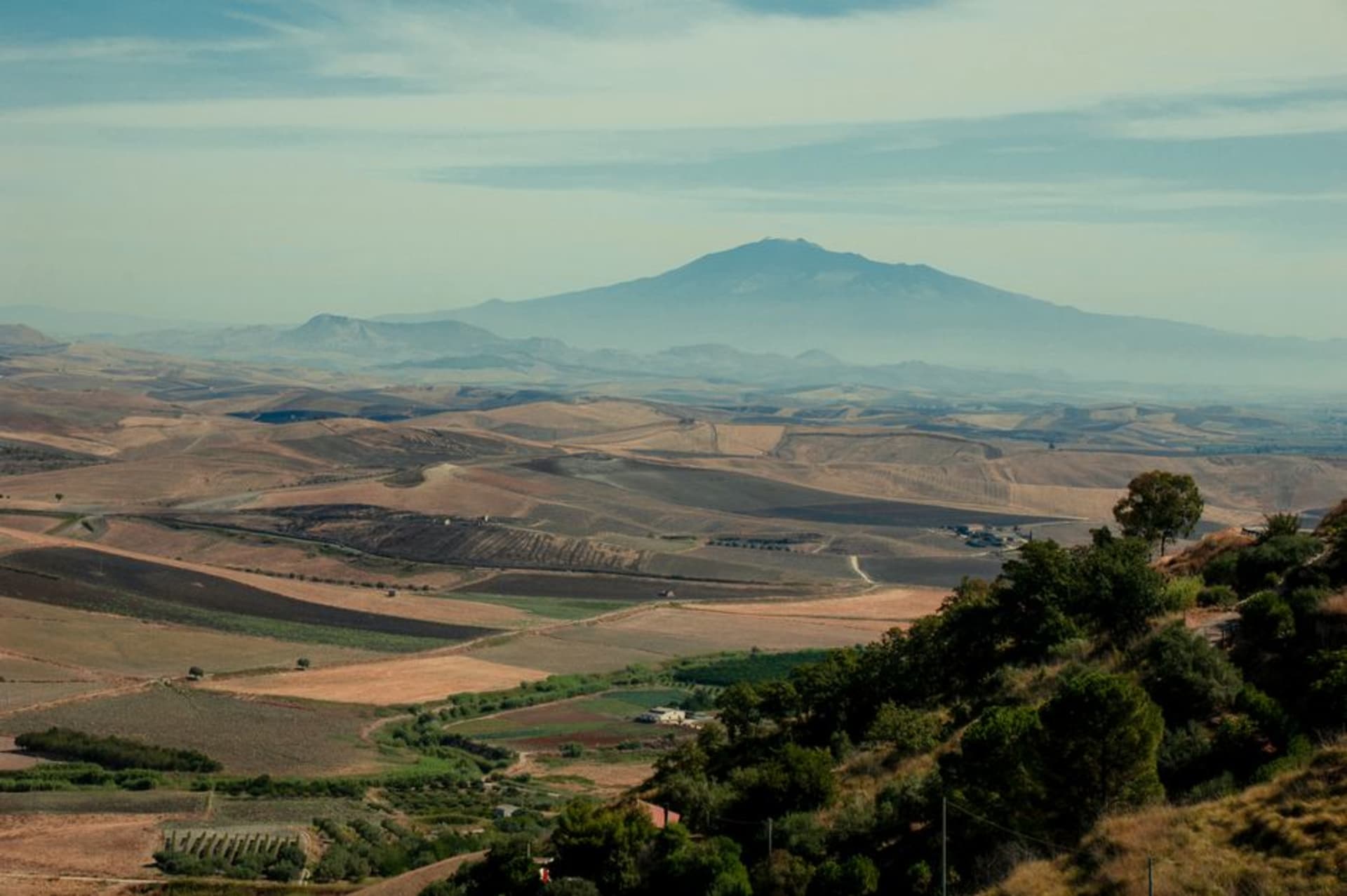
The unglamorous capital of the Tavoliere, flattened by earthquakes and bombs and rebuilt in a plain, working grid — Puglia's least photogenic city and, oddly, one of its most honest.
Lia asked me, somewhere on the drive north from Trani, why we were bothering with Foggia at all. Every guidebook we owned agreed with her — a paragraph, if that, usually beginning with the word “unfortunately.” The city was leveled by an earthquake in 1731, rebuilt, then bombed almost flat by the Allies in 1943 while it was serving as a Luftwaffe supply hub, and rebuilt again in the flat, functional grid you drive into now. No trulli, no Baroque, no sea. I didn’t have a great answer for her beyond wanting to see what a Puglia city looks like when it isn’t trying to be beautiful for anyone.
What I found was the Tavoliere doing what it does best: enormous wheat country, flat to the horizon in every direction, farm towns strung along it like beads, and at the center a city that runs on agriculture and bureaucracy rather than tourism. The cathedral survived both catastrophes in fragments — a Romanesque lower half from the twelfth century fused awkwardly to an eighteenth-century Baroque upper half, the join visible if you know to look for it, like a city literally wearing its history in layers on its own facade. Inside, an icon of the Madonna dei Sette Veli that the city has processed through its streets for eight centuries running, war and earthquake notwithstanding.
We ate lunch at a trattoria near Piazza Cavour that had exactly four tables and a menu that existed only in the owner’s head, and had the best orecchiette of the entire trip — bitter cime di rapa, a whisper of anchovy, a chili kick I hadn’t encountered anywhere else in Puglia. Lia, converted somewhere around the second bite, admitted the detour had earned itself. The piazza itself, laid out under Fascist-era rationalism, has a strange grandeur to it precisely because nobody restored it for Instagram — it’s a working civic space, full of old men on benches and kids on bikes, doing what piazzas are actually for.
What stayed with me longest was the Villa Comunale, a nineteenth-century public garden with palm trees and a bandstand, entirely full of families on a Sunday evening, entirely empty of tourists. I sat on a bench there and understood something about the Tavoliere that the coast never taught me: this is where Puglia actually feeds itself, and the city that administers all that wheat and all those tomato fields doesn’t need to dress up for anyone passing through.
When to go: Spring and early autumn, when the surrounding Tavoliere is either green with young wheat or gold at harvest — the drive in either direction is half the reason to come. Summer is brutally hot on this flat inland plain, hotter than the coast by a noticeable margin, so avoid July and August unless you enjoy standing in a convection oven.