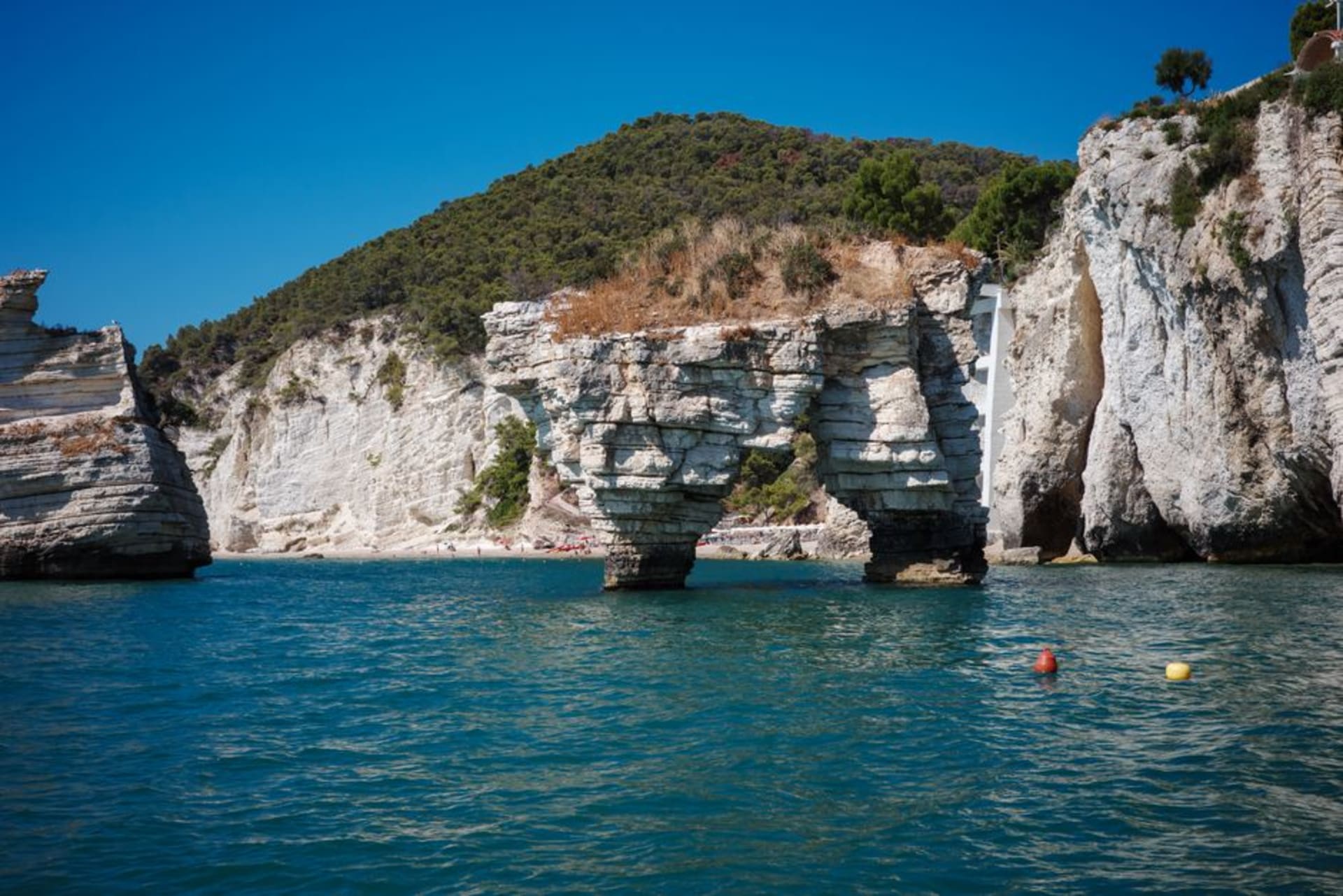
Baia delle Zagare
"You earn the Baia delle Zagare with your legs — the staircase down is part of the experience, not an obstacle to it."
One of the Gargano's signature coves, a crescent of pale sand split by two sea stacks and reached only by a long staircase cut into the cliff.
The stairs down
Between Mattinata and Vieste, the coast road runs high above the water through pine forest, and there is nothing at road level to suggest that one of the most photographed coves in Puglia sits directly below. Access is by a long staircase cut into the cliff face — several hundred steps, depending on which access point you use — descending through scrub pine that thins gradually until the sea opens up beneath you all at once, the two limestone faraglioni rising out of the water like punctuation marks in an otherwise unbroken curve of cliff.
Two beaches, one bay
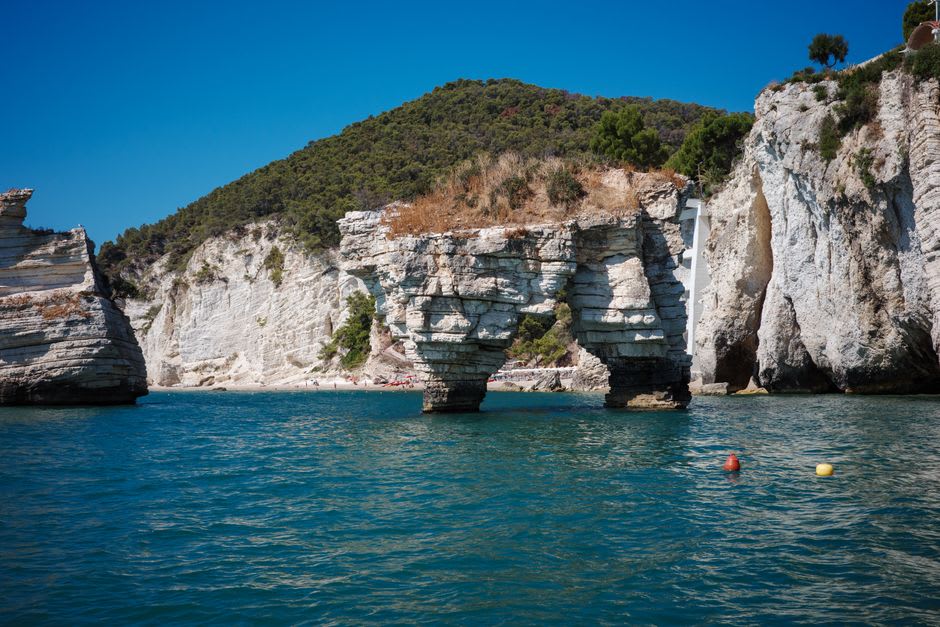
The bay is technically split in two by the sea stacks: a stretch controlled by an adjoining resort, with sunbeds and a private access lift for guests, and a public beach reachable by the free staircase, smaller and further to walk but with the same startling water. We took the public route, arrived sweating and slightly out of breath, and were in the sea within about ninety seconds of reaching the sand, which felt like the correct order of operations.
The water itself
The water inside the bay is shallow enough near shore to see every pebble on the bottom, then drops away past the sea stacks into a much deeper blue that’s genuinely startling given how close it is to the beach. We swam out to the base of one of the faraglioni and floated there for a long while, the cliff walls curving around us on three sides, the only sound the small slap of water against rock and, occasionally, someone further down the beach laughing at something we couldn’t hear.
Getting the timing right
The climb back up is the part nobody photographs, and doing it at midday in August is genuinely unpleasant — we made the mistake once and arrived at the car looking like we’d run a race. Going early morning or in the last two hours before sunset avoids both the heat on the stairs and the worst of the day-tripper crowd on the sand.
When to go: June and September, arriving either early morning or two hours before sunset, both for the light on the cliffs and to avoid climbing those stairs in the full heat of a midsummer afternoon.
Keep exploring
More from Puglia
 puglia
 Bari Vecchia
The tangled old town of Bari, where nonnas dry orecchiette on tables in the street and every alley seems designed to make you lose your phone signal and your sense of direction at once.
Explore puglia
 Barletta
A northern Adriatic port guarding a five-metre bronze colossus of a Roman emperor, a castle rebuilt by Frederick II, and the site of a medieval duel still celebrated as a matter of national honour.
Explore puglia
 Bisceglie
A fishing port on the Adriatic known for a fierce fish market, an old harbour ringed by trabucchi-style structures, and almonds turned into the region's best confetti.
Explore puglia
 Bitonto
The 'city of olives,' where a Romanesque cathedral almost identical to Bari's stands with none of the crowds, surrounded by some of the densest olive groves in Italy.
Explore puglia
 Bovino
A medieval hill town clinging to the Apennine foothills at the edge of the Tavoliere, its Norman-Swabian castle and truffle-scented woods a world away from the flat wheat country below.
Explore puglia
 Campomarino
A low-rise Ionian beach town near Maruggio built almost entirely around summer, with pine-backed sand and a laid-back crowd that skews heavily local.
Explore