Alberobello
"Stand here long enough and you stop looking for the metaphor. The trulli just are what they are — and that is stranger than any metaphor."
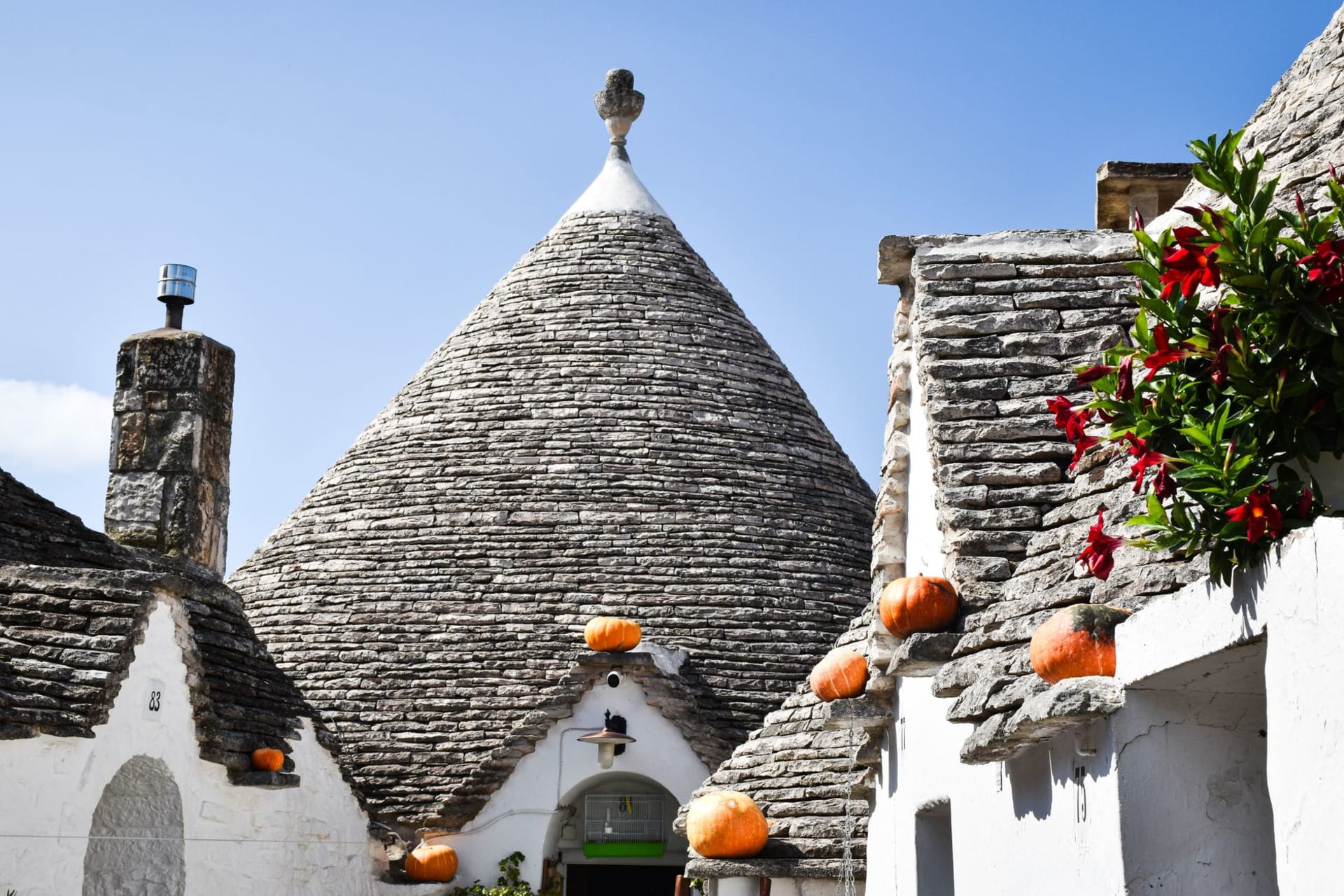
I arrived in Alberobello at seven in the morning on purpose, before the tour buses had finished their coffee. The light was still low and raking across the hillside, casting long shadows between the trulli, and for about forty minutes I had the place almost entirely to myself. A woman opened a shutter on the second floor of one of the conical houses, shook out a cloth, looked at me looking at her house, and went back inside. Ordinary Tuesday. The rooftops climbed in every direction — hundreds of those stacked limestone cones, each one painted with a symbol in white lime: a cross, a sun, a heart, a primitive planetary shape I have never been able to identify. They looked like notation for a language nobody reads anymore.
The trulli are not like anything else in European architecture, which is something guidebooks say without ever quite conveying how vertiginous that fact becomes when you are standing in the middle of Rione Monti and the houses are stacking up all around you in every direction. The theory is that they were built without mortar so they could be dismantled quickly to avoid taxes — the dry-stone construction allowed a family to collapse the roof at the approach of inspectors, presenting an unfinished building rather than a taxable one. True or not, it is an origin story that feels right for Puglia, where the relationship between the state and the people has historically been one of mutual suspicion.

Inside the trulli the ceilings dome overhead in a perfect catenary curve, the stone naturally cool even in July heat. Some have been converted into small hotels; I stayed in one for two nights and slept under the dome with a circular skylight above me, the stars in a neat circle. The proprietor brought breakfast — a slab of taralli, some local ricotta, coffee so dense it almost required chewing — and explained the symbols on the rooftops with the practiced fluency of a man who has explained them a thousand times and still seems to mean it.
The town below the trulli district is ordinary enough, full of tabacchi and hardware stores and the everyday noise of provincial Italian life, which I found reassuring. Alberobello would be unbearable if it were all tourist spectacle. It survives because real people still live in the old quarter, because the woman shaking her cloth at seven in the morning is not a local-color prop but a person with somewhere to be. The UNESCO designation sits lightly on the place, at least in the early mornings and the evenings when the coach tours have retreated.

Walk southeast into the Rione Aia Piccola neighborhood — smaller, quieter, fewer souvenir shops, more cats — and the trulli thin out into the landscape. Some are abandoned, their roofs partially collapsed, the symbols fading back into the limestone. These feel older somehow, less performed, the actual historical object rather than the preserved version. I spent an hour here doing nothing useful, just looking at the way the afternoon light moved across the cone shapes, and I did not feel I had wasted it.
When to go: September and early October are ideal — the heat has eased, the crowds have thinned, and the surrounding Valle d’Itria is beginning its quieter season. Arrive early morning regardless of when you visit; the tour buses from Bari and Taranto start arriving by ten, and the quality of experience drops measurably.