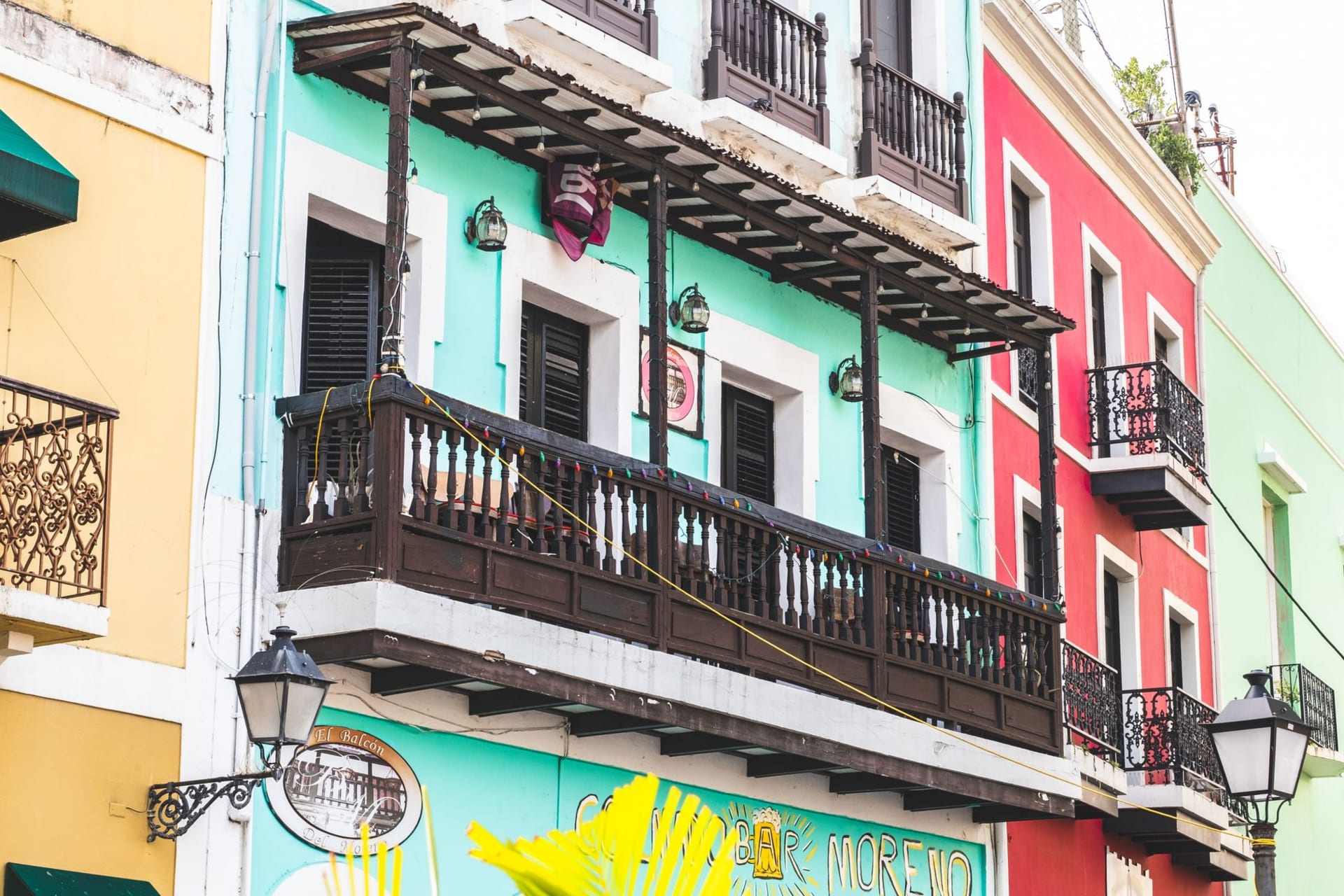
Ponce announces itself differently than San Juan. San Juan is immediate — color, cobblestones, the Atlantic and the bay all landing at once. Ponce, approached from the north through the mountains, reveals itself slowly, spreading across a coastal valley on the Caribbean side of the island with the measured composure of a city that has had since 1692 to figure out how it wants to present itself. And it has figured this out. The central plaza, Plaza las Delicias, is one of the finest public squares in the Caribbean: two churches facing each other, a fountain, shade trees, and at the center, the Parque de Bombas.
The Parque de Bombas is the most photographed building in Puerto Rico. It was built in 1882 as an exhibition hall for a trade fair, converted into a fire station in 1885, and is now a small museum — still architecturally intact, the same red and black stripes, the same Moorish arches, the same cheerful incongruity at the center of a Spanish colonial plaza. I circled it several times, which is what you do. It is one of those objects that gets more rather than less interesting the longer you look. Then I went to the art museum.

The Museo de Arte de Ponce houses a collection that would be remarkable in any city, let alone a Caribbean island of 150,000 people. Luis A. Ferré, Puerto Rico’s former governor and founder of the museum, spent decades collecting obsessively, and what he assembled — Pre-Raphaelites, Baroque Spanish masters, Italian Renaissance works, significant 19th-century European and Latin American paintings — is held in a building designed by Edward Durell Stone with a series of hexagonal skylights that bathe the galleries in the kind of diffuse natural light that makes paintings look as they were meant to. Flaming June by Frederic Leighton, perhaps the most iconic Pre-Raphaelite painting in the world, is here, in Ponce, in Puerto Rico. This fact still strikes me as one that doesn’t normalize with repetition. I stood in front of it for a long time and felt the confusion of encountering something you have seen reproduced a thousand times and suddenly finding it full-size and original and almost alarming in its color.
Ponce’s food scene has the character of a city eating for itself rather than for visitors. The bacalaítos — salt cod fritters — at the stalls near the Mercado Juan Ponce de León are the best I had in Puerto Rico: crispy at the edges, soft in the middle, the salt of the fish cutting through the oil cleanly. King’s Cream, a local ice cream institution operating from a counter on the plaza that has barely changed since the 1940s, makes coconut, guanábana, and tamarind flavors that taste specifically and defiantly local. The Barrio El Vigía, on a hill above the city with an enormous illuminated cross visible from the highway, has a cable car, panoramic views over Ponce to the Caribbean, and the relaxed atmosphere of a neighborhood that tourists rarely bother climbing toward.

The drive from San Juan to Ponce over the central mountains on PR-52 takes about ninety minutes and passes through landscapes entirely unlike the coast — cool, green, foggy in the mornings — before descending abruptly into the drier, hotter south. Ponce sits on the Caribbean side, and the light here is different: hotter, more direct, the shadows shorter. It is, in some ways, a different island from the one that San Juan presents.
When to go: Ponce’s carnival in February is one of Puerto Rico’s great public celebrations — the vejigante masks, papier-mâché constructions of extraordinary complexity and color, are specific to Ponce and worth planning around if you can. The city is pleasant year-round; the south coast runs drier and hotter than the north. December through April is the most comfortable. The Museo de Arte de Ponce is closed on Tuesdays.