Summerside
"Eight teenage pipers in full regalia on a trimmed lawn, and the sound was enormous and somehow exactly right."
Summerside is PEI’s second city, which makes it sound modest and it partly is — about fifteen thousand people, a downtown that wraps up by nine on a weekday evening, a harbour that’s more pleasure-boat than working port at this point. But it carries something Charlottetown doesn’t quite have: a slightly plainer relationship with itself. It’s not selling you anything. It’s just there, doing the things a city of fifteen thousand does, and if you arrive with no particular agenda you’ll find it agreeable in the way of things that aren’t trying.
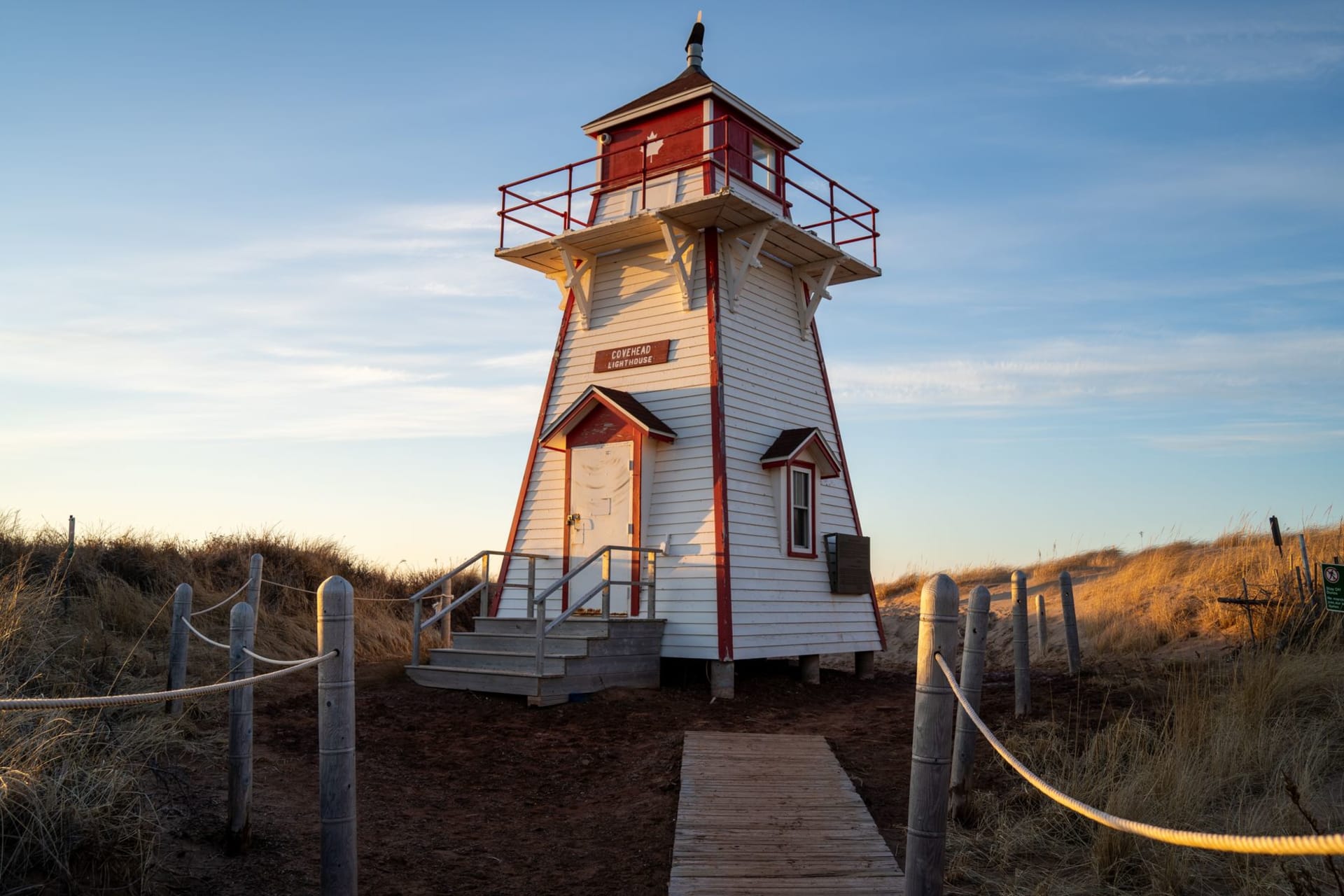
The waterfront is the obvious starting place. Spinnakers’ Landing has the requisite boardwalk and tourist infrastructure, but what makes it worth your time is the view across the harbour at dusk — the light comes in from the west and turns the water that specific shade of pewter going gold that you see in nineteenth-century marine paintings and assume is exaggerated until you witness it in person. A working lighthouse sits at the end of the pier. A few families were fishing off the dock when I visited with the unhurried dedication of people who have done this every summer evening for years.

The College of Piping on Water Street is a genuine surprise if you wander in without knowing what it is — a school of Highland bagpiping and Celtic arts that draws students from across Canada and runs free outdoor performances on summer afternoons. I arrived mid-performance: eight teenage pipers in full regalia playing something ancient-sounding on a lawn trimmed as precisely as green felt, the sound enormous and somehow exactly right for this northern light and these flat eastern streets. The music followed me for three blocks after I left.
Downtown has the kind of architecture that accumulates when a city builds steadily across three centuries without ever quite booming or busting — Victorian storefronts of red brick alongside mid-century additions alongside something recent and cautious. The Silver Fox Inn is a Victorian mansion turned bed and breakfast that serves breakfast in a dining room with original woodwork and enough implied story in every surface to distract you from your eggs. I had mine with local sausage and red soil potatoes and did not check my phone once.

A few minutes west of downtown, in the community of Miscouche, the Acadian Museum of Prince Edward Island sits in a modest building with an immodest collection. The story it tells is about erasure and survival — the Deportation of the Acadians, the slow reconstruction of a community and a language over two centuries of official indifference that occasionally sharpened into active suppression. I went in meaning to stay twenty minutes and stayed for over an hour. The artifacts are modest; the story they’re carrying is not.
When to go: July and August for the College of Piping performances and the Lobster Carnival, when the harbour turns festive. September for a quieter version of the city where you can sit in the waterfront café and hear as much French as English, and the whole place feels more honestly itself.