Greenwich
"Dead spruce trunks emerging from the sand like masts of buried ships. The dunes are winning."
The parabolic dunes at Greenwich are the most extraordinary landform on Prince Edward Island and, depending on the light and the hour, possibly the most extraordinary thing I’ve seen in Atlantic Canada. They form because the wind off the Gulf builds these curving sand walls that migrate inland at roughly four meters a year, consuming what was there before them — trees, ponds, the evidence of older shorelines — and leaving behind a landscape that feels prehistoric in the specific sense of belonging to processes that predate human concern. Standing at the leading edge of a dune face and looking at the buried forest, you understand that geology is not background scenery. It is the foreground.
I arrived at the Greenwich trailhead at seven in the morning, before the park opened its main services, and walked the boardwalk over the dune field alone. The boardwalk floats on the sand to avoid disturbing the dunes, and in the early quiet I could hear the wind working on the dune faces — a dry rushing sound, sand on sand, the sound of geography in slow progress. The marram grass at the edge of the stable sections moved in a way that looked nervous, as though it understood it was losing ground. I walked without talking to myself, which is rarer than it sounds.
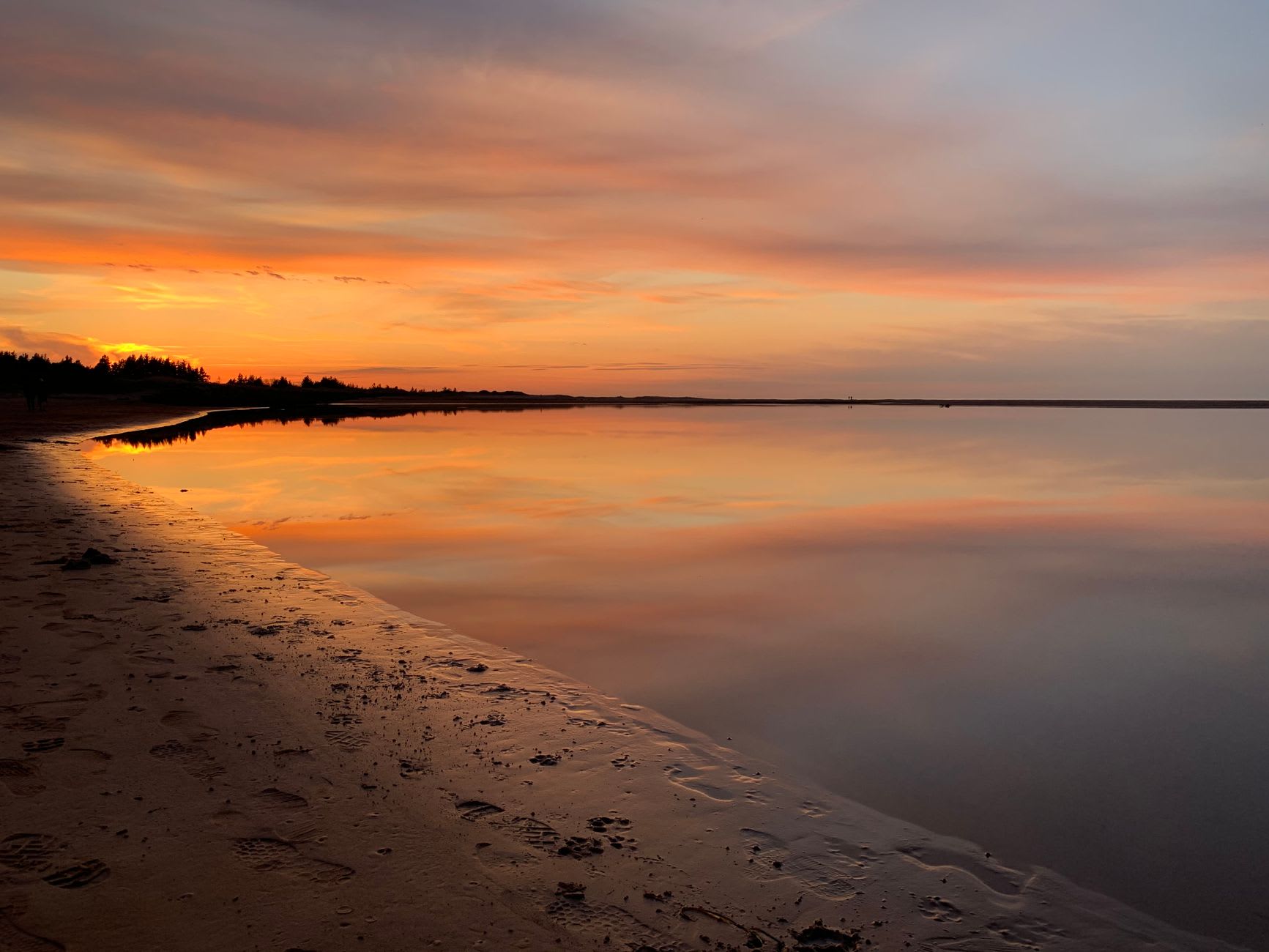
The trail continues past the dune field to a beach on St. Peters Bay that is entirely different in character from the north shore beaches — protected, calm, the water warmer, the surface a darker red sand that holds the morning light differently. I swam there for fifteen minutes, which for me in Atlantic Canada is practically an athletic achievement. The water had a still, private quality that open ocean beaches don’t have, the bay sheltering it from the chop that roughens the north shore.
The lagoon formed by the dune system behind the beach supports breeding piping plovers in summer, and the park wardens are appropriately serious about the buffer zones around nesting sites. The plovers are tiny and alarmingly bold — one walked within two feet of me and watched me with the impassive authority of a bird that has decided this particular section of beach is its business, not mine.
The drive to Greenwich from Charlottetown takes about an hour through the central island’s farming country — the potato fields in their long green rows, the occasional red barn sitting at the edge of a woodlot, the kind of pastoral rhythm that rewards attention even at highway speed. This section of the national park is considerably less visited than the Cavendish area, which means the trails have the quality of something slightly undiscovered. What I found myself thinking about, walking back from the beach in the warming morning, was the dunes’ complete indifference. They are consuming a forest at their leading edge — the dead spruce trunks emerging from the sand like masts of buried ships — and they will continue doing so long after the boardwalk rots and the interpretive panels fade. It’s the right scale at which to spend a morning.
When to go: Late June through August for beach access and the full trail system. Early morning visits in July deliver the best light on the dune faces and avoid the midday heat. Note that piping plover nesting season means some trail sections may be closed in June.