
Peniche
"Peniche doesn't dress up for anyone. It just keeps hauling in fish and hosting the best barrels in Europe."
A blunt, working fishing town turned surf pilgrimage site, where a former political prison stares down at the same waves that made Supertubos world-famous.

Peniche smells like a fishing town before it looks like one — diesel and salt and the particular sharp brine of a working harbor, well before you spot the trawlers themselves stacked three deep along the quay. This isn’t the postcard Algarve; it’s a peninsula jutting hard into the Atlantic, blunt and unglamorous, its economy built on canned fish and, more recently, on the waves that break along its western edge with a consistency surfers travel across continents to chase. I arrived on a grey October morning and the town felt entirely unbothered by my presence, which I found oddly reassuring.
Supertubos and the Draw of the Wave
Praia de Supertubos, just south of town, produces one of the heaviest, most perfectly barreling beach breaks in Europe, hosting a stop on the World Surf League’s championship tour most years, and even on an unremarkable afternoon I watched local kids paddling out alongside grizzled regulars who clearly treated the wave with real respect rather than swagger. A surf instructor I got talking to at a beachside kiosk told me the wave gets its reputation specifically from the sandbar shape offshore, which barrels the wave hard and fast right at the shore break — beautiful to watch, brutal if you get it wrong, and he’d seen more than a few overconfident visitors learn that the hard way.

A Fortress With a Darker Memory
The Fortaleza de Peniche, a squat sixteenth-century fort right on the harbor, has a far heavier history than its handsome exterior suggests: under the Estado Novo dictatorship it served as one of Portugal’s most notorious political prisons, holding opponents of the Salazar regime in cramped, damp cells until it was stormed and emptied by locals in the chaotic days following the 1974 Carnation Revolution. Walking through the preserved cell blocks, now part of a museum on the resistance, I found the contrast almost impossible to hold in my head at once — outside, teenagers on surfboards jogging past with wetsuits half-zipped; inside, handwritten prisoner testimonies behind glass describing years in isolation just meters from the same crashing Atlantic.

I ended the day at the harbor eating grilled sardines off a paper plate from a stall that had clearly been feeding fishermen long before it ever fed a tourist, watching boats come in as the light went orange over the breakwater — the same unbothered rhythm the town’s had for generations, surf tourism or not.
When to go: October to March for the biggest, most photogenic swells at Supertubos during competition season; summer if you’d rather swim than watch pros get barreled.
Keep exploring
More from Portugal
 portugal
 Peso da Régua
The working heart of the Douro wine trade, where terraced vineyards drop straight into the river and flat-bottomed rabelo boats once carried every barrel of port toward Porto's cellars.
Explore portugal
 Pico Island
Portugal's tallest peak rises straight out of the Atlantic on Pico, above a black lava coastline gridded with stone-walled vineyards that somehow coax wine out of solid rock.
Explore portugal
 Pinhão
A one-street village where the Douro river bends around terraced vineyards so steep they look hand-drawn, and the train station's blue tiles tell the whole story before you've unpacked.
Explore portugal
 Piódão
A schist village stacked into a fold of the Serra do Açor, every slate house trimmed in the same cobalt blue, so isolated it wasn't electrified until the 1970s.
Explore portugal
 Ponta de São Lourenço
Madeira's eastern tip breaks from the island's lush script entirely — a stark, arid volcanic ridge of red and ochre rock exposed to the full force of the Atlantic.
Explore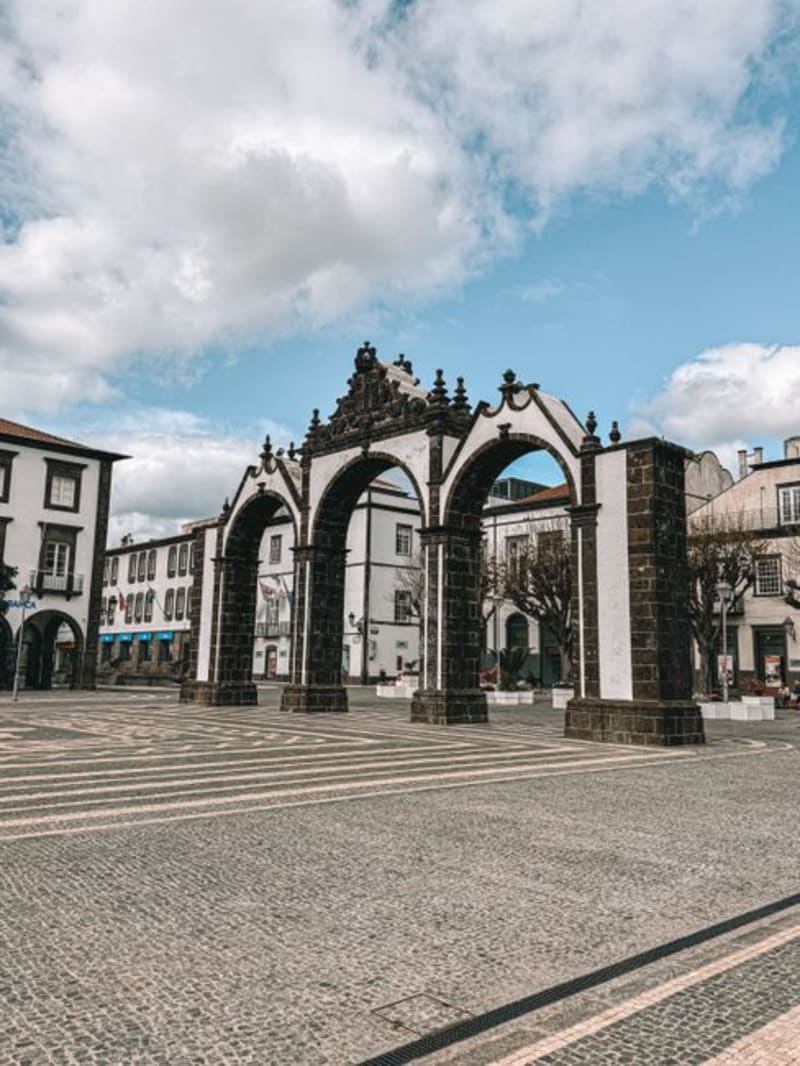 portugal
 Ponta Delgada
São Miguel's black-and-white port capital, where calçada cobblestones ripple underfoot and azulejo-covered churches face out toward an Atlantic that built this city on whaling and oranges.
Explore