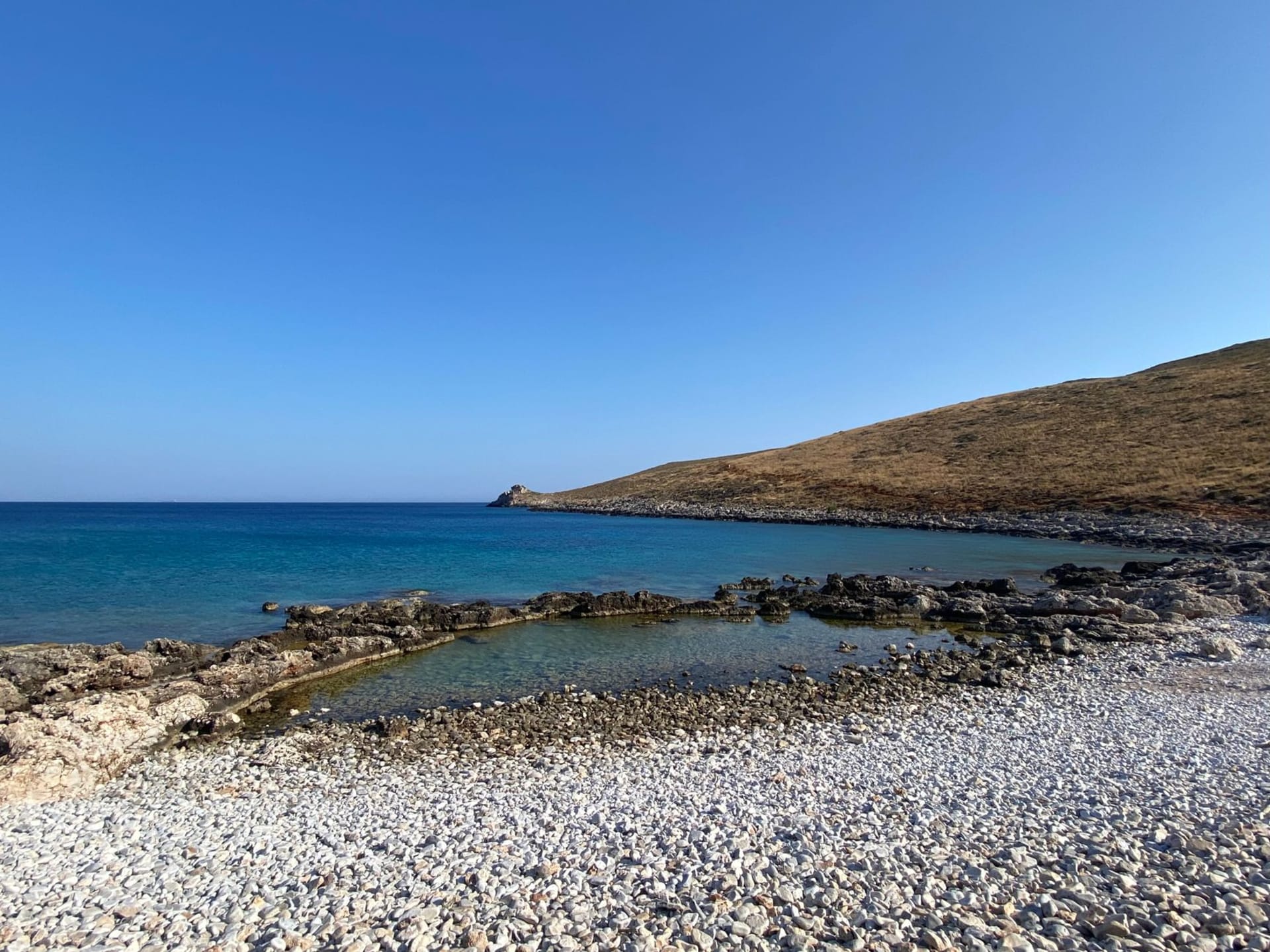
Voidokilia Beach
"A beach shaped like a letter from an alphabet nobody invented. I have seen a lot of coastline. This one made me stop the car twice."
We had been told about Voidokilia by a woman in a Kalamata taverna who described it with her hands, drawing a near-perfect semicircle in the air and then refusing to say more, on the grounds that I should see it cold. She was right to. The first view comes from the hill above, and the beach below is an almost geometrically perfect crescent of pale sand, the Ionian on one side a deep turquoise and a still lagoon on the other, the two separated by a thin ribbon of dune. I have driven a lot of coast roads. I stopped the car twice on the way down just to look.
A beach out of Homer
The name translates, with typical Greek bluntness, to something like “ox-belly,” for its curved shape. But the area is soaked in older stories than that. This is the bay of ancient Pylos, the kingdom of Nestor in the Iliad and Odyssey, and the lagoon behind the beach — Gialova — is traditionally identified with the harbour where Homer’s “sandy Pylos” stood. Standing on the dune with the lagoon flat and silver behind me, it was easy to believe Telemachus had once been rowed ashore here looking for news of his father. Lia, who reads the actual scholarship rather than the romantic version I prefer, gently noted that the identification is disputed. I chose not to hear her.

The water is the other reason to come. Because the bay is so enclosed, the sea inside the crescent is shallow, warm and astonishingly clear — you wade out a long way over rippled sand before it gets above your waist. We swam in the early morning before anyone arrived, and the only other living things were a heron stalking the lagoon edge and, somewhere out in the reeds, the racket of frogs.
The cave and the castle above
What makes Voidokilia more than just a beautiful beach is the climb at its northern end. A steep, rocky path leads up the headland to Nestor’s Cave, a real cave hung with stalactites where, by legend, Hermes hid the cattle he stole from Apollo, and where Nestor and Neleus supposedly kept their cows. It is dark, cool, and gloriously unsupervised — no ticket office, no railing, just a hole in the rock and a myth. Above it stand the crumbling walls of Palaiokastro, a thirteenth-century Frankish castle on the site of the ancient acropolis.

From the castle ramparts the whole composition lays itself out: the crescent beach, the lagoon, the dunes, the modern resort discreetly hidden behind the trees, and the open Ionian beyond. The lagoon, incidentally, is a protected wetland and one of the most important bird habitats in Greece — Lia spent an hour there with binoculars and came back triumphant about flamingos. I came back triumphant about having found a beach that lives up to a taverna owner’s hand gestures. We were both satisfied.
When to go: May, June, and September are ideal — warm water, manageable crowds, and migratory birds on the lagoon in spring and autumn. July and August bring Greek holidaymakers and considerable heat on the exposed dune; go early or late in the day. The beach has no facilities and is protected, so bring shade and take everything away with you.