Ancient Olympia
"Running through the stadium tunnel at Olympia, I understood why the Greeks thought the gods were watching."
I walked through the vaulted tunnel that leads from the sanctuary into the ancient stadium just as a group of French schoolchildren were running back out of it, laughing. For a moment I had the track to myself — the long straight strip of compacted earth, the stone starting blocks still visible at the far end, the sloping banks where the spectators sat still intact on both sides, a soft grass green in the morning light. I stood at the starting blocks and looked down the hundred-and-ninety-two metres of track and felt something I hadn’t expected: a surge of competitive instinct, some ancient response to the shape of a racecourse. I didn’t run. But I thought about it.
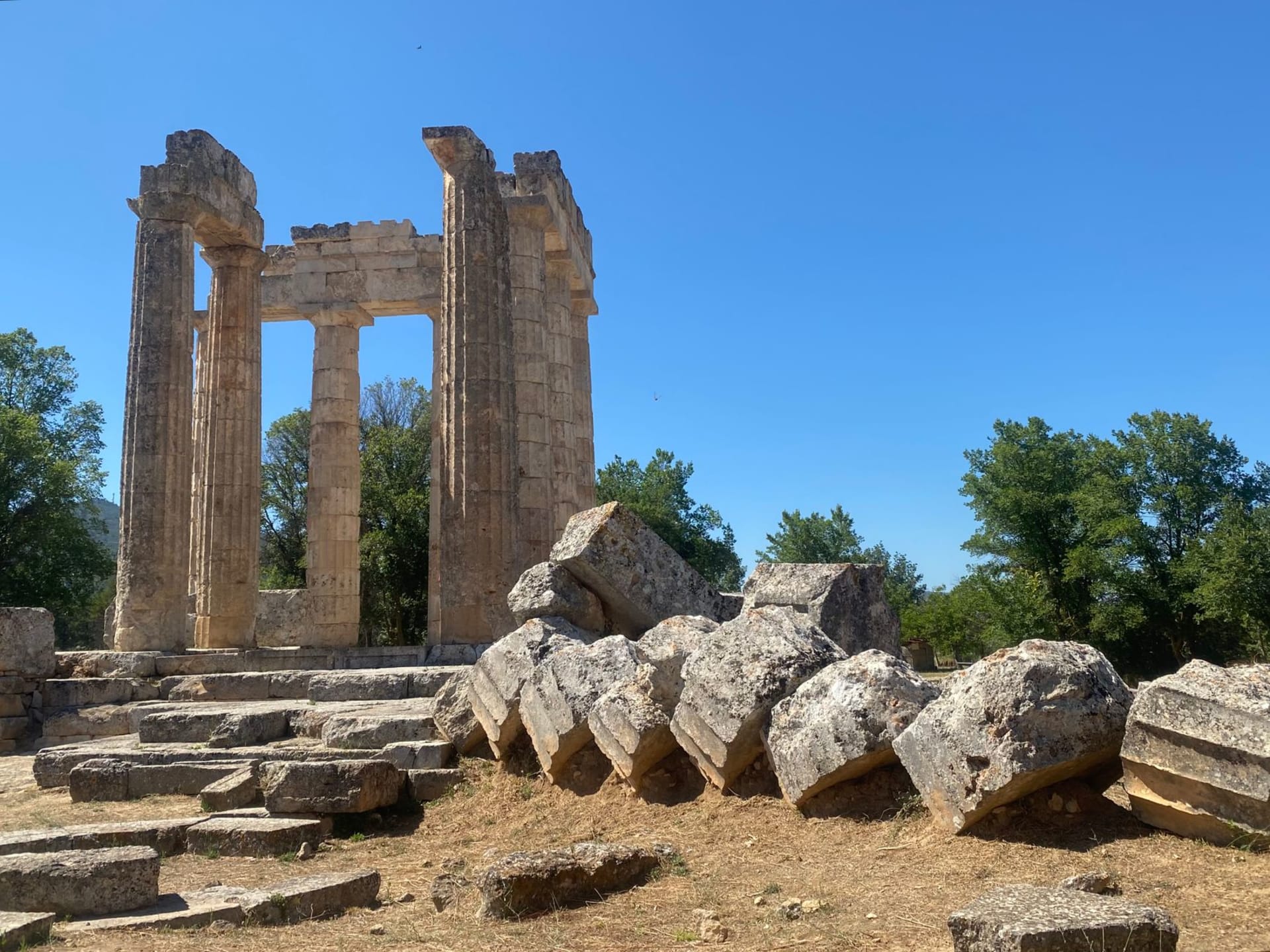
Ancient Olympia is in the western Peloponnese, in a green valley where two rivers meet — the Alpheios and the Kladeos — and the setting is, by the standards of Greek archaeological sites, almost pastoral. The Altis, the sacred precinct, is shaded by pine trees and plane trees and the ruins are distributed through this greenery in a way that feels less like a museum and more like a park that happens to contain the fragments of several civilizations’ ambitions. The Temple of Zeus — the one that housed Pheidias’s great chryselephantine statue, counted among the Seven Wonders of the Ancient World — is now a field of enormous fallen drums, toppled by earthquakes in the Byzantine period and never re-erected. I walked along the length of them slowly. Each drum was taller than me lying on its side.

The museum that sits just outside the sanctuary is one of the finest in Greece, and the thing that justifies all the hyperbole written about it are the pediment sculptures from the Temple of Zeus. These were carved around 460 BCE — the transition point between archaic rigidity and classical fluency — and they depict the Centauromachy with a violence and dynamism that feels almost modern. The marble centaurs and Lapiths are locked in combat that twists and reaches across the length of the pediment, and at the centre of the composition, a figure of Apollo stands with one arm extended, not fighting but presiding, his face entirely calm amid the chaos. I stood in front of him for a long time. There is a quality to that face that I cannot quite describe — it isn’t serenity exactly, it’s something more like certainty.
The Hermes of Praxiteles, also in the museum, has the problem of all famous things: you know it too well before you see it. But in person, in the slightly dim room where it stands, the marble has a warmth that no photograph captures. Praxiteles polished his marble to a surface that catches light differently than earlier Greek sculpture — it absorbs it rather than reflecting it, which gives the skin a softness that still confounds.

The modern village of Olympia, strung along a single main road, makes no pretense to charm: it exists entirely to service the archaeological site and does so efficiently. I ate dinner at a taverna that had been open since 1971, according to a sign on the wall, and ordered the lamb chops and a village salad with good local olive oil. The oil had a grassy sharpness that reminded me of the fields you drive through to get there. The site was five minutes’ walk away in the dark, and I thought, eating that lamb, about how continuously this valley had been feeding visitors for two and a half thousand years.
When to go: Spring — April to early June — is the ideal season: the valley is green, the wildflowers are out around the fallen temple drums, and the crowds are manageable. The site opens early and the first hour of the morning is the time to be in the stadium. July and August are genuinely brutal — full sun, no shade in the Altis, tour groups arriving from the coast resorts. September is a good compromise.