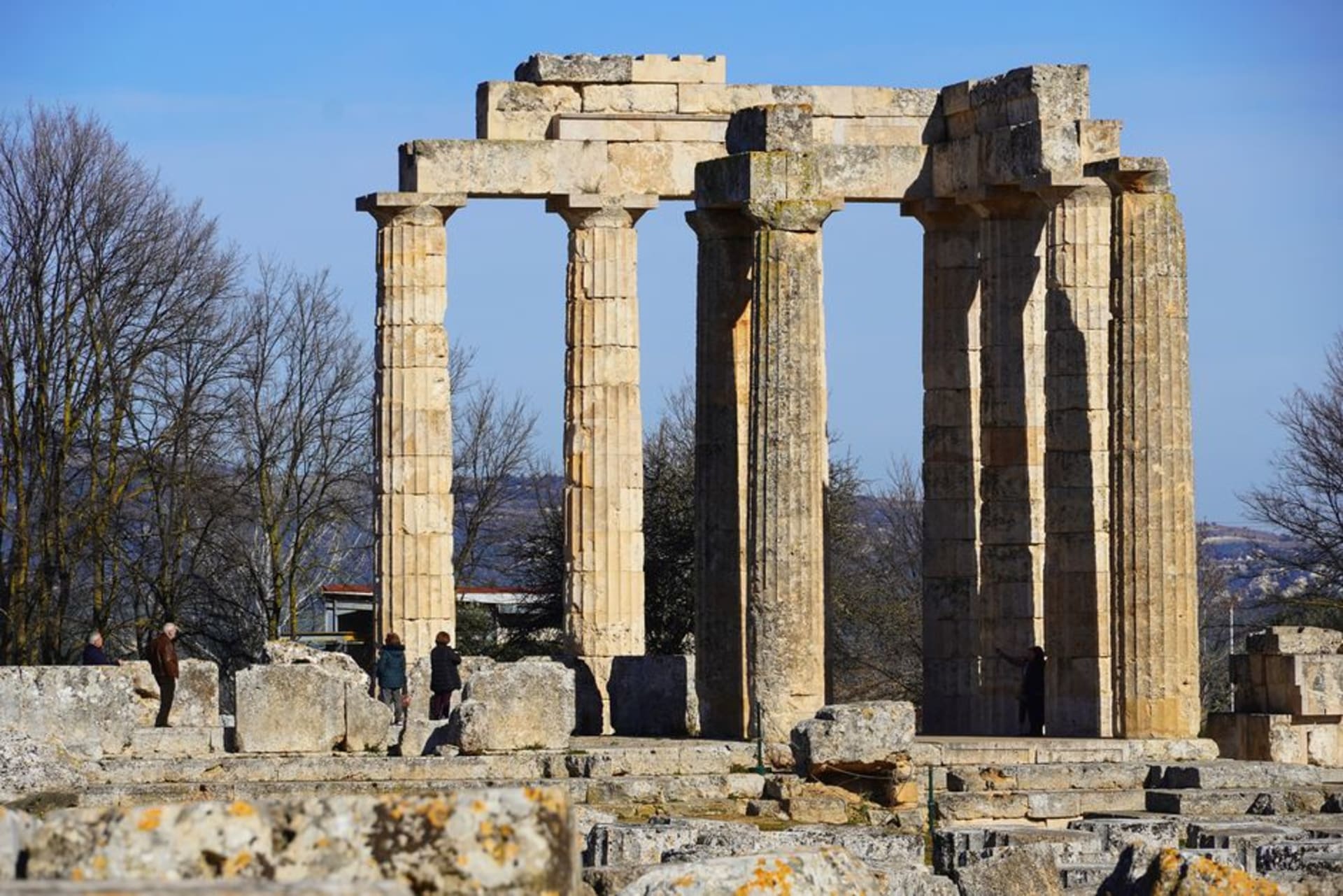
Three lonely columns, a restored ancient stadium, and a valley of Agiorgitiko vines where Heracles supposedly killed a lion.
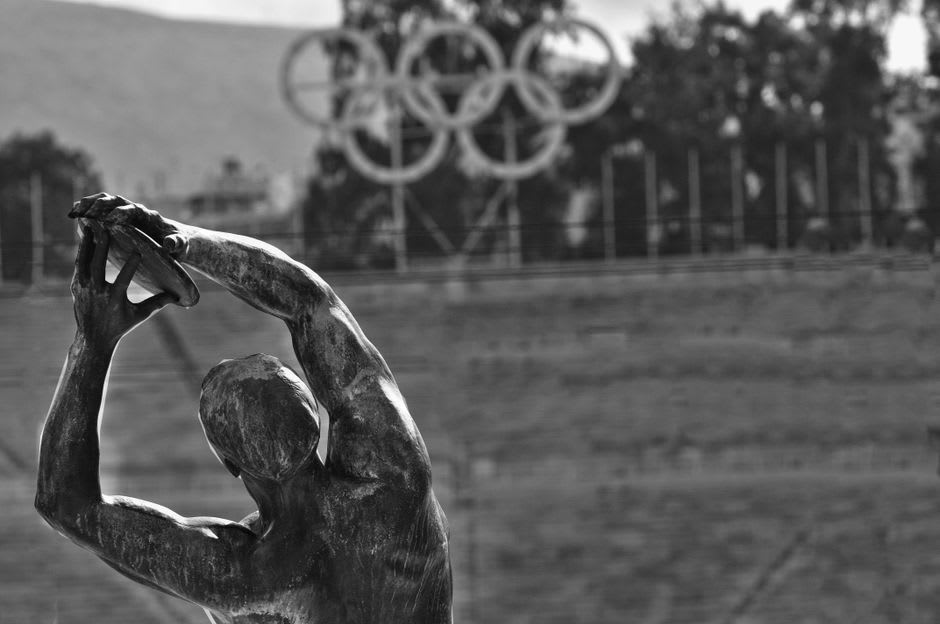
We almost skipped Nemea. It’s one of those Peloponnese stops that gets flattened into a single line in every guidebook — “site of ancient games, also wine” — and after weeks of temples and theaters, Lia and I nearly drove straight past it toward Nafplio. I’m glad we didn’t. What pulled us off the road was the stadium: not the ruined stone stands you brace yourself for, but an actual restored track, complete with the original vaulted tunnel the athletes walked through to enter, and grooves cut into the stone starting line where you can still see where their toes went. I stood in that tunnel for a minute just listening to the echo, thinking about the fact that this thing was already old when Rome was young — the Nemean Games ran here every two years from around 573 BC, ranked alongside Olympia, Delphi, and Isthmia. Lia lined up her feet in the starting grooves and made me time her sprint down the track. She won, obviously, because I was too busy laughing to run properly.
From the stadium it’s a short walk back to the sanctuary itself, where three columns of the Temple of Zeus still stand — out of the 32 that once framed the whole structure. There’s something about three columns against an open sky that hits differently than a fully intact building would. It forces you to imagine the rest, and standing there in the early evening light, shadows stretching long across the excavated foundations, I found myself doing exactly that. This was also, according to myth, where Heracles killed the Nemean lion, the first of his twelve labors — the kind of story I grew up reading in translation and never expected to feel in my chest until I was actually standing in the valley where it supposedly happened.
But Nemea’s real trick is what happens after the ruins. The whole valley around the sanctuary is Greece’s benchmark region for Agiorgitiko, and there are wineries practically within walking distance of the archaeological site. We ended up at a small family-run place recommended by the woman at our hotel, sitting on a terrace overlooking the vines with a glass of deep, velvety red in hand while the owner talked us through three generations of harvests. Lia, who usually pretends not to care about wine tourism, asked more questions than I did.
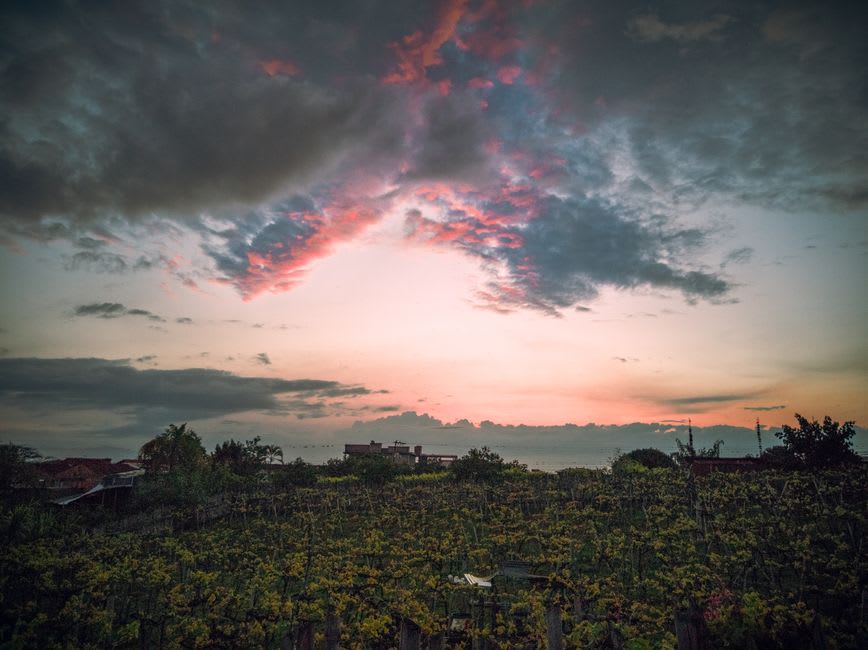
We stayed until the light went orange over the vineyard rows, in no hurry at all, which is not how either of us usually travels. That’s the thing about Nemea — it’s small enough to see in an afternoon, but it has a way of slowing you down anyway.
When to go: Spring and autumn bring the most comfortable weather for walking the ruins, but if you can time it with the September grape harvest, do — the wineries come alive in a way that made our stop feel like more than a footnote.