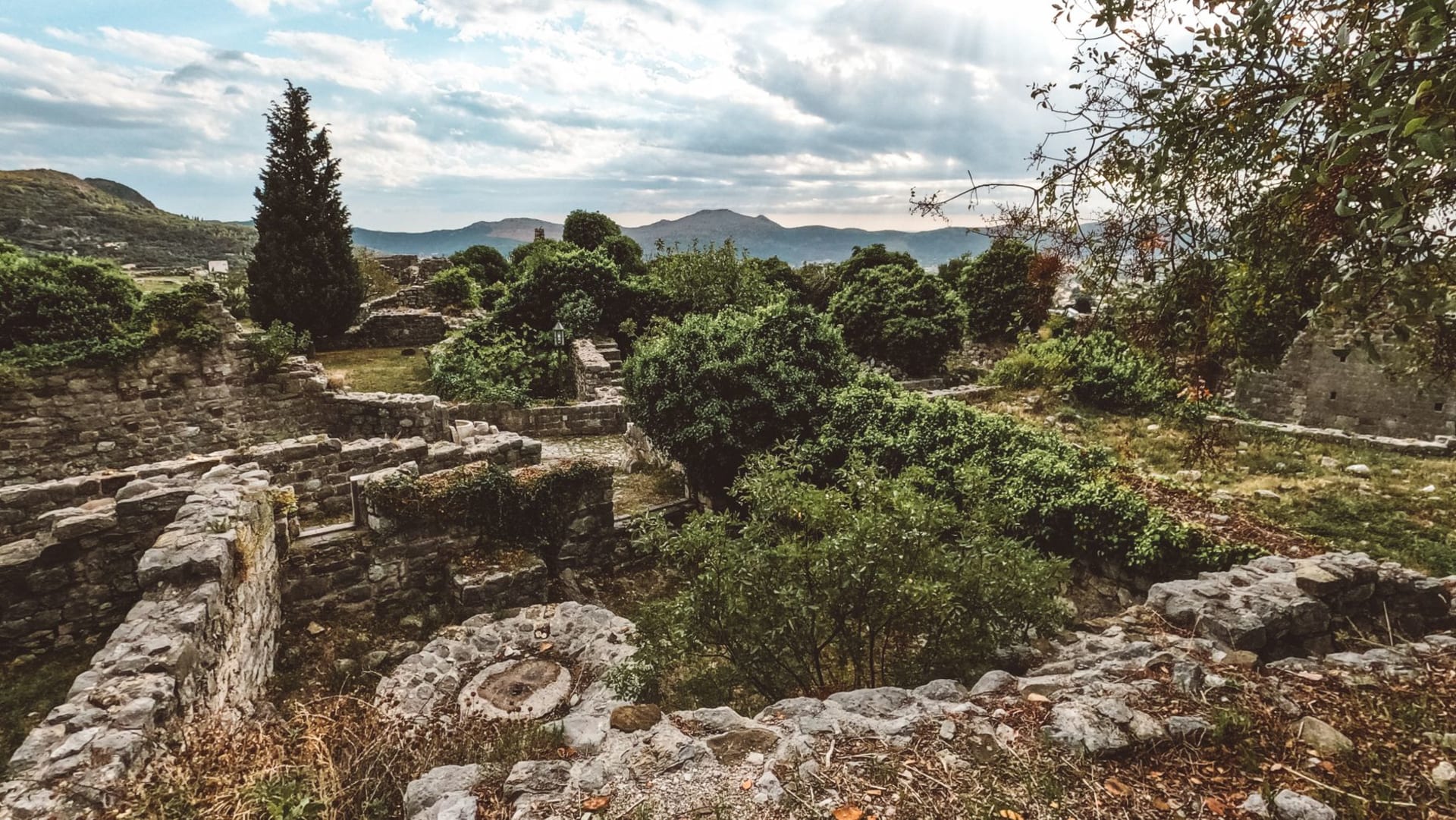
Mystras
"The frescoes at Mystras look like they were painted last century. They were painted when Constantinople still stood."
I climbed into Mystras through the lower gate on a morning when the mist hadn’t yet lifted from the Eurotas valley below, and for the first twenty minutes I had the whole ruined Byzantine city to myself. The path wound upward between stone houses whose roofs had long since fallen in, through terraced gardens gone back to wild herbs and rockrose, past a donkey trail worn smooth by centuries of use. Somewhere above me a church bell rang — not an ancient ringing, just a modern Greek Orthodox bell in the functioning nunnery of Pantanassa — and the sound bounced off the hillside and scattered. I stood still for a moment and let the echo die. The mist shifted and below me, impossibly far down, the orange groves of the Spartan plain appeared in strips of pale green light.
Mystras was the last great flourishing of Byzantine civilization — a fortified hilltop city that became, in the fourteenth and early fifteenth centuries, a genuine intellectual and artistic capital. The philosopher Plethon taught here. The last Byzantine emperor, Constantine XI, was crowned here in 1448, two years before the Ottoman siege of Constantinople ended the empire entirely. The city was then handed over peacefully, inhabited for another four centuries, and gradually abandoned as the population drifted down to the new town of Sparta in the valley below. What remains is haunted in the precise sense of that word — a place filled with the atmosphere of lives that were fully lived and then completely stopped.

The churches are the thing. There are six or seven still accessible, their exteriors modest and austere, their interiors containing some of the finest late Byzantine frescoes in existence. In the Perivleptos monastery, carved into the cliff face, the walls are covered with painted scenes — the Nativity, the Dormition of the Virgin, Christ in Pantocrator above — rendered in a style that already anticipates the Italian Renaissance, with spatial depth and human expression that Giotto would have recognized as a kindred language. The colours remain: ochres and deep blues and a particular warm crimson that shouldn’t have survived five hundred years of a leaking roof, but has. I sat on a stone bench inside the Perivleptos for perhaps half an hour, letting my eyes adjust to the dim light, and the paintings slowly gave up their details. It felt less like looking at art and more like reading a letter from a very distant era.
The path from the lower to the upper city climbs past the Metropolis — the cathedral of Saint Demetrios, the oldest major church — where the coronation of Constantine XI took place. His crowned double-headed eagle is still visible carved into the floor stones. The upper fortress, reached by a steep final scramble, gives the fullest view: the Taygetos mountain range to the west, white with snow until May, the flat Spartan plain below, the glittering stripe of the Eurotas winding through the orange groves.

Coming back down through the lower town in the afternoon, I passed through the ruined Venetian-style palaces and the old market quarter, the stone vaults still intact over empty interiors. A lizard sat motionless on a carved capital, taking the sun. The whole city smelled of thyme and hot stone and, faintly, of the incense that drifts out from the Pantanassa nunnery every morning when the services run. The nuns sell honey from the entrance. I bought a jar and ate half of it before I got back to the car.
When to go: Spring — April and May — is magnificent, with wildflowers in the abandoned gardens and the snow still visible on the Taygetos behind. September and October are excellent too. Avoid July and August midday entirely; the climb through the ruins is genuinely strenuous and the exposed hillside offers no shade. Start before nine or arrive after four.