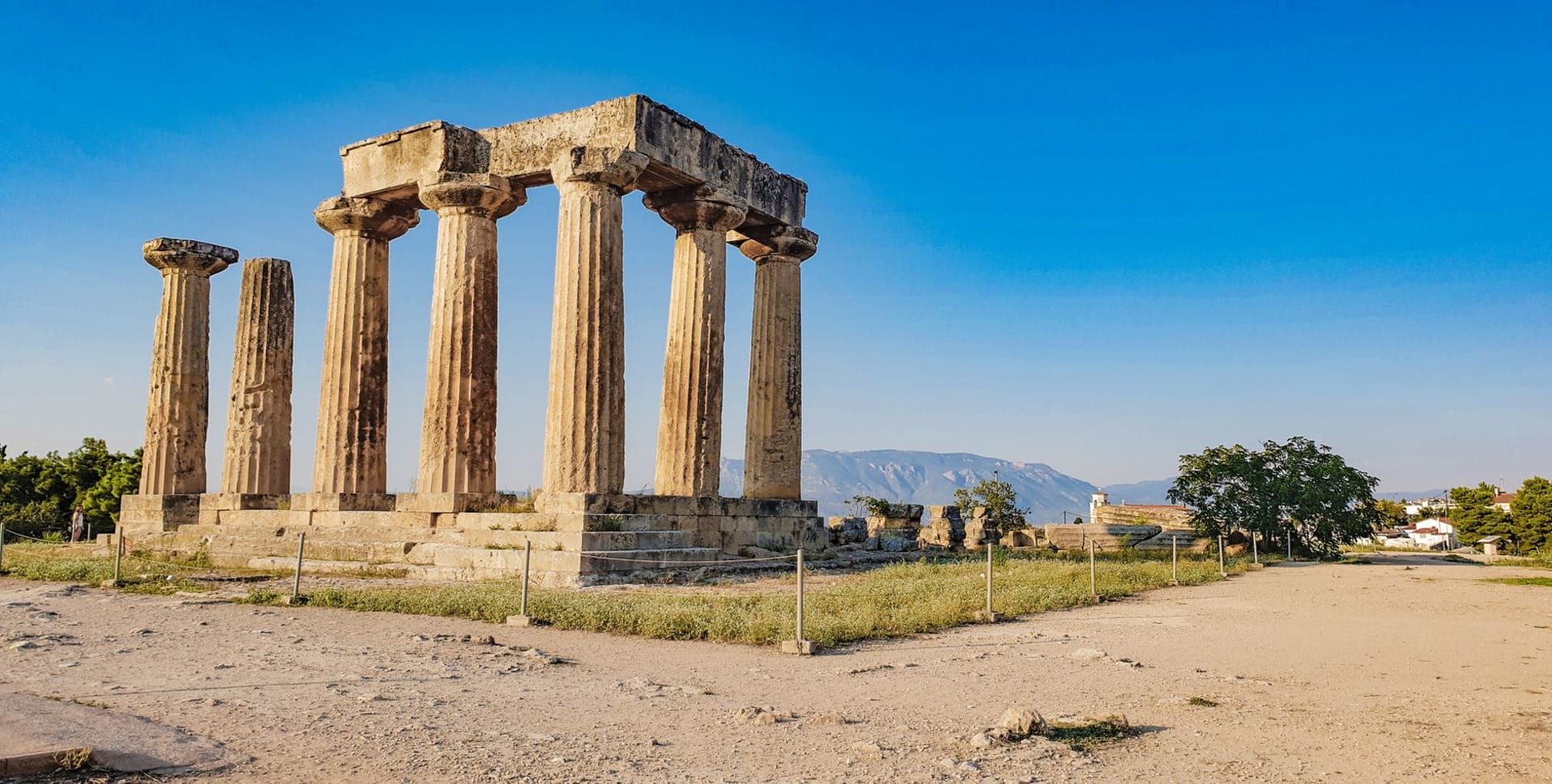
Ancient Corinth
"Corinth controlled both seas at once. Standing on the isthmus, you understand immediately why that made it the richest city in the ancient world."
The Corinth Canal stops you even when you’ve seen photographs. The thing you understand from photographs is that the canal is narrow — twenty-four metres wide, barely enough for a modern ship to squeeze through. What you don’t understand until you stand at the viewing bridge and look down is how deep the cut goes: seventy-eight metres of vertical limestone walls dropping to a ribbon of water below that looks, from up here, almost surgical. The Corinthians thought about digging this canal in antiquity — Nero actually broke ground on it in 67 CE, then abandoned the project. The canal that exists was finally finished in 1893. The effort involved in either century seems, from the bridge, almost insane.
Ancient Corinth sits a few kilometres southwest of the canal, and the ruins spread across a broad plateau below the tremendous rock of Acrocorinth, which rises another five hundred metres above the ancient city and was, for most of the ancient period, the most strategically significant piece of high ground in Greece. From up there you can see both the Saronic Gulf to the east and the Gulf of Corinth to the west — and control of those two seas, and the land route between them, made Corinth fabulously wealthy in antiquity. The geographer Strabo wrote that “the city is called wealthy because of its commerce.” He was being modest.

The archaeological site centers on the ancient agora — the main commercial and civic square — and the seven surviving columns of the Temple of Apollo, the most visually dominant ruins in the area. These columns date from the sixth century BCE, making them among the oldest standing Greek columns anywhere, their thick Doric proportions belonging to a style that predates the classical refinements of the Parthenon by a century. The agora itself is massive: the Romans rebuilt it extensively after they destroyed and then re-founded the city, and the scale of the Roman commercial infrastructure — the rows of shops, the fountain houses, the temples to the imperial cult — gives a sense of just how important Corinth was as a trading center in the first century CE. This is where Paul spent eighteen months, writing letters, arguing in the synagogue, founding a church. His first letter to the Corinthians makes considerably more sense when you’ve walked through the agora and understood what kind of city he was dealing with.
The Acrocorinth above requires a dedicated half-day. The drive up is steep and loose-surfaced and the walk from the car park to the first of three successive gates is longer than it looks on the map. But the summit is extraordinary: the remains of temples, Byzantine chapels, Frankish towers, Venetian fortifications, and Ottoman mosques all compressed into a single high point above two seas. I reached the top in the early afternoon and found it almost deserted — just a French couple consulting a guidebook and a single Greek military observer post, unmanned. The wind was strong enough to make standing difficult at the cliff edge. Both seas were very blue and very clear.

The modern town of Corinth — rebuilt after the 1858 and 1928 earthquakes on the coast rather than the ancient site — has the honest functionality of a working Greek port town. The harbor fish market operates early morning and the tavernas near the waterfront serve the catch in simple preparations. I had grilled red mullet and a glass of white Roditis at a table near the water and felt grateful for places that haven’t decided to become picturesque yet. The ancient city was famous for its luxury and excess; the modern one has entirely shed that reputation and replaced it with something more useful — a place where people actually live.
When to go: Spring — April and May — is ideal for both the archaeological site and the climb to Acrocorinth. The wildflowers on the hillside around the ruins are spectacular in April. Avoid the canal area on summer weekends when bungee-jumping tourists and cruise ship excursions fill the viewing bridges. The site itself is rarely crowded by the standards of Mycenae or Olympia, even in peak season.