Barão de Melgaço
"We cut the motor and the silence was so total that I could hear individual wingbeats."
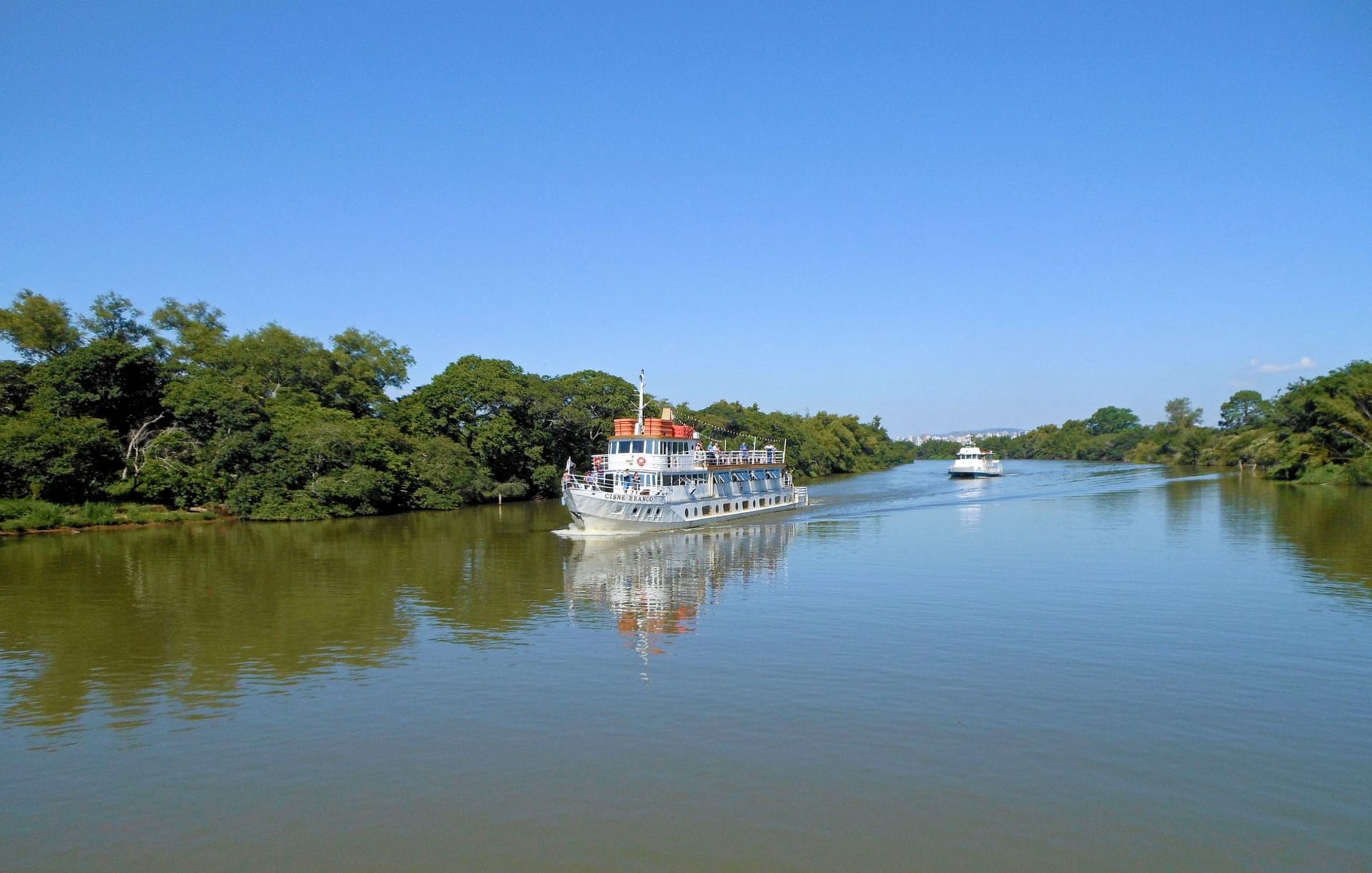
Barão de Melgaço is a small, sleepy town on the Cuiabá River, about two hours south of the city of Cuiabá, and it is the gateway to a part of the Pantanal that most visitors never reach. Everyone funnels onto the Transpantaneira road toward Porto Jofre for the jaguars, which is reasonable — the jaguars are extraordinary — but it means the watery, labyrinthine northern Pantanal around Barão de Melgaço stays quiet, and quiet is exactly what I was after. This is the Pantanal not as a safari but as a flooded world you move through by boat.
The town itself is modest: a riverfront, a church, fishing boats, men mending nets, and the particular heat of the Mato Grosso lowlands that sits on you like a wet blanket. There is not much to do in Barão de Melgaço, which is the point. You come here to get on the water and disappear into the Pantanal that lies beyond it — the lagoons, the baías, the flooded forest where the river loses its edges entirely and becomes a system rather than a line.
Into the flooded forest
We hired a local boatman named Jurandir who had grown up on these waters and knew them with the casual intimacy of someone who has never needed a map. We set off in the late afternoon, when the heat begins to release its grip, and within twenty minutes the open river had given way to narrow channels roofed by trees, the water black and still and reflecting the canopy so perfectly that we seemed to be floating through the sky. Caimans lay along the banks like fallen logs. A family of capybaras watched us pass with the supreme indifference that is their whole personality.

The birds are the thing here, more than anywhere else I have been in the Pantanal. Jurandir cut the motor in a wide lagoon and we drifted, and the silence filled up with sound — the creak and squabble of hundreds of birds. Jabiru storks, the giant black-and-white emblem of the Pantanal, stood in the shallows. Roseate spoonbills swept the water pink. Hyacinth macaws, the largest parrots on earth and a deep impossible blue, crossed overhead in pairs, screaming. I am not a serious birder and even I was undone by it. Lia kept a list and gave up somewhere past forty species.
The Chacororé lagoon and the sunsets
The great feature of this region is the Baía de Chacororé and the connected system of lagoons that swell and shrink with the seasons. In the high water they merge into something that feels like an inland sea fringed with forest; in the dry season they contract into pools that concentrate the wildlife into astonishing densities. We spent an evening on the open water of the bay watching the sun go down, and Pantanal sunsets do something I have not seen elsewhere — the flat wet horizon and the dust and the sheer quantity of birds heading to roost combine into a sky that turns through every shade of orange and violet while flights of egrets cross it like punctuation.
On the way back in the dark, Jurandir swept a torch along the banks and the night came alive with eyeshine — the red glow of caimans, the occasional larger pair of eyes that he said, with a shrug, might be an onça. We did not see the jaguar. But drifting through that black flooded forest under a sky thick with stars, with the splash of unseen things and the smell of wet earth and flowers, I did not feel I had missed anything at all.

When to go
The Pantanal has two faces and Barão de Melgaço shows both. The wet season (roughly November to March) floods the land and is the time to experience the watery maze at its fullest, though some areas become inaccessible. The dry season (May to September) concentrates wildlife around shrinking water and is easier for spotting animals, with the bird numbers peaking as the lagoons draw down. It is hot and humid year-round — bring sun protection, insect repellent, and patience. Cuiabá, two hours north, is the access point and has the nearest airport.