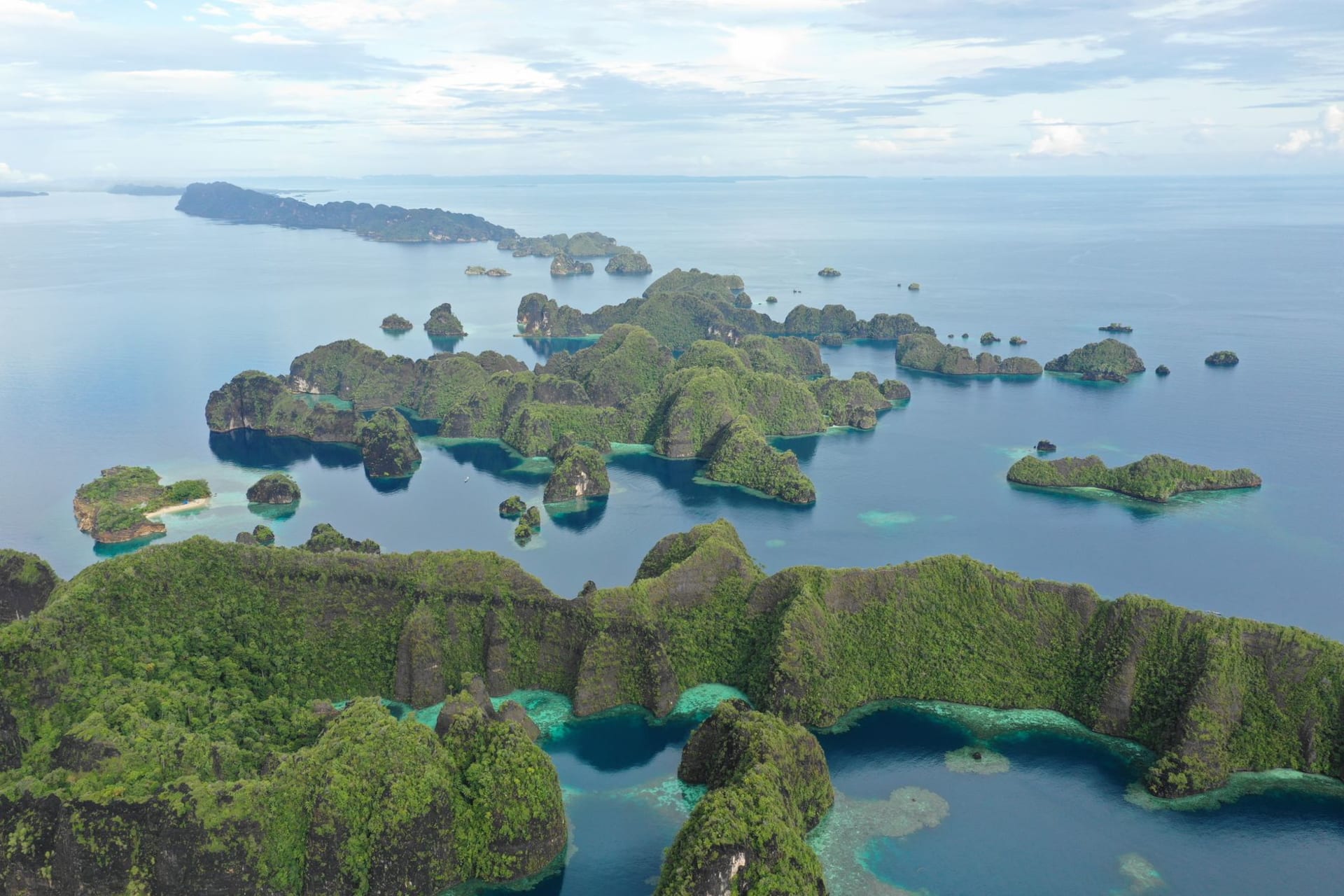
Everyone in Koror mentioned Babeldaob the same way — with a slight tilt of the head, a pause, and something along the lines of “you can go up there, but there’s not much to do.” Which meant, of course, that I had to go immediately. Babeldaob is the second-largest island in Micronesia after Guam — a fact so disproportionate to its tourist profile that it took me a minute to process — and it comprises almost eighty percent of Palau’s land area. It also contains roughly a third of Palau’s small population, the new capital of Ngerulmud, several ancient stone village sites, terraced hillsides that were cleared for agriculture centuries ago and have since regrown, and a quality of quiet that you don’t find in the Rock Islands.

I hired a car and a local guide — the roads are paved now as far as Ngerulmud, but the smaller tracks that lead to the interior sites are another matter — and we spent a full day working our way around the island’s circumference and then into its interior. The soil on Babeldaob is a deep laterite red, almost orange in the morning light, and the roads cut through it with that raw quality of infrastructure that’s recent enough not to have been absorbed into the landscape yet. You see the jungle pressing in from both sides, the banyan roots crossing the tarmac, the ferns growing out of road cuts. The island is reclaiming things steadily.
The stone monoliths at Badrulchau — a collection of large basalt stones arranged in rows in a forest clearing in the island’s north — stopped me in a way I didn’t expect. There are sixteen of them, some upright, some fallen, covered in moss and lichen, set in a clearing where the light comes through the canopy in moving patches. No one knows with certainty what they were for, which my guide treated as a reasonable fact of history rather than a mystery requiring an answer. “They were important,” he said. “That’s what we know.” I spent forty minutes there, not doing anything in particular, just sitting on the grass and thinking about all the centuries the stones had been standing there being rained on.
The terraced hillsides visible from various points on the road were cleared and shaped by Palauan communities centuries ago for taro cultivation. They’ve been largely unused since the population shifted to the islands and towns, and the terraces are slowly being overgrown — but from the road you can still see the deliberate geometry of them, the way human intention imposed itself on the hills. It’s the kind of landscape that makes you think about the relationship between land and time, which sounds abstract but is actually very concrete when you’re looking at a hillside that hundreds of people shaped and then left.

Ngerulmud, Palau’s new capital built in 2006 on a hilltop in the island’s interior, is worth a stop not for its architecture — which is utilitarian at best — but for the sheer strangeness of being in a national capital that almost nobody visits. The government buildings sit on a cleared plateau surrounded by jungle, and there is a parking lot with very few cars in it and the particular silence of places built at a scale larger than their current use demands. I ate lunch at a small canteen near the administrative buildings — local rice and fish, served by a woman who seemed mildly surprised to see a foreigner there — and drove back south through the red-dirt interior feeling like I had found a piece of Palau that most people skip, which is usually where the real texture is.
When to go: Babeldaob is accessible year-round, and the interior roads are navigable in dry season and early wet season. The waterfalls at Ngardmau in the island’s north run strongest in the wet season (May through October) if that’s your target. A car and guide is the only practical way to see the island properly; public transport is minimal and distances between sites are real. Allow a full day minimum.